
Lawn Care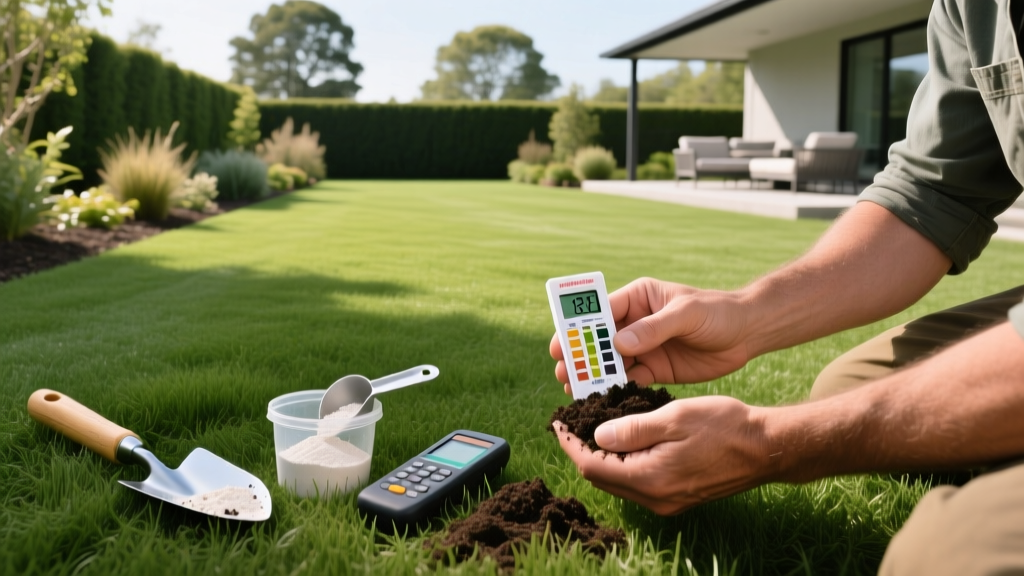
Should I Add Lime to My Lawn? Signs, Soil Tests & Costs
The Short Answer: When to Apply Lime
If you are asking yourself, should I add lime to my lawn, the answer depends entirely on your soil's active pH and its buffer pH. Lime (calcium carbonate) is not a fertilizer; it is a soil amendment used to raise the pH of acidic soils. Most turfgrasses, including Kentucky bluegrass, tall fescue, and bermudagrass, thrive in a soil pH range of 6.0 to 7.0. When pH drops below 5.5, essential macronutrients like nitrogen, phosphorus, and potassium become chemically locked in the soil profile, rendering your expensive fertilizer applications useless.
Applying lime without a soil test is a common and costly landscaping mistake. Over-liming can push your soil into alkaline territory (above 7.5), triggering severe iron chlorosis and manganese deficiencies that manifest as stark yellowing of the grass blades. You should only add lime if a verified soil test indicates a pH below 6.0.
4 Visual Symptoms of Acidic Soil
While a soil test is mandatory before application, your lawn will often display visual indicators that the pH is dropping into the danger zone. Look for these four symptoms during your spring and fall assessments:
- Moss Proliferation: Moss thrives in compacted, highly acidic soils (pH 5.0–5.5) where turfgrass roots struggle to establish.
- Unresponsive Yellowing: If your lawn remains pale green or yellow despite applying high-nitrogen fertilizers (like a 24-0-6 blend), the low pH is likely preventing nitrogen uptake.
- Thatch Accumulation: Acidic soils inhibit the microbial activity required to break down thatch. If your thatch layer exceeds 0.5 inches despite regular mowing, low pH may be the culprit.
- Acid-Loving Weed Invasion: Certain weeds are aggressive indicators of low soil pH. A heavy infestation suggests your soil chemistry is out of balance.
The Acidic Soil Weed Matrix
| Indicator Weed | Optimal Soil pH for Weed | Recommended Turfgrass Action |
|---|---|---|
| Prostrate Plantain | 4.5 – 5.5 | Apply lime + core aeration to relieve compaction |
| Dandelion | 5.0 – 6.0 | Test soil; apply lime if below 6.0, spot-treat with 2,4-D |
| Ground Ivy (Creeping Charlie) | 4.5 – 6.5 | Raise pH to 6.5+ and apply triclopyr-based herbicide |
| Common Sorrel (Sheep Sorrel) | 4.0 – 5.5 | Strong indicator of severe acidity; immediate liming required |
Stop Guessing: How to Test Soil pH Accurately
To determine exactly how much lime to apply, you must understand the difference between active pH (the current acidity of the soil water) and buffer pH (the soil's resistance to pH change, dictated by cation exchange capacity and clay content).
The Buffer pH Factor: A sandy soil and a heavy clay soil might both have an active pH of 5.0. However, because clay has a high buffer capacity, it requires significantly more lime to raise the pH to 6.5 than the sandy soil does. Only a laboratory test can measure your buffer pH.
Testing Options and Costs
- DIY Chemical Kits (e.g., Luster Leaf Rapitest 1601): Costing around $15 to $20, these use color-coded vials to estimate active pH. They are useful for a quick sanity check but cannot measure buffer pH or provide exact application rates.
- Mail-In Lab Tests (e.g., SoilKit or Local University Extension): Costing $20 to $30, these provide a comprehensive analysis including active pH, buffer pH, CEC, and exact lime recommendations in pounds per 1,000 square feet. According to the University of Maryland Extension, mail-in lab tests are the only reliable method for calculating precise lime requirements.
Calcitic vs. Dolomitic Lime: Which Do You Need?
Once your soil test confirms a need for lime, you must choose the correct chemical formulation. The decision hinges entirely on your soil's magnesium levels.
- Calcitic Lime (Calcium Carbonate): This is the standard choice for most lawns. It supplies abundant calcium and raises pH. Look for high-quality pelletized options like Jonathan Green MAG-I-CAL or Espoma Organic Garden Lime. Pelletized lime costs roughly $8 to $12 per 40-lb bag and is vastly superior to powdered lime, which creates hazardous dust clouds and blows away in light winds.
- Dolomitic Lime (Calcium-Magnesium Carbonate): Use this only if your soil test explicitly shows a magnesium deficiency. Applying dolomitic lime to soil that already has adequate magnesium can cause a nutrient lockout, preventing the grass from absorbing potassium and calcium.
Exact Application Rates by Soil Texture
The amount of lime required to raise your soil pH by a single point varies drastically based on soil texture. The following table provides baseline estimates for applying calcitic lime to raise pH from 5.5 to 6.5. Always defer to your specific lab test recommendations.
| Soil Texture | Lime Required (lbs per 1,000 sq ft) | Application Strategy |
|---|---|---|
| Sandy Loam | 25 – 35 lbs | Single application in Fall |
| Loam | 40 – 50 lbs | Single application in Fall or Spring |
| Clay Loam | 60 – 70 lbs | Split into two applications (Spring and Fall) |
| Heavy Clay | 80 – 100+ lbs | Split into three applications over 18 months |
Note: Never apply more than 50 lbs of lime per 1,000 square feet in a single application. If your soil requires 90 lbs, apply 45 lbs in the early fall and the remaining 45 lbs the following spring.
Step-by-Step Application Protocol
For maximum efficacy and integration into the root zone, follow this precise application sequence:
- Time the Application: Fall is the optimal window. The freeze-thaw cycles of winter and heavy autumn rains help work the lime deep into the soil profile. Spring applications are acceptable but take longer to alter the pH before the summer heat stress.
- Core Aerate First: Lime is relatively immobile in soil; it typically only moves downward about one inch per year. Core aeration prior to application creates 3-inch deep channels, allowing the pelletized lime to bypass the thatch layer and reach the root zone directly.
- Calibrate Your Spreader: Set your rotary spreader (e.g., Scotts EdgeGuard) to the setting specified on the lime bag. Pelletized lime is heavy; ensure your spreader gears are clean and lubricated to prevent stalling.
- Water Immediately: Apply 0.25 inches of irrigation immediately after spreading. This washes the lime dust off the grass blades (preventing foliar burn) and begins the dissolution process in the soil.
Warning: Herbicide and Fertilizer Interactions
Do not apply lime at the same time as synthetic nitrogen fertilizers or certain pre-emergent herbicides. Lime can cause ammonium-based fertilizers to volatilize into ammonia gas, wasting your money. Furthermore, the Clemson University Home & Garden Information Center notes that applying lime simultaneously with certain pre-emergents can alter their chemical breakdown rate. Maintain a minimum 3-week gap between liming and applying standard lawn chemicals.
Do not apply lime at the same time as synthetic nitrogen fertilizers or certain pre-emergent herbicides. Lime can cause ammonium-based fertilizers to volatilize into ammonia gas, wasting your money. Furthermore, the Clemson University Home & Garden Information Center notes that applying lime simultaneously with certain pre-emergents can alter their chemical breakdown rate. Maintain a minimum 3-week gap between liming and applying standard lawn chemicals.
How Long Does It Take to See Results?
Lime is a slow-acting amendment. Unlike synthetic fertilizers that green up a lawn in 72 hours, lime requires chemical reactions within the soil matrix to neutralize hydrogen ions. You should expect it to take 6 to 12 months to see a full 1.0 shift in your soil pH. Retest your soil annually in the spring to track the buffer pH decline and determine if maintenance applications (typically 15-20 lbs per 1,000 sq ft) are required to combat natural acidification from rainfall and nitrogen fertilizers.

