
Lawn Care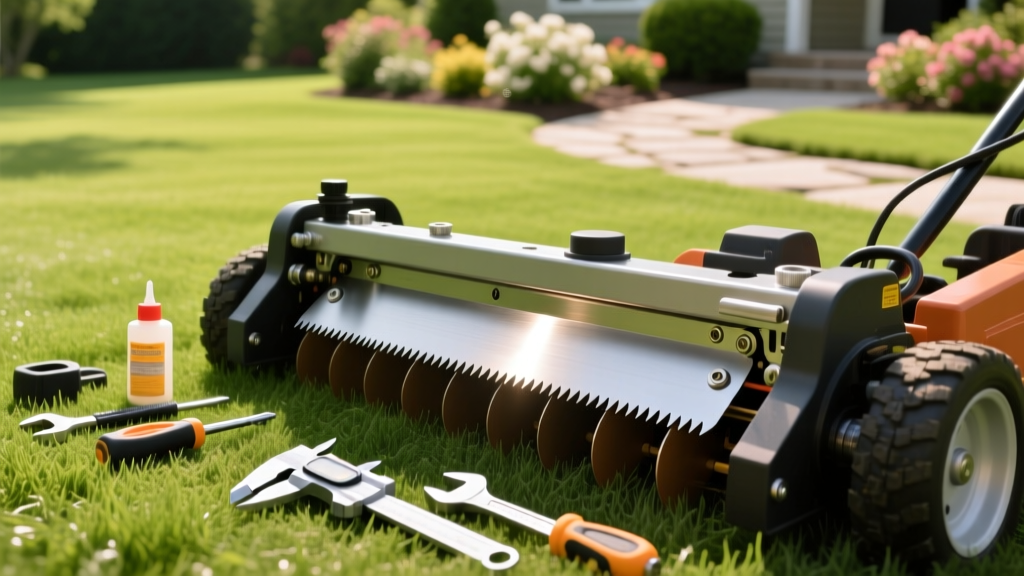
Slice Seeder Blade Maintenance and Calibration Guide
A slice seeder is the most aggressive and effective tool for lawn renovation, combining soil scoring and seed placement into a single pass. However, its mechanical complexity—specifically the blade reel, drive chain, and seed agitator—requires precise calibration and rigorous maintenance to prevent uneven germination or catastrophic mechanical failure. According to the UMass Amherst Turf Program, mechanical overseeding yields significantly higher germination rates than broadcast spreading, but only when seed-to-soil contact is engineered to exact depth specifications.
Quick Diagnostic: Is Your Seeder Dropping Seed Correctly?
If you notice seed pooling on the surface or bare patches after germination, your seed agitator is likely clogged with polymer seed coatings, or your drive chain has slipped, causing the blade reel to stall while the hopper continues to drop seed.
The Anatomy of a Slice Seeder: Selecting the Right Blade
The cutting reel is the heart of the machine. Most commercial and rental units, such as the Classen TS-20 or Ryan Ren-O-Thin Pro, accept three distinct blade types. Choosing the wrong blade for your lawn's thatch level will result in either poor soil penetration or excessive turf tearing.
- Slicing Blades (Fixed): These rigid, straight blades cut clean, precise grooves into the soil. They are ideal for lawns with less than 0.5 inches of thatch or for bare-soil renovation. Because they do not yield upon impact, they can bend if they strike hidden rocks or shallow irrigation heads.
- Flail Blades (Free-Swinging): Mounted on loose pins, flail blades swing outward via centrifugal force. When they hit an obstacle, they fold back, preventing damage to the machine and underground utilities. They are highly aggressive on thatch, chopping it into mulch, but they leave a wider, messier trench than fixed blades.
- Mat Blades (Heavy-Duty): Designed specifically for severe thatch removal (over 1 inch). They feature a wider profile that acts like a vertical mower (dethatcher), pulling up dead organic matter while simultaneously scoring the soil.
Step-by-Step Calibration: The Tarp Test Method
Never trust the factory micrometer dial on the seed hopper. Seed sizes vary wildly; fine creeping bentgrass seed flows much faster than large, polymer-coated tall fescue seed. To achieve the target application rate (usually 5 to 8 lbs per 1,000 square feet for overseeding), you must perform a physical drop test.
Executing the 100-Square-Foot Calibration
- Lay a 10x10 foot tarp (exactly 100 sq ft) on a flat, paved driveway.
- Fill the hopper with your chosen seed and set the micrometer dial to the manufacturer's suggested starting point.
- Push the seeder across the tarp at your normal walking pace (approx. 3 mph). Do not stop or start on the tarp; begin dropping seed before you cross the edge and stop after you leave it.
- Collect all seed from the tarp and weigh it on a digital postal scale.
- Multiply the collected weight by 10 to determine your actual application rate per 1,000 sq ft.
If your target is 6 lbs per 1,000 sq ft, you need exactly 0.6 lbs (9.6 ounces) on the tarp. If you collect 14 ounces, close the micrometer dial by two notches and repeat the test. The University of Minnesota Extension emphasizes that accurate calibration prevents seed waste and reduces the risk of fungal damping-off disease caused by overcrowded seedlings.
Depth Adjustment: The 1/4-Inch Rule
A slice seeder must cut through the thatch layer and score the topsoil without burying the seed too deeply. Grass seed requires light and specific moisture levels to trigger germination; burying it deeper than 1/2 inch will exhaust the seed's endosperm energy reserves before the shoot reaches the surface.
| Grass Type | Target Cutting Depth | Blade Spacing | Optimal Seed Rate |
|---|---|---|---|
| Tall Fescue (Cool-Season) | 1/4 inch | 2 to 3 inches | 5 - 7 lbs / 1k sq ft |
| Kentucky Bluegrass (Cool-Season) | 1/8 to 1/4 inch | 1 to 2 inches | 2 - 3 lbs / 1k sq ft |
| Bermudagrass (Warm-Season) | 1/4 to 3/8 inch | 2 inches | 1 - 2 lbs / 1k sq ft |
Pro-Tip for Depth Control: The depth lever on most rental units controls the front caster wheels, not the blade reel itself. Always test the depth on a patch of actual lawn, then use a trowel to dig up the trench and measure the soil displacement with a steel ruler. If the trench is too shallow, lower the caster wheels. If you are exposing subsoil or cutting irrigation lines, raise them immediately.
Routine Maintenance: Preventing Bearing and Chain Failure
Slice seeders operate in highly abrasive environments. Dust, moisture, and pulverized soil rapidly degrade moving parts. Neglecting maintenance leads to the blade reel seizing mid-pass, which gouges the lawn and destroys the drive mechanism.
The Drive Chain and Tensioner
The drive chain transfers kinetic energy from the rear wheels to the blade reel. Over time, the chain stretches. A loose chain will skip teeth on the sprocket when the blades encounter dense thatch, causing the reel to stop spinning while the seed hopper continues to drop seed.
The Fix: Check chain deflection by pressing on the midpoint of the chain. It should yield exactly 1/2 inch. If it sags more than 3/4 inch, loosen the bearing block bolts on the blade shaft, slide the shaft forward to increase tension, and retighten. Lubricate the chain with a dry PTFE (Teflon) lubricant; avoid wet greases which act as magnets for soil and grit.
Pillow Block Bearings
The blade reel spins on two heavy-duty pillow block bearings. These feature standard Zerk grease fittings. During peak fall renovation season, these bearings must be purged and regreased every 4 to 6 hours of runtime. Use a lithium-complex grease and pump until you see fresh grease purging past the bearing seal. This positive pressure forces out the fine silica dust that acts like lapping compound and destroys the bearing races.
"The most common cause of catastrophic slice seeder failure is a seized blade shaft bearing. When the bearing locks up, the drive chain snaps or strips the wheel sprocket. A $5 tube of grease prevents a $400 repair bill." — Commercial Turf Equipment Technician
The Seed Agitator and Hopper
Modern grass seeds are frequently coated with fungicides, fertilizers, and moisture-retaining polymers (e.g., Pennington Smart Seed MYCO). In high humidity, these coatings become tacky and fuse to the metal agitator brush inside the hopper. After every use, vacuum the hopper completely and use a stiff wire brush to clean the agitator fingers. Never leave coated seed in the hopper overnight.
2026 Cost Analysis: Renting vs. Buying
For homeowners deciding whether to purchase or rent, the economics depend entirely on property size and renovation frequency. In 2026, commercial-grade walk-behind slice seeders (like the Ryan Ren-O-Thin Pro) retail between $3,800 and $4,500. Rental rates at major equipment yards average $110 to $160 for a four-hour block.
If you manage less than 10,000 square feet of turf, renting is the undisputed financial choice. However, if you maintain multiple properties or manage a large estate (over 2 acres) requiring annual thickening, purchasing a mid-tier residential unit (such as the Classen TS-20, retailing around $2,800) pays for itself within three seasons. Always factor in the cost of a heavy-duty trailer or ramp system, as these machines weigh between 250 and 350 lbs and cannot be lifted into a standard SUV.

