
Lawn Care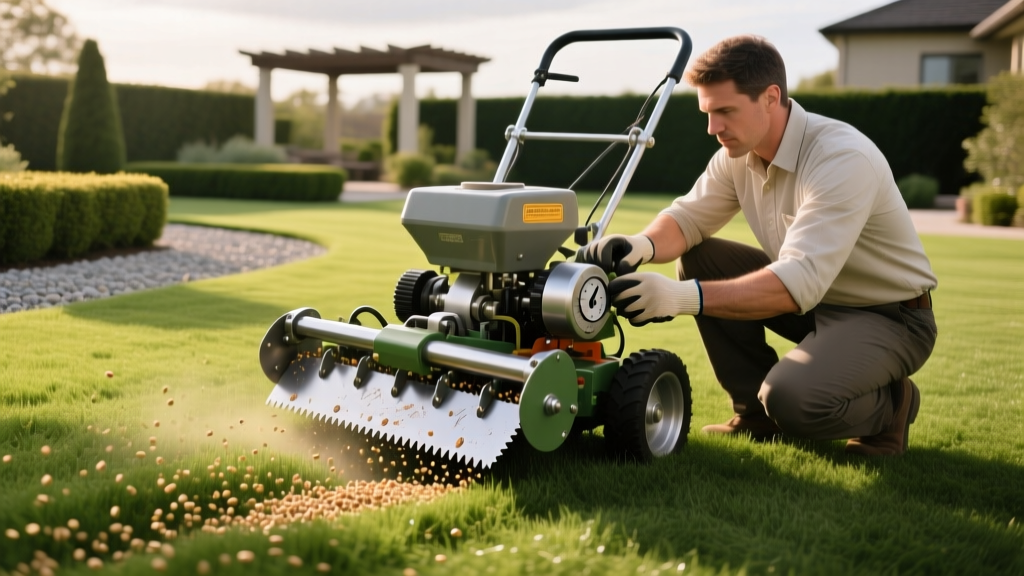
Slit Seeder Selection, Calibration, and Blade Maintenance
Broadcast spreaders fail to deliver the seed-to-soil contact required for high-germination lawn renovations. A slit seeder (or slice seeder) mechanically cuts through thatch and soil, dropping seed directly into the furrow. This mechanical advantage yields germination rates up to 80% higher than broadcast methods, but only if the equipment is correctly calibrated and maintained. Misaligned blades, worn agitator brushes, and improper depth settings will waste seed and tear existing turf.
Slit Seeder vs. Broadcast vs. Core Aeration
Understanding the mechanical advantages of a slit seeder requires comparing its seed-placement metrics against standard renovation alternatives. The data below reflects controlled turf trials for cool-season grasses like Tall Fescue and Kentucky Bluegrass.
| Renovation Method | Seed-to-Soil Contact | Expected Germination Rate | Thatch Penetration | Labor/Passes Required |
|---|---|---|---|---|
| Slit Seeder | Direct (in-furrow) | 75% - 85% | Excellent (cuts through) | 1-2 passes |
| Core Aeration + Broadcast | Moderate (in-cores) | 45% - 60% | Good (pulls plugs) | 2-3 passes + dragging |
| Broadcast + Topdressing | Low (surface) | 20% - 40% | Poor (sits on top) | 3+ passes |
According to turf management research from Penn State Extension, mechanical slit seeding consistently outperforms broadcast overseeding in thin or heavily compacted lawns because the seed is protected from wind displacement, surface drying, and bird predation.
Equipment Selection: Residential vs. Commercial Models
Selecting the right machine depends on lawn size, terrain, and budget. The market is divided into walk-behind residential units and heavy-duty commercial slicers.
Residential and Light Commercial (Under 15,000 sq ft)
- Billy Goat S2460S Slicer Seeder: Priced around $2,800, this unit features a 163cc Honda GXV engine and a 24-inch cutting width. It utilizes a cable-driven blade engagement system, which is easier for homeowners to operate than lever-driven commercial models.
- Classen TS-20: A compact 20-inch slicer ideal for tight gate access (36-inch gates). Rental rates typically range from $85 to $120 per day.
Heavy Commercial (15,000+ sq ft and Sports Turf)
- Ryan Ren-O-Thin: The industry standard for sports fields and large estates. Pricing exceeds $4,500. It features a hydrostatic drive, allowing infinite ground speed adjustment without changing engine RPM, which is critical for maintaining consistent seed drop rates on slopes.
- Redexim Verti-Seed: A tractor-mounted PTO unit used for golf course fairways, capable of slicing at depths up to 2.5 inches for deep stolon planting.
Precision Calibration: Depth, Spacing, and Seed Rate
Factory settings on rental and new slit seeders are rarely optimized for your specific soil profile and seed variety. Calibration requires a three-step process.
Step 1: Blade Depth Adjustment
The blade must score the soil, not trench it. Trenching creates deep furrows that bury seed too deeply, preventing emergence.
- Cool-Season Grasses (Fescue, Bluegrass, Ryegrass): Set depth to 1/4 inch to 3/8 inch. The blade should just break the soil surface and cut through the thatch layer.
- Warm-Season Grasses (Bermuda, Zoysia): Set depth to 1/2 inch to 3/4 inch to properly seat stolons and rhizomes.
Pro Tip: The Concrete Test. Before engaging the soil, lower the blades onto a flat concrete driveway. The blades should barely kiss the concrete, creating a faint scratching sound without sparking or grinding. This guarantees a precise 1/4-inch soil penetration once the machine's wheels sink into the turf.
Step 2: Blade Spacing Configuration
Most slit seeders allow you to remove or space out blades on the main shaft. Standard spacing is 2 inches for thin lawns and 3 inches for thick, established turf requiring overseeding. Never alternate blade patterns (e.g., left-right-left) as this creates uneven soil disruption and scalping.
Step 3: Seed Rate Calibration (The Tarp Test)
Do not trust the hopper dial numbers; seed size and coating weight vary wildly. Use the tarp test recommended by UMass Extension Turf Program:
- Lay a 10 ft x 10 ft tarp on a flat driveway.
- Fill the hopper with a known weight of seed (e.g., 5 lbs).
- Push the seeder across the tarp at your normal walking speed (approx. 2.5 mph).
- Weigh the seed collected on the tarp.
- Multiply the collected weight by 435.6 to calculate the exact pounds per acre, then scale down to pounds per 1,000 sq ft.
Blade Selection: Slicing vs. Flail
Using the wrong blade type will destroy your turf or fail to penetrate compacted soil.
| Blade Type | Design | Best Application | Wear Rate |
|---|---|---|---|
| Slicing (Flat) | Straight, flat steel edge (3/16' thick) | Standard overseeding, minimal thatch | Slow (lasts 3-5 seasons) |
| Flail (Y-Blade) | Y-shaped or serrated edge | Heavy thatch removal, aggressive renovation | Fast (requires annual replacement) |
| Carbide-Tipped | Flat blade with welded carbide edge | Highly compacted clay, sandy-gravel soils | Extremely slow (lasts 10+ seasons) |
Post-Operation Maintenance and Winterization
Slit seeders operate in high-moisture, high-friction environments. Neglecting maintenance leads to catastrophic bearing failure and seed bridging.
The Agitator Brush: The Hidden Failure Point
Inside the seed hopper, a rotating brush pushes seed into the drop tubes. Over time, the bristles wear down or become caked with moisture from morning dew. If the brush loses contact with the hopper floor, seed 'bridges' across the opening, resulting in bare strips. Inspect the brush annually; if bristles are worn below 1/2 inch, replace the brush assembly (typically a $35-$50 part).
Bearing and Shaft Lubrication
The main blade shaft rotates at high RPMs under heavy lateral load. The pillow block bearings on either side of the shaft must be greased after every 10 hours of operation.
Warning: Avoid Marine Grease. Do not use standard marine or multi-purpose white lithium grease. The friction heat generated by the blade shaft breaks down standard grease. Use an NLGI #2 Lithium Complex synthetic grease (like Mobil 1 Synthetic Grease) which maintains viscosity up to 350°F. Pump exactly two strokes per zerk; over-greasing will blow out the bearing seals, allowing soil grit to enter.
Hopper and Chassis Rust Prevention
Many premium grass seeds are coated with fungicides, fertilizers, and moisture-retention polymers. These coatings are highly corrosive to mild steel. After every use, blow out the hopper and drop tubes with compressed air. Wipe the interior with a rag soaked in WD-40 Specialist Corrosion Inhibitor, then leave the hopper lid open during storage to prevent condensation buildup.
Troubleshooting Common Slit Seeder Failures
- Symptom: Seed drops unevenly or stops entirely.
Cause: Worn agitator brush or damp seed coating bridging the drop tube.
Fix: Replace brush assembly; run dry sand through the hopper to clear polymer buildup. - Symptom: Machine pulls violently to the left or right.
Cause: Uneven blade wear or a bent blade shaft from hitting a buried rock.
Fix: Replace blades in complete sets (never just one); check shaft runout with a dial indicator (tolerance is <0.015 inches). - Symptom: Furrows are too deep, exposing subsoil.
Cause: Worn depth-gauge wheels or collapsed wheel bearings.
Fix: Adjust the depth lever down one notch; inspect wheel axles for lateral play.

