
Lawn Care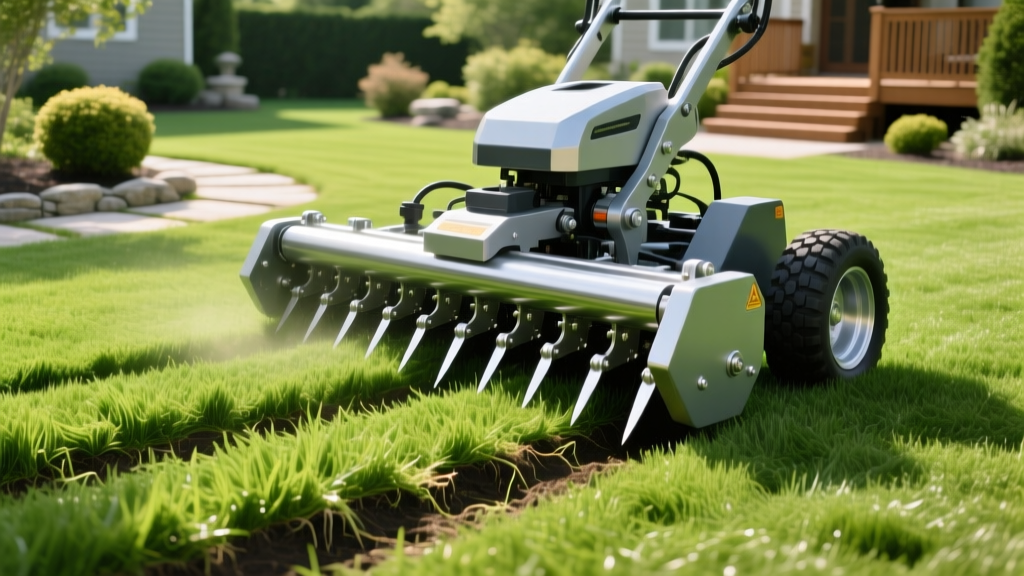
Slit Seeder Machine Selection and Maintenance Guide for Thick Lawns
The Mechanics of Slit Seeding vs. Broadcast Methods
Achieving a dense, weed-resistant turf requires optimal seed-to-soil contact, a metric where broadcast spreading consistently fails. When you broadcast seed over an existing lawn, germination rates often stagnate between 15% and 30% due to seed resting on thatch or washing away during irrigation. A slit seeder machine (often interchangeably called a slice seeder) solves this by using a series of rotating steel blades to cut precise grooves into the soil, simultaneously dropping seed directly into those freshly opened furrows. According to the University of Minnesota Extension, mechanical slit seeding can push germination rates to 60% or higher, effectively doubling or tripling the efficiency of your seed investment.
Unlike core aeration, which pulls plugs to relieve compaction but leaves the soil surface largely intact for seed placement, a slit seeder physically parts the earth. This creates a micro-environment that protects the seed from birds, wind, and surface drying, making it the undisputed champion for severe lawn renovations and thickening cool-season grasses like Kentucky Bluegrass and Tall Fescue.
When to Deploy a Slit Seeder: Use this equipment when your lawn has less than 50% desirable turf cover, when introducing a completely new grass cultivar, or when dealing with heavy thatch layers that prevent broadcast seed from reaching the soil. If your lawn is merely thin (70%+ coverage), core aeration followed by broadcast overseeding may suffice.
Evaluating Commercial vs. Residential Slit Seeder Machines
The market for slit seeders is sharply divided between prosumer models designed for occasional use by ambitious homeowners and commercial units built to withstand daily rental abuse or professional landscaping schedules. In 2026, pricing for walk-behind slit seeders ranges from roughly $3,200 for entry-level prosumer models to over $7,500 for heavy-duty commercial machines.
The primary differentiators are engine torque, blade shaft bearings, and hopper capacity. Commercial models utilize heavy-duty hex shafts and sealed bearings to handle the lateral stress of cutting through compacted clay and root systems, whereas residential models often rely on lighter round shafts that can warp if subjected to hidden rocks or extreme soil density.
2026 Slit Seeder Machine Comparison Matrix
| Model | Target User | Blade Type & Count | Cutting Width | Approx. 2026 Price |
|---|---|---|---|---|
| Ryan Ren-O-Thin RT-1200 | Commercial / Rental | 27 Flail Blades | 20 inches | $6,500 - $7,200 |
| Classen TS-20 | Commercial / Pro Landscaper | 24 Delta/Flail Options | 19 inches | $5,800 - $6,300 |
| Billy Goat S1801V | Prosumer / Large Estates | 18 Flail Blades | 18 inches | $3,200 - $3,800 |
For professionals, the Ryan Ren-O-Thin series remains the industry benchmark due to its patented blade geometry and independent blade suspension, which allows the tines to follow ground contours without scalp-ing high spots.
Blade Selection and Calibration Depth
Selecting the correct blade profile and setting the cutting depth are the two most critical operational variables when using a slit seeder machine. Incorrect settings will either bury the seed too deep (preventing emergence) or fail to penetrate the thatch layer entirely.
Flail vs. Delta Blades
- Flail Blades (L-shaped or Spoon-tipped): These are aggressive. They scoop out a small amount of soil and chop through thick thatch and stolons. Use flail blades for warm-season grasses like Bermuda or Zoysia, or for cool-season lawns with over 0.5 inches of thatch buildup.
- Delta Blades (Pointed / V-shaped): These slice cleanly into the soil with minimal surface disruption, creating a tight 'V' trench. They are ideal for established cool-season lawns where you want to introduce new seed without tearing up the existing healthy turf.
The Golden Rule of Depth Calibration
The most common mistake operators make is setting the blades too deep. Your goal is not to till the soil; it is to part it. The blades should penetrate the soil no deeper than 1/8 to 1/4 of an inch. If you set the machine to cut 1/2 inch or deeper, you create wide trenches that will collapse and bury the seed too deep for the coleoptile to reach the surface. Adjust the depth lever so the blades barely kiss the soil surface when the machine is resting on a flat, paved surface, then lower it exactly one or two notches for field operation.
The Cardboard Calibration Test
Before putting steel to soil, you must calibrate the seed drop rate. Place a piece of cardboard (exactly 2 feet by 2 feet, equaling 4 square feet) on a driveway. Engage the blade clutch and push the machine over the cardboard at your normal walking pace. Weigh the seed deposited on the cardboard, multiply by 1,000, and divide by 4 to determine your drop rate per 1,000 square feet. Adjust the micrometer dial on the seed hopper until the output matches your specific seed blend's recommended overseeding rate (typically 3 to 5 lbs per 1,000 sq ft for Tall Fescue).
Essential Maintenance Schedule for Slit Seeders
Slit seeders operate in highly abrasive, dirt-choked environments. Neglecting maintenance leads to seized blade shafts, snapped drive belts, and ruined seed agitators. Adhere to this strict maintenance protocol to protect your investment.
Daily Post-Operation Maintenance
- Hopper Evacuation: Never leave seed in the hopper overnight. Modern grass seeds are often clay-coated or treated with fungicides that absorb ambient moisture and harden into a concrete-like mass, which will strip the plastic seed agitator gears upon the next startup.
- Undercarriage Scraping: Use a putty knife to scrape wet clay and thatch buildup from the blade guard and seed drop tubes. Clogged drop tubes cause patchy, uneven germination patterns.
Monthly and Seasonal Maintenance
- Blade Shaft Bearings: Purge the grease zerks on the main blade shaft using a high-quality NLGI #2 lithium complex grease. Pump until you see fresh grease purging from the seals, ensuring dirt and moisture are pushed out.
- Drive Belt Tension: Check the hydrostatic or mechanical drive belt. It should have exactly 1/2 inch of deflection when pressed firmly at the mid-span. A loose belt will slip when the machine encounters dense soil, causing the blades to stop spinning while seed continues to drop, resulting in seed clumping on the surface.
- Chain Lubrication: If your model utilizes a chain drive for the seed agitator, apply a dry PTFE chain lube. Avoid wet oils, which attract soil grit and form a grinding paste that accelerates sprocket wear.
Troubleshooting Common Slit Seeding Failures
Even with premium equipment, environmental factors can derail a renovation project. Understanding these failure modes allows you to pivot before wasting hundreds of dollars in seed.
"Soil moisture dictates slit seeder performance. Attempting to slice bone-dry, compacted summer soil will dull blades rapidly and result in shallow, dusty trenches where seed cannot establish. Conversely, operating in saturated mud will cause the soil to smear and seal the trench shut over the seed, cutting off oxygen. The ideal window is 24 to 48 hours after a moderate rainfall, when the soil is friable and crumbly."
— Adapted from turf renovation guidelines by Penn State Extension.
Failure Mode: Seed Washing Away
Diagnosis: Blades were set too deep, creating trenches rather than slices, or the lawn was heavily irrigated immediately after seeding with high-pressure sprinklers.
Fix: Raise the cutting depth to 1/8 inch. Use a low-pressure misting nozzle for the first 14 days of germination to keep the top inch of soil moist without creating surface runoff.
Failure Mode: Uneven Germination in Straight Lines
Diagnosis: One or more seed drop tubes are clogged with hardened seed coating, or the agitator brush is worn down and failing to push seed into the drop ports.
Fix: Clear tubes with a stiff wire. Inspect the hopper agitator brush; if the bristles are bent or shortened by more than 25%, order a replacement agitator assembly.
Mastering the slit seeder machine requires treating it not just as a lawn mower with a seed hopper, but as a precision agricultural implement. By respecting the calibration depths, matching the blade profile to your specific thatch layer, and adhering to rigorous cleaning protocols, you will consistently achieve the dense, deep-rooted turf that broadcast methods simply cannot deliver.

