
Lawn Care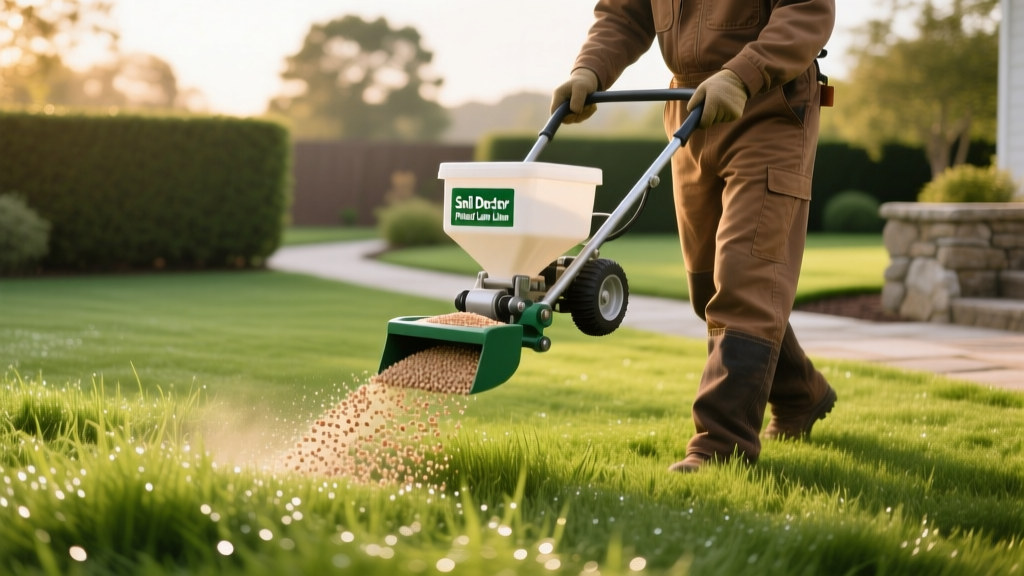
Soil Doctor Pelleted Lawn Lime: Application Rates & Guide
The Agronomic Case for Pelleted Lime
When soil pH drops below 6.0, essential macronutrients like phosphorus and potassium bind with aluminum and iron, becoming entirely unavailable to turfgrass roots. Traditional pulverized agricultural limestone fixes this, but it creates a massive dust hazard and requires specialized drop spreaders to avoid coating nearby vehicles and siding. Soil Doctor Pelleted Lawn Lime solves the application problem by binding finely ground calcium carbonate (CaCO3) into uniform, dust-free granules using a bentonite clay binder. This allows homeowners to use standard rotary broadcast spreaders for even distribution across established lawns.
However, the clay binder that makes pelleted lime user-friendly also dictates how it must be applied. Unlike powdered lime which reacts immediately upon contact with soil moisture, pelleted lime requires deliberate irrigation to dissolve the clay matrix and release the active calcium carbonate into the soil profile. Understanding this mechanical difference is the key to achieving a successful pH correction without wasting product.
Pelleted vs. Pulverized vs. Liquid Lime
Choosing the right amendment depends on your equipment, timeline, and budget. Below is a structural comparison of the three primary lime formats available to residential lawn care operators.
| Feature | Soil Doctor Pelleted | Pulverized (Powdered) | Liquid Lime |
|---|---|---|---|
| Dust Factor | Negligible | High (requires windless days) | None |
| Spreader Type | Rotary / Broadcast | Drop Spreader Only | Hose-end / Pump Sprayer |
| Reaction Time | 3 to 6 weeks | 2 to 4 weeks | Immediate (short-lived) |
| Cost per 1,000 sq ft | $6.00 - $9.00 | $3.00 - $5.00 | $12.00 - $18.00 |
| Longevity | 12 - 18 months | 12 - 18 months | 3 - 4 months |
Calculating Your Application Rate via CEC
Blindly applying a standard 40 lb bag per 1,000 square feet is a common failure mode that leads to over-liming. The exact amount of Soil Doctor Pelleted Lawn Lime required depends on your soil's Cation Exchange Capacity (CEC), which is heavily influenced by soil texture. According to Penn State Extension, soils with high clay content have a high CEC and possess a strong buffering capacity, meaning they resist pH changes and require significantly more lime to move the needle.
Target pH by Grass Type
- Tall Fescue & Kentucky Bluegrass: 6.0 to 6.8
- Bermudagrass & Zoysia: 6.0 to 7.0
- Centipedegrass: 5.0 to 6.0 (Rarely requires lime; applying lime to Centipede often induces severe iron chlorosis).
- St. Augustinegrass: 6.0 to 7.5
To determine your exact application rate, you must submit a soil sample to a reputable laboratory, such as the UMass Amherst Soil and Plant Tissue Testing Laboratory. The lab will provide a buffer pH reading alongside your standard water pH. Use the following baseline metrics for Soil Doctor Pelleted Lime (40 lb bags) to raise soil pH by 0.5 to 1.0 units:
- Sandy Loam (Low CEC): 20 lbs per 1,000 sq ft (1/2 bag)
- Loam (Medium CEC): 40 lbs per 1,000 sq ft (1 full bag)
- Heavy Clay (High CEC): 60 to 80 lbs per 1,000 sq ft (1.5 to 2 bags)
Step-by-Step Application Protocol
Proper timing and mechanical preparation ensure the calcium carbonate reaches the root zone rather than sitting uselessly on top of the thatch layer.
- Core Aerate First (If dealing with Clay): If your soil test indicates heavy clay, core aerate the lawn before applying lime. The aeration holes provide direct pathways for the dissolved lime to bypass the thatch and reach the subsoil where active root exchange occurs.
- Calibrate the Spreader: Soil Doctor pellets are roughly 2-3mm in diameter. For a standard Scotts EdgeGuard broadcast spreader, a setting of 11.5 will typically empty a 40 lb bag over 2,000 square feet. Always verify this on the back of the specific bag you purchase, as binder formulations can slightly alter granule density.
- Apply in a Criss-Cross Pattern: Apply half the required rate walking North-South, and the second half walking East-West. This eliminates striping and ensures uniform coverage, preventing localized hot-spots of high pH.
- The Critical Watering Step: Immediately after application, apply exactly 0.25 inches of irrigation. This is not enough to cause runoff, but it is the precise amount of moisture required to break down the bentonite clay binder and initiate the chemical breakdown of the pellets into the soil surface.
Warning: Avoid Phosphorus Conflict
Do not apply Soil Doctor Pelleted Lime on the same day as a high-phosphorus starter fertilizer (e.g., a 10-18-10 blend). Free calcium ions rapidly bind with soluble phosphorus to create calcium phosphate, an insoluble compound that turfgrass cannot absorb. Separate lime and phosphorus-heavy fertilizer applications by at least 14 days.
Do not apply Soil Doctor Pelleted Lime on the same day as a high-phosphorus starter fertilizer (e.g., a 10-18-10 blend). Free calcium ions rapidly bind with soluble phosphorus to create calcium phosphate, an insoluble compound that turfgrass cannot absorb. Separate lime and phosphorus-heavy fertilizer applications by at least 14 days.
Common Mistakes and Edge Cases
Even with a high-quality pelleted product, environmental variables can derail your soil amendment strategy. Watch for these specific failure modes:
- Applying Before Heavy Rain: While moisture is required, applying right before a torrential downpour will wash the pellets off target, especially on sloped lawns or dormant warm-season grasses lacking dense canopy cover to catch the granules.
- Ignoring the Buffer pH: If your water pH reads 5.5, but your buffer pH reads 6.8, your soil actually has low reserve acidity. Applying a full 40 lb rate will overshoot the target and push your soil into alkaline territory, locking out micronutrients like iron and manganese.
- Expecting Overnight Results: Pelleted lime is a slow-release amendment. While the pellets dissolve into the thatch within 3 weeks, the actual cation exchange process—where calcium displaces hydrogen ions on soil clay particles—takes 3 to 6 months to fully reflect on a subsequent soil test.
Sourcing and Pricing in 2026
As of early 2026, a standard 40 lb bag of Soil Doctor Pelleted Lawn Lime retails between $16.00 and $22.00 at major home improvement centers and local agricultural co-ops. Because shipping 40 lb bags of rock is cost-prohibitive for e-commerce, purchasing locally is highly recommended. Ensure the bag is stored in a climate-controlled, dry environment; if the bentonite binder is exposed to ambient humidity in a damp garage for several months, the pellets will fuse into a solid brick that cannot be broken apart for spreader use.
Frequently Asked Questions
Can I apply pelleted lime and grass seed at the same time?
Yes. Soil Doctor pelleted lime is completely safe to apply during overseeding. In fact, if your soil pH is below 5.5, applying lime during your fall aeration and overseeding routine is critical, as acidic soil severely inhibits the germination and seedling vigor of Tall Fescue and Kentucky Bluegrass.
Will pelleted lime burn my lawn?
No. Unlike synthetic nitrogen fertilizers, calcium carbonate does not possess a high salt index and will not cause osmotic burn to grass blades, even if it sits on the leaf tissue for a few days before being watered in. However, it can leave a temporary white residue on the grass blades until it is washed down to the soil level.
How often should I reapply?
Never reapply lime on a fixed calendar schedule. Soil pH drifts downward over time due to the leaching of base cations from rainfall and the use of acidifying nitrogen fertilizers (like ammonium sulfate). Test your soil every 24 to 36 months and only apply Soil Doctor Pelleted Lime when the lab report explicitly recommends a pH correction.

