
Lawn Care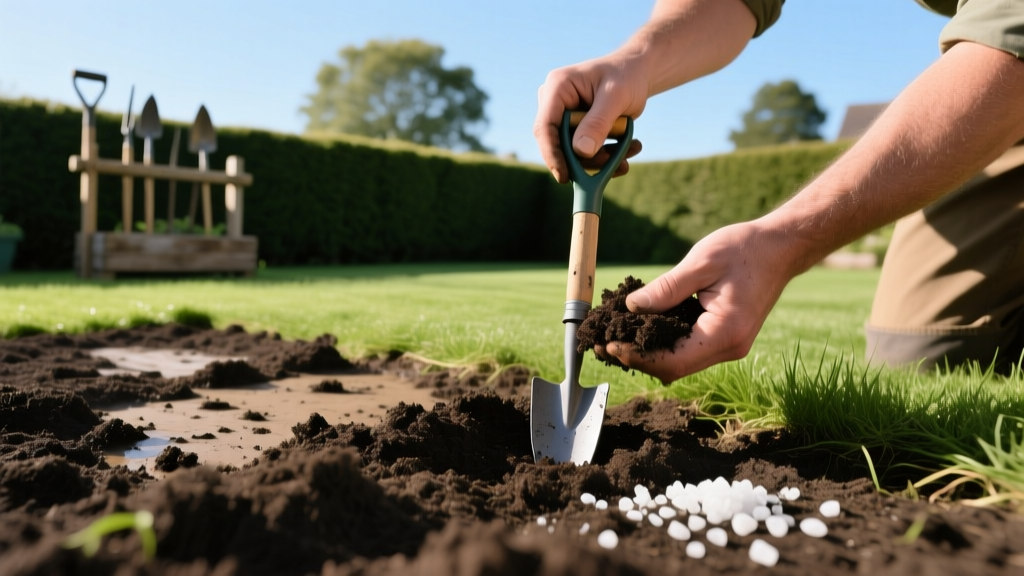
When to Run a Soil Test for Gypsum on Heavy Clay Lawns
The Misunderstood Role of Gypsum in Lawn Care
Gypsum (calcium sulfate dihydrate) is frequently mischaracterized in the lawn care industry as a universal cure-all for heavy, compacted clay soils. Homeowners often apply it blindly, hoping it will fracture dense clay and improve drainage. However, gypsum does not alter soil pH, nor does it mechanically break up non-sodic clay. Its primary chemical function is to remediate sodic soils—soils with dangerously high levels of exchangeable sodium that destroy soil structure and prevent water infiltration.
Before spending $40 to $80 per bag on soil amendments, you must verify that your lawn actually suffers from sodium toxicity. This requires a specific type of laboratory analysis. A standard soil test for gypsum applications must measure sodium levels and calculate the soil's structural stability metrics, which basic N-P-K test kits completely ignore.
Why Standard Soil Tests Fail the Gypsum Question
Most local university extension offices and retail garden centers offer basic soil tests for $15 to $25. These standard panels measure pH, phosphorus, potassium, calcium, magnesium, and sometimes organic matter. They rarely measure exchangeable sodium unless you specifically request it and pay for an upgraded panel.
If you apply gypsum to a clay lawn that has normal sodium levels but poor structure due to lack of organic matter or heavy foot traffic, the calcium in the gypsum will simply compete with existing calcium and magnesium on the Cation Exchange Capacity (CEC) sites. The result is a waste of money and an unnecessary accumulation of sulfur in your soil profile.
Warning: The Lime vs. Gypsum Confusion
Never substitute gypsum for agricultural lime if your goal is to raise soil pH. Gypsum is pH-neutral. If your soil test indicates a pH below 6.0, you need calcitic or dolomitic lime. If your pH is optimal but water pools on the surface due to sodium-induced clay dispersion, gypsum is the correct amendment.
How to Order the Correct Soil Test for Gypsum
To determine if your lawn requires gypsum, you must send a soil sample to a professional agronomic laboratory (such as Ward Laboratories, Logan Labs, or A&L Great Lakes) and request a Sodic Soil Analysis or a Comprehensive Turf Panel with Sodium and SAR. Expect to pay between $45 and $75 for this level of detail.
- Collect 10 to 15 sub-samples: Use a clean soil probe or spade to extract cores from the top 4 to 6 inches of your lawn. Avoid areas near downspouts, driveways, or recently fertilized zones.
- Mix and dry: Combine the sub-samples in a clean plastic bucket. Break apart clods and let the soil air-dry in the shade for 24 hours. Do not bake it in the sun or oven.
- Select the right lab panel: When filling out the lab submission form, explicitly check the boxes for Exchangeable Sodium Percentage (ESP), Sodium Adsorption Ratio (SAR), and Electrical Conductivity (EC). According to Colorado State University Extension, these three metrics are the only reliable indicators of sodicity and salinity.
- Specify your grass type: Note whether you have a cool-season (e.g., Kentucky Bluegrass, Tall Fescue) or warm-season (e.g., Bermudagrass, Zoysia) turf, as some labs adjust their baseline recommendations based on turf salt tolerance.
Interpreting Your Results: The Sodicity Decision Matrix
Once your lab results arrive, bypass the N-P-K recommendations and look directly at the ESP and SAR values. The ESP measures the percentage of the soil's CEC occupied by sodium, while the SAR measures the ratio of sodium to calcium and magnesium in the soil solution. Use the following matrix to determine your next steps.
| Metric | Value Range | Soil Classification | Gypsum Requirement |
|---|---|---|---|
| ESP / SAR | ESP < 10% / SAR < 10 | Normal Clay | None. Focus on aeration and organic matter. |
| ESP / SAR | ESP 10-15% / SAR 10-13 | Marginal / At Risk | Maintenance rate: 20 lbs per 1,000 sq ft. |
| ESP / SAR | ESP > 15% / SAR > 13 | Sodic Soil | Reclamation rate: 50-85 lbs per 1,000 sq ft. |
| EC (Salinity) | > 4.0 dS/m | Saline-Sodic | Leach with heavy irrigation before applying gypsum. |
Calculating Application Rates Based on Lab Data
If your soil test confirms an ESP above 15%, you must calculate the exact amount of gypsum required to displace the excess sodium. The agronomic standard is that replacing 1 milliequivalent (meq) of exchangeable sodium per 100 grams of soil requires approximately 1.7 tons of gypsum per acre. Translated to residential lawn care, this equals roughly 85 pounds of gypsum per 1,000 square feet for every 1 meq/100g of sodium that needs replacing.
Because applying 85 lbs per 1,000 sq ft in a single pass can smother existing turf, agronomic experts at Crop Nutrition recommend splitting the application into two or three treatments spaced 30 to 45 days apart, accompanied by deep irrigation to flush the displaced sodium out of the root zone.
Pelletized vs. Powdered Gypsum Products
The physical form of the gypsum you purchase dictates how easily you can apply it and how quickly it reacts in the soil profile.
- Pelletized Gypsum (e.g., EcoGEM, Lawn Restore): Extruded into uniform 2mm to 4mm granules. This form flows flawlessly through rotary and drop spreaders (like a Scotts EdgeGuard). It is dust-free and costs approximately $35 to $45 per 40-lb bag. Pellets require moisture to break down, making them ideal for spring or fall applications when rainfall is consistent.
- Powdered / Pulverized Gypsum (e.g., Espoma Organic Gypsum): Milled to a fine dust or coarse sand consistency. It reacts faster with the soil CEC because of the higher surface area, but it is notoriously difficult to apply evenly with standard spreaders. It often clumps in the hopper and creates dust clouds. Best applied using a broadcast spreader with an agitator, or top-dressed manually over small, severely compacted zones.
Frequently Asked Questions About Gypsum Testing
Can I use a home soil test kit to check for sodium?
No. Consumer-grade chemical drop kits and digital pH/EC meters (like the Luster Leaf Rapitest or Sonkir MS02) cannot measure exchangeable sodium or calculate ESP. Sodium requires extraction via ammonium acetate and measurement using atomic absorption spectroscopy or flame photometry, which only professional laboratories possess.
Will gypsum lower my soil pH?
Gypsum is calcium sulfate. Unlike elemental sulfur (which lowers pH) or agricultural lime (which raises pH), the sulfate in gypsum does not generate acidity in the soil solution, and the calcium does not neutralize it. It is strictly a structural amendment for sodium displacement and a secondary nutrient source for calcium-hungry turfgrasses.
How long does it take for gypsum to fix a sodic clay lawn?
Chemical displacement begins within 48 hours of watering the gypsum into the soil, but physical improvement in soil structure and drainage typically takes 6 to 12 months. The displaced sodium must be physically leached below the 6-inch root zone via heavy irrigation or sustained rainfall. If your lawn lacks subsurface drainage, the sodium will remain in the lower profile and eventually wick back up via capillary action during dry summer months.

