
Lawn Care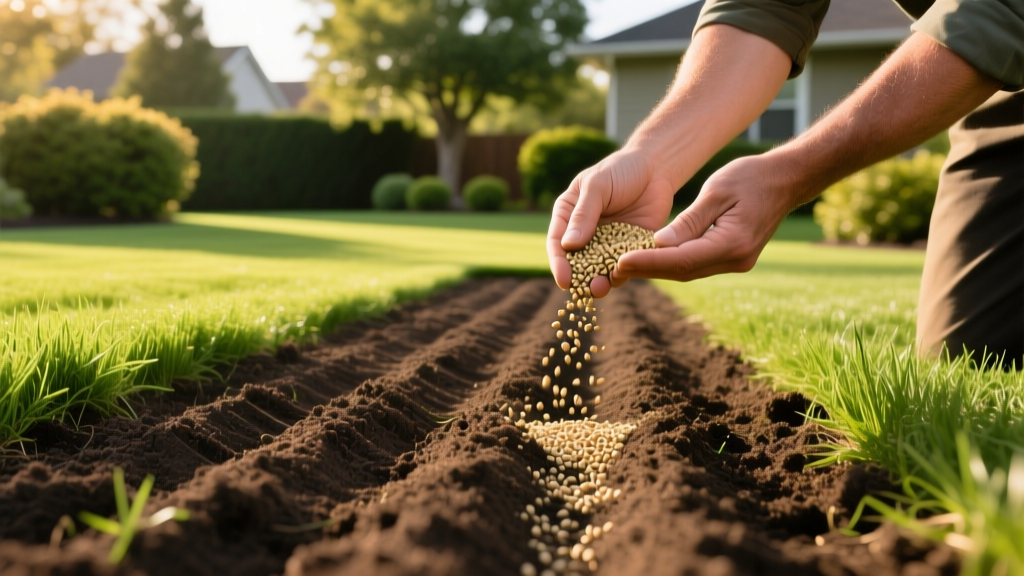
How to Sow Grass Seed: Exact Timing, Rates, and Soil Prep
Establishing a dense, weed-resistant lawn from seed requires more than scattering kernels over dirt and turning on the hose. The difference between a patchy, disease-prone yard and a thick, resilient turf lies in precise soil temperature targeting, exact seeding rates, and strict moisture management during the critical 21-day germination window. This guide provides the exact agronomic parameters and step-by-step protocols required to successfully sow grass seed and establish a permanent lawn.
The Science of Germination: Why Timing Dictates Success
Grass seed will not germinate based on the air temperature; it responds strictly to soil temperature at a 2-inch depth. Sowing seed when the soil is too cold leads to seed rot and damping-off disease, while sowing in excessively hot soil causes rapid moisture evaporation and seedling desiccation before the taproot can establish.
| Grass Species | Optimal Soil Temp (2" Depth) | Primary Sowing Window | Secondary Sowing Window |
|---|---|---|---|
| Kentucky Bluegrass | 50°F – 65°F | Early Fall (Aug 15 - Sep 30) | Early Spring (Apr 1 - May 15) |
| Tall Fescue | 50°F – 70°F | Early Fall (Aug 15 - Oct 15) | Early Spring (Mar 15 - May 1) |
| Perennial Ryegrass | 50°F – 65°F | Early Fall (Aug 15 - Sep 30) | Early Spring (Apr 1 - May 15) |
| Bermudagrass (Hulled) | 65°F – 75°F | Late Spring (May 15 - Jul 1) | N/A |
According to agronomic data from NC State TurfFiles, cool-season grasses sown in late summer benefit from warm soil that accelerates germination, followed by cool autumn air that promotes deep root growth without the heat stress of summer. Use a digital soil probe thermometer to verify temperatures before deploying your spreader.
Calculating Exact Seeding Rates (Stop Guessing)
Over-seeding is a common mistake that leads to intense competition for water and nutrients, resulting in weak, spindly seedlings that die off during the first summer drought. Under-seeding leaves bare patches vulnerable to crabgrass and broadleaf weed invasion.
Warning: The Overseeding Multiplier
Do not use 'New Lawn' seeding rates when overseeding an existing thin lawn. Existing grass will intercept up to 40% of the seed. When overseeding, reduce the new-lawn application rate by exactly 50% and use a core aerator beforehand to ensure seed-to-soil contact.
- Kentucky Bluegrass: 2.0 – 3.0 lbs per 1,000 sq ft (New Lawn) | 1.0 – 1.5 lbs (Overseed)
- Tall Fescue: 6.0 – 8.0 lbs per 1,000 sq ft (New Lawn) | 3.0 – 4.0 lbs (Overseed)
- Perennial Ryegrass: 5.0 – 7.0 lbs per 1,000 sq ft (New Lawn) | 3.0 – 5.0 lbs (Overseed)
- Bermudagrass (Hulled): 1.0 – 2.0 lbs per 1,000 sq ft (New Lawn)
Premium turf-type tall fescue blends in 2026 typically cost between $6.00 and $9.00 per pound. Always check the seed tag for the 'Pure Live Seed' (PLS) percentage; if the PLS is below 85%, you must mathematically increase your application rate to compensate for inert matter and weed seed content.
Soil Preparation: The 4-Inch Rule and Amendment Chemistry
Grass roots will not penetrate compacted subsoil. The seedbed must be physically fractured and chemically balanced before the seed touches the ground. Penn State Extension emphasizes that proper seedbed preparation is the single most critical factor in long-term turf survival.
- Kill Existing Vegetation: Apply a non-selective systemic herbicide (like glyphosate) 14 days prior to tilling. Do not till live weeds, as this chops and distributes rhizomes, multiplying the weed problem.
- Fracture the Subsoil: Use a rear-tine rototiller to break up the top 4 to 6 inches of soil. If the soil is heavy clay, incorporate 2 cubic yards of screened compost per 1,000 sq ft during this step to improve drainage and cation exchange capacity (CEC).
- Grade and Level: Rake the area to establish a 1% to 2% slope away from the home's foundation. Remove all rocks larger than a golf ball and debris.
- Apply Starter Fertilizer: New seedlings require high phosphorus for rapid root development. Apply a starter fertilizer with an N-P-K ratio similar to 10-18-10 or 24-25-4 at a rate of 1.0 lb of actual nitrogen per 1,000 sq ft. Note: Many municipalities restrict phosphorus applications unless a soil test confirms a deficiency or you are establishing a new lawn.
- Create a Micro-Trench: Lightly drag a leaf rake over the soil to create shallow grooves (1/8 inch deep) which will catch the seed and prevent wind displacement.
Sowing Techniques: Broadcast vs. Drop Spreaders
The equipment you use to sow grass seed dictates the uniformity of your lawn. Calibration is mandatory; never rely solely on the settings printed on the seed bag, as spreader mechanics vary wildly by brand and tire pressure.
| Spreader Type | Mechanism | Best Use Case | Calibration Tip |
|---|---|---|---|
| Rotary Broadcast | Slings seed in a wide, overlapping circular pattern via a spinning impeller. | Open areas over 2,500 sq ft; irregular lot shapes. | Set to 50% of bag recommendation. Walk at a brisk 3 mph pace. Overlap passes by 50%. |
| Drop Spreader | Drops seed directly downward through a series of holes in the hopper base. | Small urban yards, areas near garden beds or water features. | Align wheel tracks exactly with the previous pass. High risk of striping if overlap is missed. |
For professional-grade establishment, split your total seed volume in half. Sow the first half in a North-South direction, and the second half in an East-West direction. This cross-hatching technique eliminates striping and guarantees uniform density.
The Critical 21-Day Establishment Watering Protocol
Once you sow grass seed, the embryo inside the seed absorbs water and swells, rupturing the seed coat. If the seed dries out even once during the first 10 days, the embryo will die. The goal is to keep the top 1/2 inch of soil constantly moist, not saturated.
- Days 1 through 7 (Germination Phase): Water 3 to 4 times per day for 5 to 10 minutes per zone. The soil surface should look dark and damp, but water should never pool or run off. If you are using a hose-end sprinkler, move it frequently to maintain the micro-climate.
- Days 8 through 14 (Taproot Extension): As seedlings reach 1 inch in height, reduce frequency to 1 to 2 times per day, but increase duration to 15 minutes. This encourages the nascent roots to chase the moisture slightly deeper into the soil profile.
- Days 15 through 21 (Tillering Phase): Transition to deep, infrequent watering. Water every other day for 20 to 30 minutes. This hardens off the turf and prepares it for standard lawn maintenance schedules.
Common Sowing Failures and Troubleshooting
Even with meticulous preparation, environmental variables can disrupt establishment. Recognize these failure modes early to implement corrective action.
Seed Washout and Erosion:
If heavy rain occurs within 48 hours of sowing, seed will wash into low spots. Fix: Apply a hydromulch or a thin layer (1/4 inch) of peat moss immediately after sowing to bind the seed to the soil. Avoid using straw, which often contains agricultural weed seeds and can smother delicate bluegrass seedlings.
Damping-Off Disease:
Seedlings emerge but suddenly pinch at the soil line, turn brown, and collapse. This is a fungal infection caused by overwatering and poor air circulation. Fix: Immediately reduce watering frequency, allow the surface to dry slightly between cycles, and apply a preventative fungicide containing azoxystrobin if the outbreak is severe.
Bird and Rodent Predation:
Large patches of seed disappear before germination. Fix: While you cannot eliminate wildlife, raking the seed lightly into the top 1/8 inch of soil and covering it with a biodegradable erosion control blanket reduces seed visibility and accessibility by up to 80%.

