
Lawn Care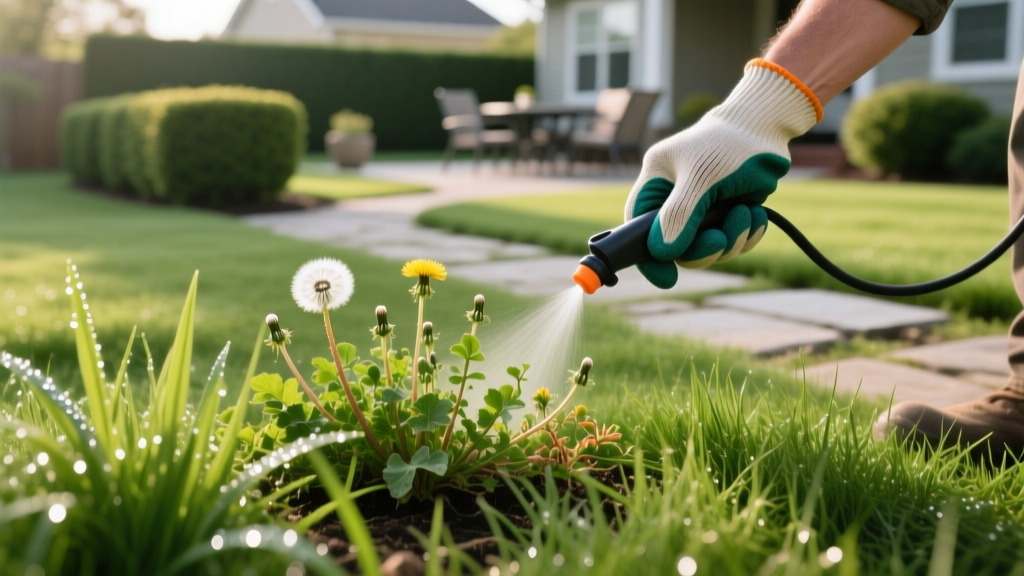
Spot-Treating Bad Weeds: A Targeted Guide for Tough Lawn Invaders
Why Broadcast Spraying Fails Against Truly Bad Weeds
Most homeowners treat their entire lawn for weeds, wasting money, stressing the turf, and disrupting the soil microbiome. When dealing with truly bad weeds—species with aggressive rhizomes, allelopathic properties, or high herbicide resistance—broadcast spraying is often ineffective and economically illogical. Spot-treating targets the specific invader while preserving your healthy turf. According to Penn State Extension, targeted application reduces chemical usage by up to 85% compared to blanket applications, making it the gold standard for managing isolated, severe infestations.
⚠️ Warning: The "Bad Weed" Misconception
A weed is not "bad" simply because it is ugly. In turfgrass management, a bad weed is defined by its structural threat: deep taproots that survive aeration, tubers that defy physical extraction, or allelopathic chemicals that actively poison surrounding grass roots.
A weed is not "bad" simply because it is ugly. In turfgrass management, a bad weed is defined by its structural threat: deep taproots that survive aeration, tubers that defy physical extraction, or allelopathic chemicals that actively poison surrounding grass roots.
The Big Three Bad Weeds and Spot-Treatment Protocols
To successfully eradicate these invaders, you must match the active ingredient to the weed's specific biological vulnerabilities. Below are the exact protocols for the three most notorious bad weeds found in North American lawns.
1. Yellow Nutsedge (Cyperus esculentus)
The Threat: Nutsedge reproduces via underground tubers (nutlets). Pulling the plant snaps the shoot, leaving 1 to 3 nutlets in the soil, each capable of generating new plants. Standard broadleaf herbicides (like 2,4-D) are completely useless against it.
- Active Ingredient: Halosulfuron-methyl (Brand: SedgeHammer).
- Mix Rate: 0.9 grams (one packet) per 1 gallon of water per 1,000 sq ft.
- Crucial Additive: You MUST include a Non-Ionic Surfactant (NIS) at 0.25% v/v (approx. 1/2 teaspoon per gallon). Without NIS, the herbicide beads up on the waxy sedge leaf and fails.
- Cost: ~$25 for a box of 5 packets (treats up to 5,000 sq ft of spotted infestation).
- Timing: Apply when nutsedge is actively growing in late spring/early summer, before it produces mature nutlets in late July.
2. Dallisgrass (Paspalum dilatatum)
The Threat: Dallisgrass features thick, woody rhizomes that store massive energy reserves. It thrives in wet, compacted soil and chokes out desirable turf.
- Active Ingredient (Warm-Season Lawns): Thiencarbazone + iodosulfuron + dicamba (Brand: Celsius WG).
- Mix Rate: 0.057 oz per gallon per 1,000 sq ft. Requires sequential applications spaced 14–21 days apart.
- Active Ingredient (Cool-Season Lawns): Fluazifop-P-butyl (Brand: Fusilade II). Note: Fusilade can stunt tall fescue if applied during summer heat; use only in spring/fall at reduced rates (0.15 fl oz per 1,000 sq ft) with a methylated seed oil (MSO).
- Cost: Celsius WG (~$130 for 10 oz); Fusilade II (~$60 per pint).
3. Creeping Charlie (Glechoma hederacea)
The Threat: A broadleaf weed that spreads via stolons (above-ground runners) that root at every single node. If you miss a node during manual removal, it regenerates rapidly. The University of Missouri Extension notes that Creeping Charlie is highly resistant to single-ingredient herbicides.
- Active Ingredient: Carfentrazone-ethyl + 2,4-D + MCPP + Dicamba (Brand: SpeedZone).
- Mix Rate: 1.4 fl oz per gallon per 1,000 sq ft.
- Cost: ~$110 per gallon (highly concentrated; one gallon makes over 90 gallons of spray solution).
- Pro Tip: Apply in the fall when temperatures are between 60°F and 75°F. Fall applications force the herbicide into the root system as the plant stores winter carbohydrates.
Spot-Treatment Decision Matrix
Use this matrix to ensure you are selecting the correct chemistry for your specific grass type and weed target. Applying the wrong herbicide can result in severe turf phytotoxicity.
| Weed Species | Safe Grass Types | Recommended Product | Wait Time to Overseed |
|---|---|---|---|
| Yellow Nutsedge | All warm & cool-season | SedgeHammer | 4 weeks |
| Dallisgrass | Bermuda, Zoysia, Centipede | Celsius WG | 6 weeks |
| Dallisgrass | Tall Fescue | Fusilade II | 14 days |
| Creeping Charlie | All cool-season grasses | SpeedZone | 3 weeks |
Precision Application: Tools and Techniques
Spot-treating bad weeds requires surgical precision. Drift onto desirable turf can cause localized bleaching or stunting.
💡 The Blueprint Dye Trick
Always add an indicator dye (like Blueprint Indicator Blue, ~$15 per bottle) to your tank mix. This stains the weed blue, allowing you to see exactly which leaves you have covered and preventing accidental double-spraying, which wastes chemical and increases the risk of soil leaching.
Always add an indicator dye (like Blueprint Indicator Blue, ~$15 per bottle) to your tank mix. This stains the weed blue, allowing you to see exactly which leaves you have covered and preventing accidental double-spraying, which wastes chemical and increases the risk of soil leaching.
Hardware Requirements for Spot Spraying
- The Sprayer: Use a 1-gallon or 2-gallon handheld pump sprayer (e.g., Chapin 20000). Avoid hose-end sprayers entirely; they lack the pressure control required for spot treatments.
- The Nozzle: Swap the default cone nozzle for a TeeJet 8002 Flat Fan nozzle. Flat fan nozzles provide a uniform, predictable spray pattern that minimizes off-target drift.
- Pressure Control: Pump the sprayer to exactly 20–30 PSI. Pumping to 50+ PSI creates microscopic droplets that become airborne and drift onto nearby garden beds or desirable turf.
Critical Failure Modes and Edge Cases
Even with the right chemical, homeowners frequently experience treatment failure due to these non-obvious edge cases:
1. The Surfactant Omission
Bad weeds like nutsedge and wild violet have highly waxy cuticles designed to repel water. If your herbicide label mandates a Non-Ionic Surfactant (NIS) or Methylated Seed Oil (MSO) and you skip it, the active ingredient will literally roll off the leaf and onto the soil, where it degrades without harming the weed. Always read the "Adjuvants" section of the label.
2. Temperature Volatility
Applying ester-based herbicides (like SpeedZone or Trimec) when ambient temperatures exceed 85°F causes the chemical to vaporize. This vapor drift can damage trees, shrubs, and neighboring lawns up to a mile away. Restrict spot treatments to early mornings when temperatures are below 80°F.
3. Premature Mowing
Mowing too soon after application physically removes the herbicide before it has time to translocate to the roots. The Golden Rule: Do not mow for 48 hours before application (to maximize leaf surface area) and wait at least 48 to 72 hours after application before your next mow.
4. Ignoring Soil Moisture
Herbicides are transported through the plant's vascular system via water. If the lawn is experiencing drought stress, the weed's stomata will close, and translocation halts. Water your lawn deeply 24 hours before spot-treating bad weeds to ensure the plants are actively growing and pulling the chemical down to the root zone.
Summary: Your Spot-Treatment Action Plan
✔️ Pre-Treatment: Water lawn 24 hours prior. Mow 48 hours prior.
✔️ Mixing: Measure exact chemical rates per 1,000 sq ft. Add mandatory surfactant and indicator dye.
✔️ Application: Use flat-fan nozzle at 20-30 PSI. Spray only the target weed until just wet (not dripping).
✔️ Post-Treatment: Wait 48-72 hours to mow. Monitor for 14 days for a second sequential application if required by the label.
✔️ Mixing: Measure exact chemical rates per 1,000 sq ft. Add mandatory surfactant and indicator dye.
✔️ Application: Use flat-fan nozzle at 20-30 PSI. Spray only the target weed until just wet (not dripping).
✔️ Post-Treatment: Wait 48-72 hours to mow. Monitor for 14 days for a second sequential application if required by the label.

