
Lawn Care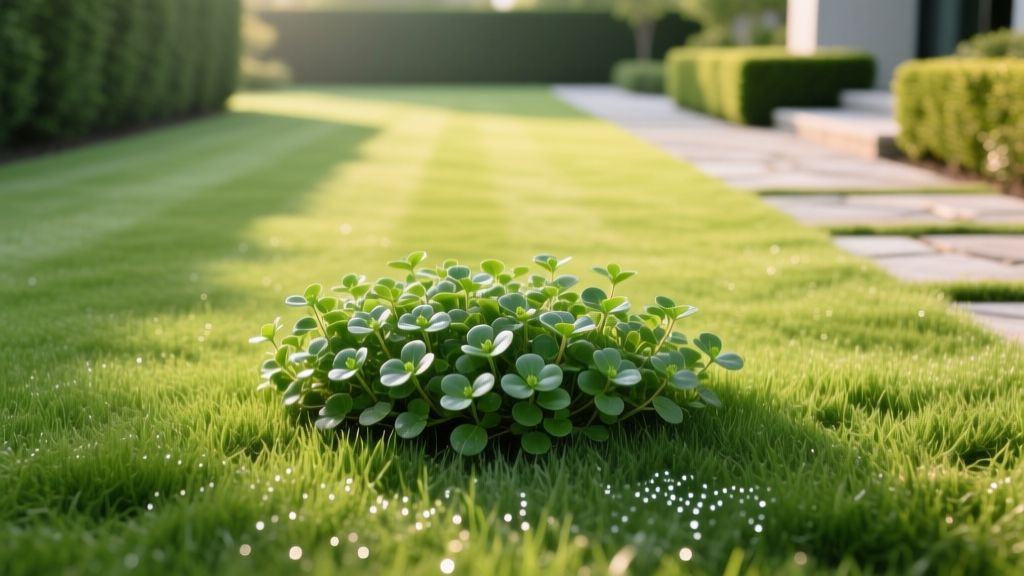
How to Identify and Spot-Treat Carpet Weeds in Your Lawn
Identifying Carpet Weeds: Botanical Profile & Lookalikes
Carpetweed (Mollugo verticillata) is a highly aggressive summer annual that thrives in thin, compacted, or newly established turf. Unlike upright weeds that compete vertically, carpet weeds grow prostrate, forming dense, circular mats that choke out desirable grass by monopolizing sunlight and surface moisture. Because homeowners frequently confuse carpetweed with other mat-forming nuisances, misidentification often leads to ineffective chemical applications.
Accurate identification requires examining the node structure, stem texture, and sap. According to the UC IPM Weed Gallery, carpetweed is uniquely characterized by its whorled leaf arrangement, which is rare among common lawn weeds.
| Weed Species | Leaf Structure | Stem Characteristic | Distinguishing Feature |
|---|---|---|---|
| Carpetweed (M. verticillata) | Whorled (5-8 leaves per node), smooth, spatulate | Smooth, branching, non-hairy | Small white flowers; no milky sap when broken |
| Prostrate Spurge (E. maculata) | Opposite, oblong, often with a red/purple spot | Hairy, reddish-tinted | Exudes a distinct white, milky sap when snapped |
| Prostrate Knotweed (P. aviculare) | Alternate, lance-shaped, bluish-green | Wire-like, tough, swollen nodes | Papery sheath (ochrea) at the base of each leaf |
The Biology of Mat-Forming Weeds
Carpetweed germinates when soil temperatures consistently reach 60°F to 65°F in late spring. It features a shallow but tenacious taproot that anchors the center of the mat while lateral stems root at the nodes. This dual-rooting mechanism makes hand-pulling notoriously difficult; if the central taproot snaps, the peripheral nodes will regenerate new shoots within 7 to 10 days.
⚠️ Expert Warning: Do not use string trimmers or edgers to cut back carpetweed mats. The mechanical action scatters the tiny, spherical seeds (which can remain viable in the soil seed bank for up to 3 years) and fragments the stems, encouraging vegetative propagation rather than eradication.
Step-by-Step Spot-Treatment Protocol
Effective spot-treatment requires a phased approach, prioritizing mechanical extraction for isolated outbreaks and chemical intervention for established mats. The NC State TurfFiles Weed Management database emphasizes that timing herbicide applications during the weed's active vegetative growth phase (before flowering) yields the highest kill rates.
Phase 1: Mechanical Removal (For Infestations Under 10 Sq Ft)
- Hydrate the Soil: Water the targeted area deeply 24 hours prior to extraction to soften the soil profile to a 4-inch depth.
- Use a Taproot Extractor: Utilize a stand-up weed puller with a serrated claw (e.g., Fiskars Stand-Up Weeder, approx. $35) to grip the central rosette.
- Extract and Inspect: Pull straight up with steady pressure. Inspect the extracted root; if the taproot is longer than 3 inches and intact, success is likely. If it snaps, proceed immediately to Phase 2.
Phase 2: Chemical Spot-Treatment (Active Ingredients & Product Picks)
Carpetweed is a broadleaf weed, meaning standard grassy-weed killers (like fluazifop) will fail. You need a systemic broadleaf herbicide containing a combination of 2,4-D, Dicamba, and MCPP-p (a standard 3-way mixture). The combination of three active ingredients prevents the weed from metabolizing the toxin and ensures translocation down to the taproot.
- Consumer Pick 1: Ortho WeedClear Weed Killer for Lawns (Contains 2,4-D, Quinclorac, Dicamba). Excellent for carpetweed and mixed infestations. Cost: ~$18 to $22 per gallon ready-to-spray.
- Consumer Pick 2: Spectracide Weed Stop for Lawns (Contains 2,4-D, MCPP-p, Dicamba, Sulfentrazone). The addition of sulfentrazone provides a faster visual burn-down (within 24 hours). Cost: ~$13 to $15 per gallon.
- Prosumer Concentrate: PBI Gordon Trimec Classic. Highly concentrated, requires a 1-gallon or 2-gallon pump sprayer. Mix rate: 1.5 oz per gallon of water per 1,000 sq ft. Cost: ~$45 for a 2.5-gallon jug (yields over 200 gallons of mixed solution).
Application Rules: Spray only until the leaves are wet (point of runoff). Do not broadcast spray over the entire lawn if the infestation is localized; spot-treating preserves soil microbiology and reduces chemical load. Apply when daytime temperatures are between 65°F and 85°F, and ensure no rain is forecast for at least 24 hours.
Pre-Emergent Defense: Stopping the Carpet Before It Forms
If carpetweed plagued your lawn last summer, the soil seed bank is already loaded. Relying solely on post-emergent spot treatments is a reactive, losing battle. You must deploy a pre-emergent herbicide.
For carpetweed, Dithiopyr (sold under the trade name Dimension) is vastly superior to Prodiamine (Barricade). While Prodiamine strictly prevents germination, Dithiopyr offers early post-emergent activity, meaning it will kill carpetweed seedlings that have already sprouted but haven't yet developed beyond the 2-leaf stage.
💡 Pro Tip for Pre-Emergent Timing: Do not rely on the calendar. Apply your pre-emergent when soil temperatures at a 2-inch depth consistently hit 55°F for three consecutive mornings. In most transitional and cool-season zones, this occurs in mid-April, but local microclimates vary. Use a digital soil probe thermometer to verify.
Turfgrass Recovery Post-Treatment
When a carpetweed mat dies, it leaves behind a ring of bare soil. If left unaddressed, crabgrass and new carpetweed seeds will immediately colonize this void. According to University of Minnesota Extension Weed Control guidelines, rapid turf establishment is the ultimate biological weed control.
- Rake the Void: Once the treated weed turns brittle and brown (usually 14-21 days post-spray), use a steel tine rake to aggressively scratch the bare soil and remove the dead organic matter.
- Aerate and Top-Dress: If the soil is compacted (which originally invited the carpetweed), use a hand core aerator on the bare patch. Apply a 1/4-inch layer of screened compost.
- Overseed: Apply a turf-type tall fescue or Kentucky bluegrass seed blend (depending on your zone) at a rate of 6 to 8 lbs per 1,000 sq ft. Keep the seed constantly moist for 14 days until germination occurs.
Carpet Weed Spot-Treatment FAQ
Q: Will vinegar or horticultural acetic acid kill carpetweed?
A: No. While 20% to 30% horticultural vinegar will burn the top foliage of carpetweed within hours, it is strictly a contact herbicide. It will not translocate to the taproot, and the weed will resprout from the root crown within a week. Furthermore, repeated vinegar applications severely depress soil pH and harm beneficial soil microbes.
Q: Can I use a weed-and-feed fertilizer to kill existing carpetweed?
A: Most granular weed-and-feed products rely on broadleaf herbicides that must stick to the weed's foliage to be absorbed. Carpetweed's smooth, waxy leaves often cause granules to bounce off. Liquid spot-treatment with a surfactant (which breaks the water surface tension) is significantly more effective for existing mats.
Q: How long does it take for 3-way herbicides to kill carpetweed?
A: You will typically see leaf curling and yellowing (epinasty) within 3 to 5 days. Complete necrosis (browning and death) of the entire plant, including the taproot, takes 14 to 21 days depending on ambient temperatures and the size of the weed mat.

