
Lawn Care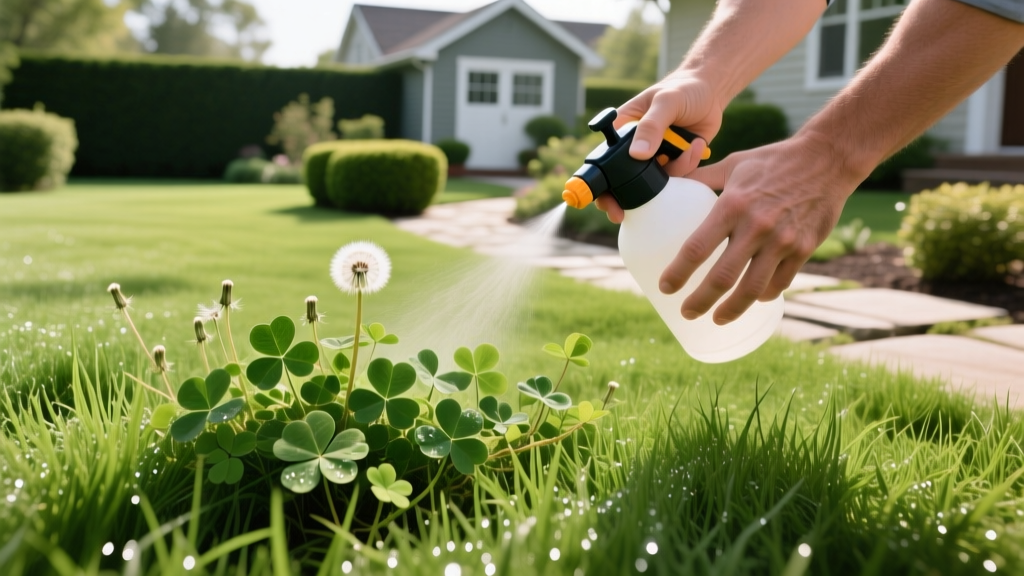
Spot-Treating Clovers and Weeds: A Targeted Lawn Care Guide
The Strategic Advantage of Spot-Treating Clovers and Weeds
Broadcast spraying an entire lawn to eliminate a few patches of clover is an outdated, expensive, and ecologically damaging practice. When dealing with clovers and weeds, spot-treatment targets the specific infestation while preserving the soil microbiome and beneficial insects in the surrounding turf. According to the University of California Integrated Pest Management (IPM) program, localized treatment reduces chemical runoff by up to 85% compared to blanket applications, while saving homeowners roughly $40 to $60 per season in concentrated herbicide costs.
Spot-treating requires a precise understanding of weed biology, selective chemistry, and application mechanics. This guide provides exact formulations, mixing ratios, and environmental thresholds to eradicate clover without causing phytotoxicity (chemical burn) to your desirable cool- or warm-season grass.
Why Clovers Invade: The Nitrogen Indicator
Clover (Trifolium species) is a legume. Unlike standard broadleaf weeds, clovers possess a symbiotic relationship with Rhizobium bacteria in their root nodules, allowing them to fix atmospheric nitrogen into the soil. If clovers and weeds are dominating your lawn, it is a primary biological indicator that your soil's available nitrogen levels have dropped below the 2 lbs per 1,000 square feet threshold required to sustain dense turfgrass.
Diagnostic Tip: Before reaching for herbicides, test your soil. If a clover patch is thriving while the surrounding grass is pale green and thinning, a nitrogen deficiency is the root cause. Killing the clover without addressing the soil fertility will only result in a new flush of weeds occupying the bare voids left behind.
Clover Species Identification Matrix
Accurate identification dictates your chemical selection. White clover responds differently to certain active ingredients than red or hop clover. Use this matrix to identify your specific invader.
| Species | Leaflet Structure | Flower / Growth Habit | Optimal Active Ingredient |
|---|---|---|---|
| White Clover (T. repens) | Three leaflets with white 'V' chevron marks | White/pink spherical flowers; creeping stolons | Triclopyr + 2,4-D + Dicamba |
| Red Clover (T. pratense) | Larger, hairy leaflets with pale green V-marks | Magenta/red flowers; upright taproot growth | 2,4-D + MCPP |
| Hop Clover (T. campestre) | Small, asymmetrical leaflets; center leaflet stalked | Small yellow flowers resembling hops | Quinclorac + Dicamba |
Chemical Spot-Treatment Protocols
To effectively spot-treat clovers and weeds, you must use a selective post-emergent broadleaf herbicide. Selective herbicides target the unique growth hormones (auxins) in broadleaf plants, causing them to grow uncontrollably and collapse, while leaving monocot grasses unharmed.
Formulation Selection and Pricing
For residential spot-treating, avoid single-ingredient concentrates. You need a three-way or four-way herbicide blend to prevent clover resistance and ensure complete root kill.
- Ortho WeedClear Lawn Weed Killer (Model #9992110): Contains 2,4-D, Quinclorac, and Dicamba. Pricing: $18–$22 per gallon (ready-to-use) or $25 for a 32oz concentrate. Highly effective on white clover.
- Bayer BioAdvanced All-In-One Lawn Weed and Crabgrass Killer: Contains 2,4-D, Quinclorac, and Dicamba. Pricing: $20–$26 per 32oz hose-end sprayer. Better for larger perimeter spot-treatments.
- Fertilome Weed Free Zone (Triclopyr + 2,4-D + MCPP + Dicamba): The professional-grade standard for stubborn red clover and hop clover. Pricing: $35–$45 per half-gallon.
The Mixing and Application Framework
When mixing concentrates for a 1-gallon pump sprayer to target specific clover patches, follow this exact protocol:
- Base Rate: Mix 2.0 fluid ounces of three-way herbicide concentrate per 1 gallon of water. This covers approximately 500 square feet of spot-treatment area.
- Add a Surfactant: Clover leaves possess a waxy cuticle that repels water-based sprays. Add 1 teaspoon (0.16 fl oz) of a Non-Ionic Surfactant (NIS) or a few drops of liquid dish soap to the tank. This breaks the surface tension, allowing the herbicide to spread and adhere to the clover leaflets.
- Nozzle Selection: Use a flat-fan nozzle (e.g., TeeJet 8002VS) rather than a cone nozzle. Flat-fan nozzles produce medium droplets that minimize drift onto desirable grass and ensure even coverage on the broadleaf target.
- Spray Technique: Spray until the clover leaves are uniformly wet, but not dripping. Dripping wastes chemical and increases the risk of soil-level root absorption, which can harm shallow-rooted turfgrasses like Kentucky Bluegrass.
Warning: Temperature and Volatility Limits
Never spot-treat clovers and weeds when ambient temperatures exceed 85°F (29°C). At high temperatures, ester-based herbicides vaporize and drift, causing severe twisting and cupping damage to nearby trees, shrubs, and desirable turf. Apply strictly between 65°F and 80°F during early morning or late evening hours.
Never spot-treat clovers and weeds when ambient temperatures exceed 85°F (29°C). At high temperatures, ester-based herbicides vaporize and drift, causing severe twisting and cupping damage to nearby trees, shrubs, and desirable turf. Apply strictly between 65°F and 80°F during early morning or late evening hours.
Organic and Non-Selective Spot Alternatives
If you prefer to avoid synthetic auxin herbicides, two organic spot-treatment methods are highly effective against clover, though they require different application strategies.
Iron HEDTA (FeHEDTA) Formulations
Chelated iron (FeHEDTA) is a naturally occurring compound that causes acute oxidative stress in broadleaf weeds. Because grasses naturally store iron and metabolize it differently, they may temporarily darken but will recover, while clovers desiccate and die within 48 to 72 hours.
- Top Product: Natria Lawn Weed Control or Fiesta Turf Weeder.
- Cost: $24–$30 per quart of concentrate.
- Application Note: FeHEDTA degrades rapidly in UV light. Apply in the late afternoon or on overcast days. Two applications spaced 14 days apart are usually required to exhaust the clover's root reserves.
Horticultural Vinegar (20% Acetic Acid)
Kitchen vinegar (5% acetic acid) is useless against established clover. You must use 20% to 30% horticultural vinegar. Note: This is a non-selective contact burn. It will kill the clover, but it will also burn any grass it touches.
- Application Method: Do not spray. Use a sponge-tipped weed wand or a paintbrush to physically wipe the vinegar directly onto the clover leaflets.
- Safety: 20% acetic acid causes severe eye and skin burns. Wear splash goggles and heavy nitrile gloves during application.
Post-Treatment Recovery and Void Management
Eradicating the weed is only half the battle. According to NC State Extension, the voids left by dead clover stolons will rapidly be colonized by crabgrass or spurge if left bare.
The 21-Day Recovery Timeline:
- Days 1-2: Do not mow. Allow the herbicide 48 hours to translocate from the clover leaves down to the root crown.
- Day 7: Clover will begin to yellow and curl. Mow the lawn at your standard height, bagging the clippings to remove the decaying weed biomass and prevent thatch buildup.
- Day 14: Apply a localized, fast-acting nitrogen fertilizer (e.g., 20-0-0 urea) at a rate of 0.5 lbs of nitrogen per 1,000 sq ft exclusively to the treated patches to stimulate surrounding grass tillering.
- Day 21-28: If bare spots remain larger than 4 inches in diameter, loosen the top 1/2 inch of soil with a hand rake and drop a pinch of matching turfgrass seed into the void. Most selective post-emergents require a 3-to-4-week waiting period before overseeding; check your specific product label.
Frequently Asked Questions
Will pulling clovers by hand work better than spot-treating?
Hand-pulling is only effective for isolated, newly sprouted clover plants. Mature white clover develops extensive, deeply rooted horizontal stolons. Pulling usually snaps the stolon, leaving root nodes in the soil that will aggressively resprout within 10 to 14 days. Chemical spot-treatment ensures the systemic active ingredient reaches and destroys the entire root network.
Can I mix clover herbicide with liquid lawn fertilizer?
While tank-mixing is common in commercial agriculture, residential spot-treatments should avoid mixing herbicides with high-nitrogen liquid fertilizers. The salts in the fertilizer can alter the pH of the spray solution, causing the herbicide to precipitate out of suspension or bind to the fertilizer molecules, drastically reducing its efficacy against the clover.
How long does it take for clovers and weeds to die after spraying?
With a three-way selective herbicide (2,4-D, Dicamba, MCPP) applied with a surfactant at optimal temperatures (70°F–80°F), you will see visible leaf curling and twisting within 48 hours. Complete desiccation and root death typically take 14 to 21 days. Patience is critical; applying a second dose before the 14-day mark will result in chemical antagonism and a failed treatment.

