
Lawn Care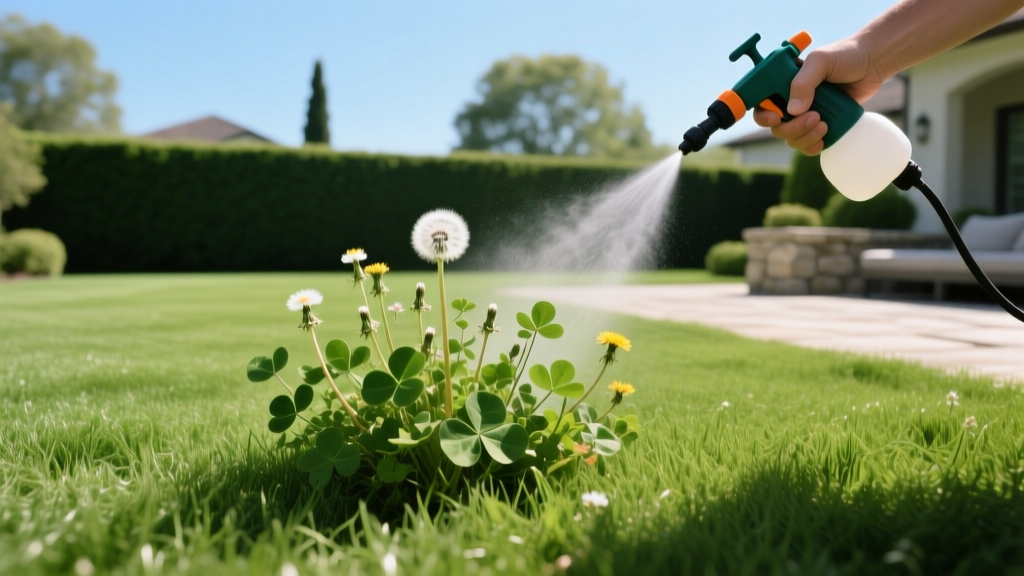
How to Spot-Treat Flower Weeds Without Killing Your Grass
The Biology of Flower Weeds: Why They Bloom and Spread
Flower weeds, scientifically categorized as broadleaf weeds, are dicotyledonous plants that disrupt the uniformity of turfgrass. Unlike grassy weeds (which are monocots), flower weeds possess a different vascular structure, wider leaves, and, most notably, vibrant blooms. From a lawn care perspective, the presence of flowers is a critical biological indicator: it means the plant has transitioned from its vegetative growth phase to its reproductive phase. During this shift, the plant redirects energy and systemic fluids upward toward the seed heads rather than downward into the taproot.
⚠ Timing Warning: Spot-treating flower weeds while they are in full bloom reduces the efficacy of systemic herbicides. Because the plant's internal translocation is moving fluids upward to support the flowers, the chemical may not reach the deep taproot, leading to rapid top-kill but inevitable regrowth. For optimal results, physically mow off the flower heads 48 hours before applying your spot treatment to force the plant to redirect energy back to its root system.
Understanding this biological clock is the foundation of effective weed species spot-treatment. By targeting the weeds during their active vegetative growth—typically when daytime temperatures are consistently between 60°F and 80°F—you ensure the active ingredients are pulled deep into the root zone, eradicated the plant entirely.
Identification Matrix: 5 Common Flower Weeds in Turf
Accurate identification dictates your chemical selection. Some flower weeds have waxy cuticles that repel water-based herbicides, while others have fibrous root systems that require different active ingredients than deep-taprooted species. According to Texas A&M AgriLife Extension, misidentifying broadleaf species is the leading cause of treatment failure among homeowners.
| Common Name | Flower Characteristics | Leaf Structure | Root System | Optimal Herbicide |
|---|---|---|---|---|
| Dandelion | Bright yellow, turning to white puffballs | Deeply lobed, basal rosette | Deep, brittle taproot | 2,4-D + Dicamba |
| White Clover | White to pale pink spherical clusters | Trifoliate with light green 'V' mark | Shallow, creeping stolons | Triclopyr + MCPP |
| Creeping Charlie | Small, funnel-shaped, purplish-blue | Scalloped edges, minty scent when crushed | Aggressive rhizomes and stolons | Triclopyr (high rate) |
| Common Chickweed | Tiny, star-like white flowers | Small, oval, smooth, opposite pairs | Shallow, fibrous | Carfentrazone-ethyl |
| Wild Violet | Purple/white, 5-petal, pansy-like | Heart-shaped, waxy cuticle | Fleshy rhizomes | Quinclorac + Surfactant |
Spot-Treatment Protocols: Chemical vs. Organic
When treating isolated patches of flower weeds, broadcasting chemicals across the entire lawn is ecologically wasteful and economically inefficient. Spot-treating allows you to use higher concentrations of specialized active ingredients on the weeds while minimizing soil impact. Always consult the Environmental Protection Agency (EPA) guidelines for safe handling and application of pest control products.
Selective Post-Emergent Herbicides (The Chemical Route)
Selective herbicides exploit the physiological differences between monocots (your grass) and dicots (the flower weeds). The industry standard for stubborn broadleaf weeds is a 'three-way' or 'four-way' ester or amine formulation.
- SpeedZone (Carfentrazone-ethyl + 2,4-D + MCPP + Dicamba): This is a premium professional-grade concentrate. Carfentrazone provides a rapid 'burn-down' effect within 24 hours, while the other three ingredients translocate to kill the root. Cost: ~$48 per pint. Mix Rate: 1.5 fl oz per gallon of water for cool-season grasses; 1.0 fl oz for warm-season grasses.
- Ortho WeedClear Lawn Weed Killer (Ready-to-Use): Ideal for small, isolated patches. Contains 2,4-D choline salt, which has lower volatility than older ester formulations, reducing the risk of vapor drift damaging nearby ornamental shrubs. Cost: ~$14 per 1-gallon jug.
Organic and Non-Selective Spot Treatments
For homeowners managing lawns near sensitive water tables, vegetable gardens, or pets, organic spot-treatments offer a viable alternative, though they require stricter application precision.
- Iron HEDTA (FeHEDTA): Sold under brand names like Fiesta or Natria Lawn Weed Control. Chelated iron is absorbed rapidly by broadleaf weeds, causing severe oxidative stress and cellular necrosis (the weed turns black and dies in 3 to 4 days). Grasses metabolize the iron safely. Cost: ~$30 per 32 oz bottle. Drawback: It is a contact herbicide; it does not translocate well to deep taproots, meaning dandelions may require a second application 14 days later.
- Horticultural Vinegar (20% to 30% Acetic Acid): This is a non-selective burn-down agent. It will kill flower weeds instantly, but it will also severely burn any turfgrass it touches. Use only for weeds growing in sidewalk cracks or use a physical spray shield over the lawn.
Step-by-Step Precision Application Technique
Drift is the enemy of spot-treatment. Wind or improper nozzle selection can carry selective herbicides onto desirable broadleaf plants or cause localized turf phytotoxicity.
- Check Environmental Conditions: Apply only when wind speeds are below 5 mph and temperatures are between 60°F and 85°F. Above 85°F, ester-based herbicides can vaporize and drift invisibly, damaging nearby garden beds.
- Calibrate the Nozzle: Swap the standard cone nozzle on your pump sprayer for a flat-fan nozzle (e.g., TeeJet 8002). This produces larger, heavier droplets that resist wind drift and penetrate the dense canopy of the flower weed.
- Add a Non-Ionic Surfactant: Flower weeds like Wild Violet and Chickweed have waxy leaf cuticles that cause water to bead up and roll off. Add 0.25% v/v of a non-ionic surfactant (like Dyne-Amic) to break the surface tension. This equates to roughly 1/2 teaspoon per gallon of mixed solution.
- Use a Spray Shield or Foam Brush: For highly isolated weeds surrounded by sensitive plants, attach a plastic bell-shaped spray shield to your wand. Alternatively, for ultra-precision, dip a sponge-tipped weed applicator brush directly into the concentrated solution and wipe it onto the weed's leaves.
- Mark and Wait: Flag the treated area. Do not mow for 48 hours post-application to allow maximum foliar absorption. Do not irrigate for 24 hours.
Post-Treatment Recovery and Prevention
Spot-treating flower weeds leaves voids in your turf canopy. If these bare spots are not addressed, new weed seeds will germinate in the exposed soil. According to Purdue University Turf Science, maintaining a dense turf canopy is the most effective long-term pre-emergent strategy available.
Once the flower weed has turned brown and died (usually 10 to 14 days post-treatment), use a hand rake to vigorously scratch the bare soil. Overseed the void with a matching turfgrass cultivar at a rate of 2 to 3 pounds of seed per 1,000 square feet. Top-dress lightly with compost and keep the specific spot moist until germination occurs. To prevent the next generation of flower weeds from germinating, apply a pre-emergent herbicide like Prodiamine when soil temperatures at a 2-inch depth consistently reach 55°F in the spring, or use a post-emergent pre-emergent combo product in the fall.
Frequently Asked Questions
Can I just pull flower weeds by hand instead of spraying?
Hand-pulling is effective for shallow-rooted weeds like chickweed. However, for tap-rooted flower weeds like dandelions, the taproot often snaps off an inch below the soil surface. The remaining root tissue contains enough stored carbohydrates to regenerate a new plant within three weeks. If you pull, use a specialized weeding tool like the Fiskars Uproot Weeder to extract the entire taproot.
Why did the flower weed turn yellow but not die after treatment?
This usually indicates a sub-lethal dose or poor translocation. If you sprayed during a drought, the weed's stomata (pores) were closed to conserve water, preventing the herbicide from entering the leaf tissue. Always water your lawn deeply 24 hours before applying spot treatments to ensure the weeds are actively growing and absorbing the chemical.
Is it safe to spot-treat flower weeds near my vegetable garden?
Selective herbicides containing 2,4-D or Dicamba can cause severe deformity to tomatoes, peppers, and grapes if vapor drift occurs. If your flower weeds are within 10 feet of a vegetable garden, avoid volatile ester formulations. Instead, use an amine-based herbicide, apply it on a cool, still morning, or rely exclusively on physical extraction or shielded Iron HEDTA applications.

