
Lawn Care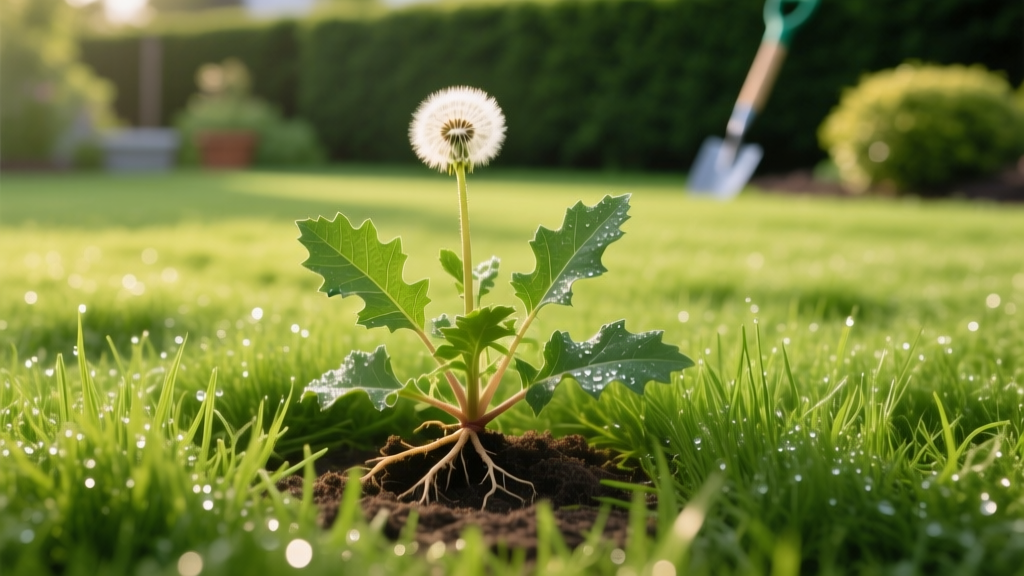
Spot-Treatment Guide for Fully Grown Weeds in Lawns
Treating a few stray weed seedlings is a straightforward task, but managing fully grown weeds requires a completely different physiological approach. When weeds reach maturity, they develop extensive root architectures, woody stems, and thick protective leaf cuticles that easily repel standard ready-to-use (RTU) herbicide sprays. Spot-treating these established invaders without damaging the surrounding desirable turf demands precise chemistry, correct surfactant selection, and targeted application techniques.
The Science of Mature Weed Resistance
As weeds mature, their leaves develop a dense layer of epicuticular wax. This waxy cuticle serves as an evolutionary defense mechanism to prevent moisture loss, but it also causes water-based herbicide droplets to bead up and roll off onto the soil. Furthermore, mature weeds like dandelions (Taraxacum officinale) and broadleaf plantain (Plantago major) develop massive taproots that can extend several feet into the soil profile. If a contact herbicide only burns the top growth, the mature root system will simply push out new shoots within 10 to 14 days.
⚠️ The Volatility Warning: When spot-treating grown weeds with products containing Dicamba or 2,4-D, never apply when ambient temperatures exceed 85°F. At high temperatures, these active ingredients vaporize and drift, causing severe curling and stunting to nearby desirable broadleaf plants, shrubs, and neighboring gardens.
Active Ingredient Matrix for Grown Weeds
Selecting the correct active ingredient is critical. Mature broadleaf weeds require multi-ester formulations for rapid penetration, while mature grassy weeds require highly specific selective graminicides or careful non-selective wicking. Below is a decision matrix for professional-grade and high-quality consumer concentrates.
| Target Weed Type | Recommended Active Ingredients | Product Example & Est. Cost |
|---|---|---|
| Mature Broadleaf (Dandelion, Thistle, Plantain) | Triclopyr + 2,4-D + Dicamba + Carfentrazone | PBI Gordon SpeedZone (~$65 / gallon) |
| Mature Grassy (Quackgrass, Nimblewill, Dallisgrass) | Fluazifop-P-butyl (Selective) or Glyphosate (Wicking) | Ortho Grass B Gon (~$25 / quart) |
| Mature Sedge (Purple Nutsedge, Yellow Nutsedge) | Sulfentrazone + Imazaquin | Image Kills Nutsedge RTU (~$15 / 32oz) |
| Mature Vining (Bindweed, Ground Ivy) | Triclopyr (Ester formulation) | Ortho Poison Ivy & Brush Killer (~$20 / 32oz) |
According to turfgrass research published by the Purdue University Turfgrass Program, ester-based formulations of Triclopyr and 2,4-D penetrate the waxy cuticles of mature broadleaf weeds significantly faster than amine-based formulations, especially in cooler spring or fall temperatures.
Advanced Application Techniques for Established Roots
Broadcast spraying a mature weed patch often results in herbicide waste and unnecessary chemical exposure to the surrounding turf. For precise eradication of grown weeds, utilize targeted physical application methods.
The "Glove-Over-Glove" Wicking Method
When dealing with mature grassy weeds like quackgrass or nimblewill growing inside a desirable cool-season lawn, selective herbicides are often ineffective. The glove-over-glove method allows you to apply a non-selective herbicide (like a 2% Glyphosate solution) directly to the weed without touching the surrounding turf.
- Base Layer: Put on a snug, chemical-resistant nitrile glove on your dominant hand.
- Wicking Layer: Pull a 100% cotton work glove directly over the nitrile glove.
- Preparation: Mix a 2% solution of Glyphosate or Fluazifop in a small cup.
- Application: Dip the cotton fingertips into the solution until they are damp, but not dripping.
- Execution: Pinch the base of the grown weed and slide your fingers upward to the tip, coating the foliage evenly. The nitrile glove protects your skin, while the cotton glove acts as a controlled wick.
Surfactant Selection: MSO vs. NIS
Never spray a mature weed with herbicide alone. You must include a surfactant to break the surface tension of the water and dissolve the leaf wax. While Non-Ionic Surfactants (NIS) are sufficient for young seedlings, fully grown weeds require a Methylated Seed Oil (MSO). MSO actively strips the epicuticular wax layer, forcing the stoma open and driving the active ingredient into the plant's phloem. Mix MSO at a rate of 1 ounce per gallon of spray solution. A 2.5-gallon jug of high-quality MSO costs approximately $35 and will last a homeowner several seasons.
The Translocation Rule: Avoid the Mowing Mistake
The most common failure mode in spot-treating grown weeds is improper mowing timing. Systemic herbicides rely on the plant's natural translocation process—moving sugars from the leaves (the "source") down to the roots (the "sink").
💡 The 48-Hour Protocol: Do not mow your lawn for 48 hours before application, and do not mow for 48 hours after application. Mowing right before spraying removes the leaf surface area required to absorb the chemical. Mowing immediately after spraying cuts off the treated foliage before the herbicide has time to translocate down to the deep taproot.
The University of California Statewide IPM Program emphasizes that mature perennial weeds store massive amounts of energy in their root systems. If the herbicide does not reach the deepest root tips, the weed will simply regenerate from the crown. Expect a 14 to 21-day waiting period for mature weeds to fully yellow and collapse; do not reapply prematurely.
Post-Eradication Soil and Turf Recovery
Once the grown weed has completely necrotized and the roots are dead, the physical removal process begins. Do not yank dead dandelions or plantains out by hand immediately; wait until the foliage turns entirely brown. This visual cue confirms that the systemic herbicide has completed its journey to the root tip.
After removing the dead weed, you will be left with a bare soil crater. To prevent new weed seeds from colonizing this open space, immediately fill the void with a 50/50 mix of screened topsoil and compost. Drop 3 to 4 grass seeds into the center of the divot, lightly tamp the soil down with your heel, and keep the spot consistently moist for 10 days. By rapidly re-establishing desirable turf in the exact footprint of the eradicated weed, you close the canopy and eliminate the sunlight required for the next generation of weed seeds to germinate.

