
Lawn Care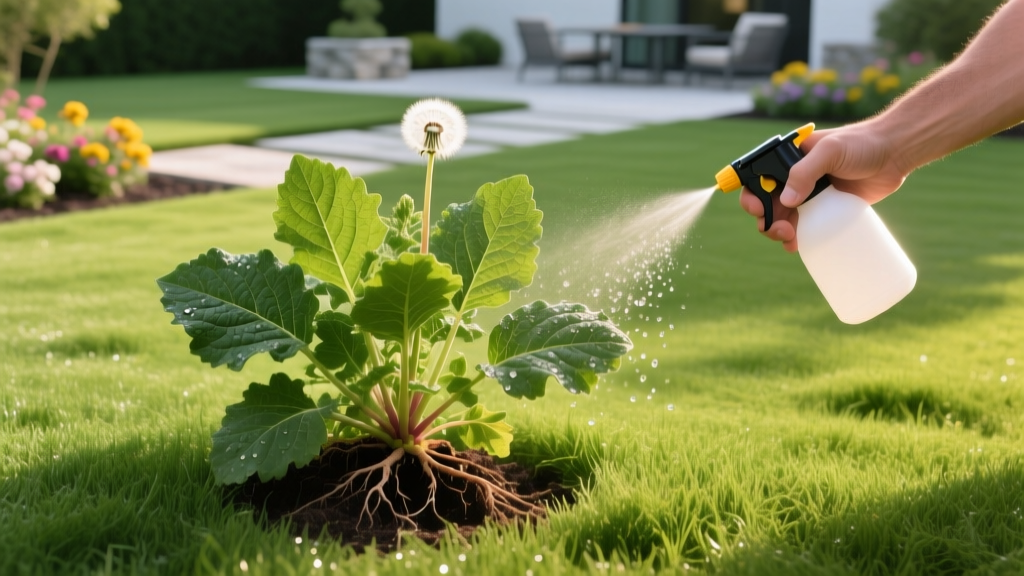
Spot-Treatment Guide: Identifying and Killing a Weed With Large Leaves
The Broadleaf Problem: Why Large Leaves Threaten Your Turf
When homeowners search for solutions to a weed large leaves problem, they are almost always dealing with broadleaf perennials. Species like broadleaf plantain, curly dock, and common dandelion develop expansive foliar canopies that actively shade out surrounding turfgrass. This aggressive light-blocking stunts grass growth, leading to thinning lawns that invite further weed invasion and soil erosion.
Broadcast spraying an entire lawn to kill a few dozen large-leafed weeds is an inefficient use of chemicals and money. Spot-treatment targets the specific weed, preserves beneficial soil biology, and costs pennies per application when using professional-grade liquid concentrates. According to NC State TurfFiles, precise spot-treatment combined with proper cultural practices is the most sustainable method for managing broadleaf weeds in residential turf.
The Usual Suspects: Identifying Weeds With Large Leaves
Before mixing any herbicide, you must accurately identify the weed. Misidentification leads to selecting the wrong active ingredient, resulting in a burned lawn or a surviving weed. Below is a diagnostic matrix for the most common large-leafed turf invaders.
| Weed Species | Leaf Characteristics | Root Structure | Optimal Active Ingredients |
|---|---|---|---|
| Broadleaf Plantain | Oval, 3-7 inches long, prominent parallel veins | Fibrous, shallow taproot | 2,4-D + Dicamba + MCPP |
| Curly Dock | Large, wavy margins, reddish stems, 6-12 inches | Deep, brittle taproot | Triclopyr + 2,4-D |
| Common Dandelion | Deeply lobed rosette, 2-8 inches, jagged edges | Thick, fleshy taproot | Carfentrazone + 2,4-D |
| Wild Violet | Heart-shaped, 1-3 inches, scalloped margins | Rhizomes and fibrous roots | Triclopyr + Dicamba |
Pro Identification Tip: Crush a leaf between your fingers. Curly dock emits a slightly sour smell, while wild violet has a distinct, sweet floral scent. Plantain leaves will snap cleanly, revealing stringy, celery-like vascular bundles.
The Spot-Treatment Decision Framework
Not all herbicides are safe for all grasses. Applying a standard 2,4-D blend to St. Augustinegrass will cause severe phytotoxicity (leaf curling and yellowing). Use this framework to select your concentrate:
For Cool-Season Grasses (Fescue, Kentucky Bluegrass, Ryegrass)
- Top Pick: SpeedZone Lawn Weed Killer Concentrate or Trimec 992.
- Active Ingredients: 2,4-D, MCPP, Dicamba, and Carfentrazone-ethyl.
- Cost: $45–$60 per 20 oz bottle (covers up to 14,000 sq ft for broadcast, but lasts years for spot-treating).
For Warm-Season Grasses (Bermudagrass, Zoysia, Centipede)
- Top Pick: SpeedZone Southern or Celsius WG.
- Active Ingredients: 2,4-D ester (lower concentration), MCPP, Dicamba (SpeedZone Southern) or Thiencarbazone, Iodosulfuron, Dicamba (Celsius).
- Cost: $50–$75 per container.
For St. Augustinegrass & Centipedegrass (Sensitive Turfs)
- Top Pick: Atrazine-based products (e.g., Hi-Yield Atrazine) or Penoxsulam (e.g., Southern Ag Lawn Weed Killer).
- Warning: Avoid 2,4-D entirely during hot summer months on St. Augustine. Apply Atrazine only when temperatures are below 85°F.
Step-by-Step Spot-Treatment Protocol
Follow this exact procedure to ensure the herbicide penetrates the waxy cuticle of large leaves and translocates down to the taproot.
- Prep the Turf (24 Hours Prior): Mow your lawn and hold off on watering. You want the weed actively growing and slightly thirsty, which forces it to pull liquids (and the herbicide) down into its root system rapidly.
- Mix the Solution: In a 1-gallon or 2-gallon pump sprayer, add water first, then the herbicide.
- Standard Mix Rate: 1.5 fl oz of concentrate per 1 gallon of water (treats roughly 1,000 sq ft).
- Surfactant: Add 0.5 teaspoons of a non-ionic surfactant (like Dyne-Amic or Alligator) per gallon. Large-leafed weeds like plantain and dock have heavy waxy cuticles; without a surfactant, the herbicide will bead up and roll off onto the soil.
- Calibrate the Nozzle: Adjust your pump sprayer nozzle to a pin-stream or tight flat-fan pattern. Avoid cone/mist patterns, which cause herbicide drift onto desirable grass and ornamental beds.
- Apply to the Foliage: Spray the large leaves until they are visibly wet, but not dripping. Ensure you coat the center 'crown' of the weed where the new growth emerges.
- The 48-Hour Rule: Do not water, irrigate, or mow the lawn for at least 48 hours. The University of Minnesota Extension notes that systemic broadleaf herbicides require 24 to 48 hours to fully translocate from the large leaves down to the deepest root tips.
Temperature Warning: Never apply 2,4-D or Dicamba products when ambient temperatures exceed 85°F. High heat causes these chemicals to volatilize (turn into a gas), which will drift and severely damage nearby trees, shrubs, and vegetable gardens.
Post-Treatment Lawn Recovery and Overseeding
Once the large-leafed weed curls, yellows, and dies (usually within 10 to 14 days), it leaves a bare spot in your turf. If left alone, crabgrass or nutgrass will fill that void.
Overseeding Timelines Based on Herbicide
| Herbicide Used | Safe to Overseed After | Notes |
|---|---|---|
| SpeedZone / Trimec (2,4-D blends) | 3 to 4 weeks | Soil residual prevents grass seed germination. |
| Celsius WG | 1 to 2 months | Depends on application rate; check label for specific seed types. |
| Tenacity (Mesotrione) | Immediately | Acts as a pre-emergent for weeds but is safe for most grass seed at seeding. |
Recovery Action Plan: Rake out the dead weed debris to expose the soil. Apply a starter fertilizer (e.g., 18-24-12) at a rate of 4 lbs per 1,000 sq ft. Drop a handful of grass seed that matches your existing turf, lightly top-dress with peat moss, and water twice daily for 10 minutes until germination occurs.
Common Mistakes That Cause Large-Leaf Weeds to Return
- Skipping the Surfactant: Plantain and dock leaves are highly hydrophobic. If your spray beads up, the active ingredient never enters the plant's vascular system.
- Mowing Too Soon: Cutting off the sprayed leaves before the herbicide reaches the taproot simply removes the chemical. The weed will push out new, smaller leaves from the surviving root crown within a week.
- Ignoring Soil Compaction: Broadleaf plantain thrives in heavily compacted soils where grass roots suffocate. If plantain returns repeatedly in the same area, schedule a core aeration service to relieve soil bulk density.
- Using 'Weed and Feed' Granules: Granular broadleaf killers require the weed leaves to be wet with morning dew for the granules to stick. This is highly unreliable for spot-treating large, established perennials. Liquid concentrates are vastly superior for these species.
Frequently Asked Questions
Can I pull a weed with large leaves by hand instead of spraying?
You can, but hand-pulling is rarely 100% effective for deep taproot species like curly dock or dandelion. If even a half-inch of the taproot snaps off in the soil, the weed will regenerate. Spot-spraying with a systemic liquid herbicide ensures the chemical travels to the very tip of the root, killing it entirely.
Will vinegar kill weeds with large leaves?
Horticultural vinegar (20% to 30% acetic acid) will burn the large leaves to a crisp within hours, but it is a contact-only herbicide. It does not translocate to the roots. The weed will simply resprout from the surviving taproot two weeks later, making it an ineffective long-term solution for perennial broadleaf weeds.
How much does professional spot-treatment cost compared to DIY?
A professional lawn care company typically charges $50 to $85 per application for a standard residential lot, which includes broadcast spraying. By purchasing a $50 bottle of professional concentrate and a $25 pump sprayer, your DIY spot-treatment cost drops to roughly $0.05 per weed, paying for itself after the first use.

