
Lawn Care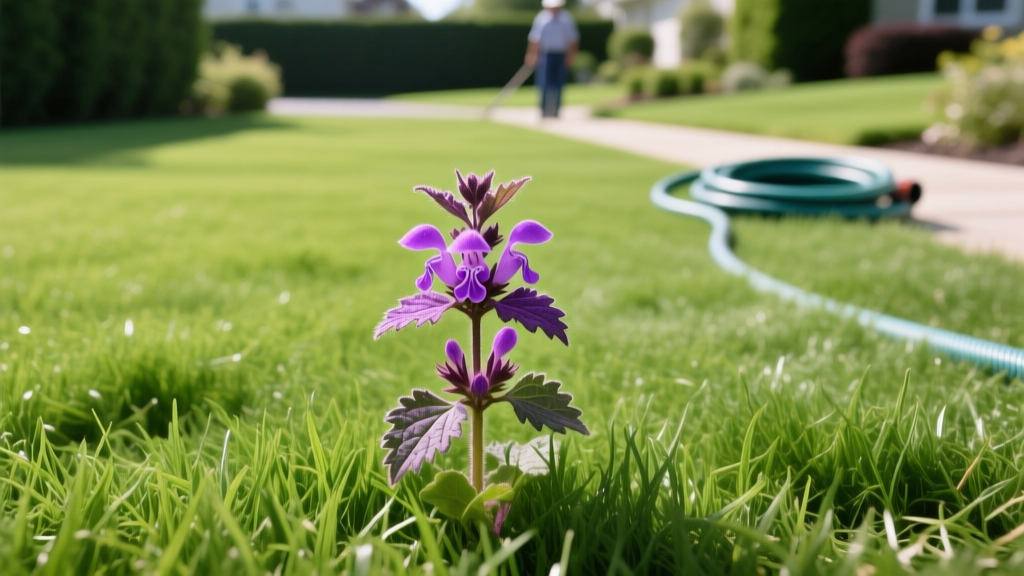
How to Identify and Treat Weeds With Purple Flowers in Lawns
Purple flowers blooming in your turf might look picturesque for a few weeks in spring, but they signal a critical failure in your lawn's density and soil health. When homeowners search for solutions to weeds with purple flowers in lawns, they are usually dealing with one of four aggressive invaders: Creeping Charlie, Wild Violet, Henbit, or Purple Deadnettle. Each species requires a radically different spot-treatment protocol based on its root structure, leaf cuticle, and life cycle.
Blanket spraying your entire yard is a waste of chemical and money. This guide provides exact identification markers, specific herbicide formulations, and precise application timing to eradicate purple-flowered weeds and restore your turf.
The Big Four: Identifying Purple-Flowered Lawn Invaders
Accurate identification is the prerequisite for effective chemical control. Misidentifying a winter annual as a perennial will lead to wasted herbicide and rapid regrowth. Use the matrix below to diagnose your specific infestation.
| Weed Species | Leaf Shape & Characteristics | Growth Habit | Root System | Life Cycle |
|---|---|---|---|---|
| Creeping Charlie (Glechoma hederacea) |
Scalloped, round leaves; emits a strong minty odor when crushed. | Spreads rapidly via above-ground stolons (runners) that root at nodes. | Fibrous roots at nodes; no deep taproot. | Perennial |
| Wild Violet (Viola sororia) |
Heart-shaped leaves with a distinct waxy, water-repellent cuticle. | Forms dense, low-growing clumps that choke out surrounding grass. | Deep, fleshy taproot and underground rhizomes. | Perennial |
| Henbit (Lamium amplexicaule) |
Rounded leaves that clasp directly around the square stem (no petiole). | Upright, branching stems; often forms large mats in thin turf. | Shallow, fibrous root system. | Winter Annual |
| Purple Deadnettle (Lamium purpureum) |
Triangular, serrated leaves with a distinct reddish-purple tint at the top. | Upright square stems; lower leaves are green, upper leaves are purple. | Shallow, fibrous root system. | Winter Annual |
Spot-Treatment Protocols for Broadleaf Purple Weeds
Once you have identified the species, select the appropriate eradication method. Perennials (Charlie and Violets) require systemic herbicides that translocate to the roots, while winter annuals (Henbit and Deadnettle) can be managed with contact herbicides or pre-emergents.
Chemical Control: Post-Emergent Herbicides
Standard 2,4-D formulations found in cheap box-store weed killers will burn the leaves of Wild Violets and Creeping Charlie but fail to kill the roots. You need specific active ingredient combinations.
- For Creeping Charlie: Triclopyr is the undisputed king of ground ivy control. Look for products like Ortho WeedClear for Lawns or professional-grade T-Zone SE. Mix at a rate of 1.5 fl oz per gallon of water for spot treatments.
- For Wild Violets: Violets require a three-way or four-way herbicide containing 2,4-D, MCPP, Dicamba, and ideally Carfentrazone (e.g., SpeedZone or Trimec Classic). The waxy leaf cuticle repels water, so you must add a Non-Ionic Surfactant (NIS) at a rate of 0.25% v/v (roughly 1/2 teaspoon per gallon) to break the surface tension and allow the chemical to penetrate.
- For Henbit & Purple Deadnettle: Because these are winter annuals, almost any broadleaf herbicide containing 2,4-D or Triclopyr will kill them rapidly. However, if they are already flowering in late spring, they are preparing to drop seed. Apply a pre-emergent like Dimension (dithiopyr) in early September to stop the next generation.
⚠️ Herbicide Warning: Never apply Triclopyr or Dicamba when daytime temperatures exceed 85°F. Volatilization will cause the chemical to vaporize and drift, severely damaging nearby ornamental shrubs, tomato plants, and desirable broadleaf trees.
Organic and Non-Chemical Eradication
If you maintain an organic lawn or have pets that frequent the turf immediately after application, chelated iron (FeHEDTA) is your best option. Products like Fiesta Lawn Weed Killer utilize iron toxicity to cause rapid cellular necrosis in broadleaf weeds while turfgrass safely metabolizes the iron.
The Catch: FeHEDTA is a contact burner, not a systemic killer. You will need to apply it 2 to 3 times, spaced exactly 21 days apart, to exhaust the root reserves of Wild Violets and Creeping Charlie. Apply at a rate of 3 to 5 fl oz per 1,000 sq ft, and do not mow for 48 hours post-application.
Timing Your Application for Maximum Kill Rate
The single most common reason spot-treatments fail is poor timing. Herbicide efficacy is dictated by the plant's internal carbohydrate movement.
The Fall Advantage (September 15 – October 30)
For perennial weeds like Creeping Charlie and Wild Violets, early fall is the optimal treatment window. As soil temperatures drop below 70°F, these weeds begin pulling carbohydrates (and systemic herbicides) down into their root systems to prepare for winter dormancy. A single application of Triclopyr in late September yields a 90%+ kill rate, whereas the same application in May yields only a 40% kill rate. According to Penn State Extension, fall applications ensure the herbicide reaches the deepest rhizomes before the ground freezes.
The Spring Window (March 1 – April 15)
Spring treatments should be reserved exclusively for winter annuals (Henbit and Purple Deadnettle). Catch them when they are young and actively growing, before they produce purple flowers and set seed. Once Henbit flowers, its cuticle thickens, and herbicide absorption drops by nearly half.
Post-Eradication Lawn Recovery and Cultural Defense
Killing the weed is only 50% of the battle. Weeds with purple flowers are indicator species that exploit specific environmental weaknesses in your turf. If you do not correct the underlying soil conditions, the weeds will return from neighboring properties within 18 months.
Correcting Soil pH for Violet Infestations
Wild Violets thrive in acidic, compacted soils with a pH between 5.0 and 6.0. Most turfgrasses (Kentucky Bluegrass, Fescue, Bermuda) require a pH of 6.5 to 7.0 to access soil nutrients. If your lawn is heavily infested with violets, conduct a soil test. If the pH is below 6.2, apply pelletized dolomitic lime at a rate of 50 lbs per 1,000 sq ft in the late fall. As noted by Michigan State University Extension, raising the soil pH naturally suppresses violet vigor while boosting turfgrass density.
Canopy Management for Creeping Charlie
Creeping Charlie is highly shade-tolerant and exploits thin turf under tree canopies. To prevent regrowth:
- Prune tree limbs up to 10 feet off the ground to allow dappled sunlight to reach the soil.
- Aerate compacted soil using a core aerator to pull 3-inch plugs, improving drainage and oxygen flow to grass roots.
- Overseed bare patches immediately after the weeds die back. Use a shade-tolerant seed mix (like Fine Fescue or a Shade-Tolerant Kentucky Bluegrass blend) at a rate of 4 lbs per 1,000 sq ft. Keep the seed moist for 14 days to ensure germination before Charlie can re-establish.
Frequently Asked Questions
Will vinegar kill wild violets and creeping charlie?
Household vinegar (5% acetic acid) will burn the top growth of purple-flowered weeds, but it cannot penetrate the waxy cuticle of violets or kill the deep rhizomes of Creeping Charlie. It will also severely acidify your soil and harm surrounding grass. Horticultural vinegar (20%+) is non-selective and will kill your lawn alongside the weeds.
How long does it take for SpeedZone to kill purple weeds?
SpeedZone contains carfentrazone, which provides a rapid 'burn-down' effect. You will see visible wilting and browning of purple flowers and leaves within 24 to 48 hours. However, complete root death of perennial species like Wild Violets takes 14 to 21 days. Do not reapply within 14 days of the first application.
Should I pull purple deadnettle by hand?
Because Purple Deadnettle is a winter annual with a shallow, fibrous root system, hand-pulling is highly effective if the infestation is small. Pull them in early March before the purple flowers open. If they have already flowered, bag them immediately in a trash bag; do not compost them, as the seeds can survive standard composting temperatures and reinfect your lawn next year.

