
Lawn Care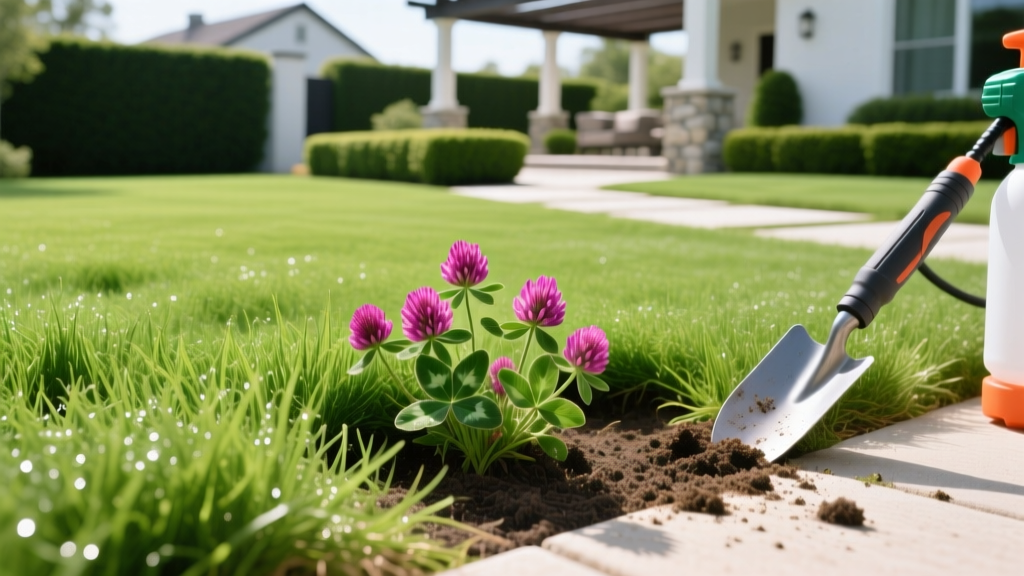
Spot-Treatment Guide: Eradicating Red Clover Species in Lawns
The Challenge of Red Clover in Turfgrass
Red clover (Trifolium pratense) is a perennial legume that frequently infiltrates home lawns, outcompeting desirable turfgrass through aggressive nitrogen fixation and deep taproot systems. Unlike its smaller, smooth-stemmed cousin (white clover), red clover species present unique challenges for spot-treatment due to their pubescent (hairy) foliage, which naturally repels water-based herbicide droplets. Eradicating this weed requires a precise combination of correct botanical identification, targeted chemical selection, and the use of specific adjuvants to ensure foliar absorption.
Botanical Profile: Identifying Red Clover Species
Before mixing any herbicides, accurate identification is critical. Misidentifying red clover as white clover or oxalis often leads to ineffective chemical applications. According to University of Minnesota Turfgrass Science, red clover exhibits several distinct morphological traits that separate it from other common lawn weeds.
Quick Identification Matrix
- Stems: Heavily pubescent (hairy), upright or creeping, often reaching 12 to 24 inches if left unmowed.
- Leaves: Trifoliate (three leaflets) with prominent, V-shaped white or light-green watermarks (chevrons) on the upper surface. Leaflets are larger than white clover, typically 1 to 2 inches long.
- Flowers: Spherical, dense heads ranging from magenta to purplish-red, blooming from late spring through early autumn.
- Root System: A deep, branching taproot that can penetrate 12 to 24 inches into compacted soil, making manual hand-pulling largely ineffective as fragmented roots will readily resprout.
Why Red Clover Invades Your Turf
Red clover is an indicator weed. Its presence signals specific underlying soil deficiencies or physical barriers that are suppressing your turfgrass. Clover species form symbiotic relationships with Rhizobium bacteria in their root nodules, allowing them to fix atmospheric nitrogen. In lawns where soil nitrogen is depleted, red clover thrives while the surrounding grass starves and thins out. Furthermore, red clover is highly tolerant of soil compaction and low-oxygen environments, allowing it to colonize high-traffic areas where Kentucky bluegrass or tall fescue roots fail to penetrate.
Herbicide Selection: Chemistry and Efficacy
Standard broadleaf herbicides relying solely on 2,4-D often fail to control mature red clover species. The waxy cuticle and hairy leaves of the plant require a multi-active-ingredient approach or specific synthetic auxins. Below is a comparison of the most effective active ingredients for spot-treating red clover in 2026.
| Active Ingredient(s) | Efficacy on Red Clover | Speed of Control | Best Commercial Product Example |
|---|---|---|---|
| Triclopyr | Excellent | 7-14 days | Ortho WeedClear Lawn Weed Killer |
| Carfentrazone + 2,4-D + MCPP + Dicamba | Excellent | 24-48 hours (burndown) | PBI/Gordon SpeedZone Lawn Herbicide |
| 2,4-D + Dicamba + MCPP (Standard 3-Way) | Good (requires repeat) | 10-21 days | Trimec Classic Broadleaf Herbicide |
| Quinclorac | Poor | N/A | Drive XLR8 (Not recommended for clover) |
For the fastest visual results and highest kill rate on mature red clover, a formulation containing carfentrazone combined with a 3-way auxin mix (like SpeedZone) is the industry standard. Carfentrazone acts as a rapid PPO-inhibitor, destroying cell membranes and causing the weed to desiccate within 48 hours, while the systemic auxins travel down to the deep taproot to prevent resprouting.
⚠️ Critical Adjuvant Requirement
Because red clover leaves are covered in fine hairs (pubescence), water-based herbicide sprays will bead up and roll off onto the soil, wasting the chemical and risking turf root damage. You must add a Non-Ionic Surfactant (NIS) to your tank mix. Use an NIS at a rate of 0.25% to 0.5% v/v (approximately 1/2 to 1 teaspoon per gallon of mixed solution). This breaks the surface tension, allowing the herbicide to flatten out and penetrate the leaf cuticle.
Step-by-Step Spot-Spraying Execution
Proper application technique is just as important as the chemical itself. Follow this precise protocol to maximize kill rates while protecting your surrounding turfgrass.
- Preparation (Days 1-2): Mow your lawn 2 days before application. This forces the red clover to push out fresh, tender growth, which absorbs systemic herbicides much more rapidly than older, waxy leaves.
- Mixing the Solution: In a 1-gallon or 2-gallon pump sprayer, add half the required water, then the exact herbicide concentrate (e.g., 2.0 fl oz of SpeedZone per gallon of water for cool-season turf), followed by the Non-Ionic Surfactant. Top off with the remaining water and agitate gently to avoid excessive foaming.
- Targeted Application: Adjust your sprayer nozzle to a coarse, low-pressure fan spray or a direct stream. Do not use a fine mist, which increases drift risk. Spray the red clover until the leaves are uniformly wet, but not to the point of runoff. Avoid spraying the surrounding desirable grass unnecessarily.
- Post-Application Wait: Do not water your lawn or allow irrigation to run for at least 24 hours. Wait 2 days before your next mowing to allow the herbicide ample time to translocate down into the taproot.
Warm-Season vs. Cool-Season Turf Safety
Herbicide tolerance varies drastically depending on your grass species. Applying cool-season herbicide rates to warm-season grasses during summer heat will result in severe phytotoxicity (chemical burn) or permanent turf death.
Turfgrass Safety Guide
- Cool-Season Grasses (Kentucky Bluegrass, Tall Fescue, Perennial Ryegrass): Can tolerate full label rates of Triclopyr and 3-way/4-way auxin herbicides. Apply when daytime temperatures are between 65°F and 85°F.
- Warm-Season Grasses (Bermudagrass, Zoysia): Tolerate 2,4-D and Dicamba well, but are highly sensitive to Triclopyr. Use reduced rates of 2,4-D based products and avoid application during peak summer drought stress.
- St. Augustinegrass & Centipedegrass: Highly sensitive to 2,4-D. For spot-treating red clover in these lawns, you must use Atrazine (e.g., Hi-Yield Atrazine Weed Killer) applied during cooler spring or fall months, as Atrazine is one of the few broadleaf herbicides safe for these specific turf species.
Cultural Controls and Post-Eradication Recovery
Chemical spot-treatment removes the existing red clover, but it does not change the soil conditions that allowed the weed to germinate in the first place. According to Penn State Extension, failing to address soil fertility guarantees the weed's return the following spring.
Nitrogen Fertilization
Once the clover has desiccated and died back (usually 14-21 days post-spray), apply a high-quality, slow-release nitrogen fertilizer. Aim for 1.0 to 1.5 lbs of actual nitrogen per 1,000 square feet. A 32-0-10 fertilizer applied at a rate of 3.1 lbs per 1,000 sq ft will deliver exactly 1 lb of nitrogen. This rapid nutrient boost forces the surrounding turfgrass to thicken, shade the soil surface, and choke out any dormant clover seeds.
Alleviating Soil Compaction
If the red clover was concentrated in high-traffic areas (like pathways or play zones), the soil is likely compacted. Schedule core aeration for the early fall (for cool-season grasses) or late spring (for warm-season grasses). Extracting 2-to-3-inch soil plugs increases oxygen flow to the turf roots and disrupts the compacted layers that favor clover taproot penetration.
Frequently Asked Questions
Can I just pull red clover out by hand?
Hand-pulling is generally ineffective for mature red clover. The taproot can extend up to two feet deep into the soil. If the root snaps off below the crown, the remaining root tissue will generate multiple new shoots, resulting in a denser patch of clover than before you started. Chemical spot-treatment is the only reliable way to kill the entire root system.
Is red clover beneficial for my soil?
In agricultural pastures, red clover is highly valued as a cover crop for fixing nitrogen and preventing erosion. However, in a managed home lawn, its aggressive growth habit, tall flowering stalks, and ability to shade out desirable turfgrasses make it a nuisance. The nitrogen it fixes is largely retained in its own tissue and is not readily shared with neighboring grass plants unless the clover is killed and decomposes.
How much does professional spot-treatment cost compared to DIY?
Hiring a professional lawn care service to spot-treat weeds typically costs between $75 and $125 per visit, regardless of how small the weed patches are. Conversely, a 16 oz bottle of professional-grade Triclopyr concentrate costs roughly $35 to $45 and yields enough diluted solution to treat up to 10,000 square feet. This brings the DIY material cost down to approximately $4.50 per 1,000 square feet, making DIY spot-treatment vastly more economical for isolated weed invasions.

