
Lawn Care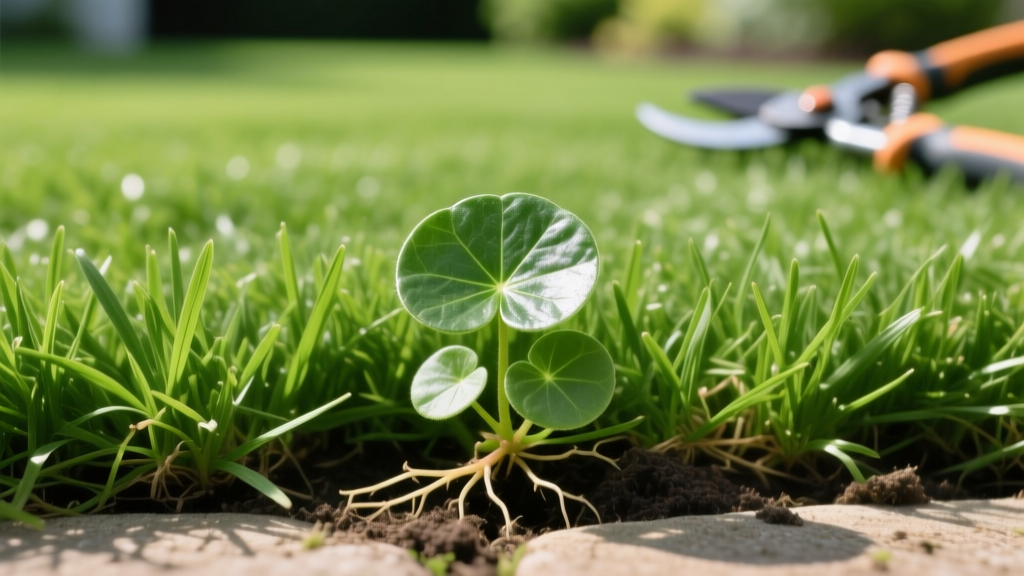
How to Identify and Spot-Treat Round Leaved Weeds
The Problem with Round Leaved Weeds in Turfgrass
Homeowners frequently group all broadleaf weeds together, assuming a single off-the-shelf herbicide will eliminate them. This approach fails spectacularly with round leaved weeds. Species like Creeping Charlie (Ground Ivy), Dollarweed, and Common Mallow share a similar circular leaf profile but possess entirely different reproductive strategies, root structures, and chemical resistances. Applying a standard 2,4-D product to Creeping Charlie, for example, will only burn the top growth while the stolons continue to spread underground.
Successful eradication requires precise identification followed by targeted spot-treatments using specific active ingredients, correct surfactant ratios, and optimal seasonal timing. According to the University of Minnesota Extension, misidentification and improper herbicide selection are the primary reasons homeowners struggle with these specific weeds year after year.
Diagnostic Flowchart: Which Round Leaved Weed is in Your Lawn?
Before purchasing any herbicide, examine the weed's stem attachment and leaf margin. Use this decision tree to identify your specific invader:
- Stem attaches to the center of the leaf (peltate) like an umbrella: You have Dollarweed (Hydrocotyle umbellata). Leaves are perfectly round, glossy, and lack scalloped edges.
- Stem attaches to the edge, leaves have scalloped margins, emits a minty odor when crushed: You have Creeping Charlie (Glechoma hederacea). Also known as Ground Ivy, it forms dense mats in shaded, moist areas.
- Stem attaches to the edge, leaves are deeply lobed (geranium-like) with a velvety texture: You have Common Mallow (Malva neglecta). Often found in compacted soils and neglected lawn edges.
Targeted Spot-Treatment Protocols by Species
1. Creeping Charlie (Ground Ivy)
Creeping Charlie is notoriously difficult to kill because standard 2,4-D herbicides are largely ineffective against it. You must use a product containing Triclopyr. Triclopyr mimics plant growth hormones specifically in a way that disrupts the vascular system of woody and semi-woody broadleaves, translocating down into the creeping stolons.
Recommended Product: Ortho Weed B Gon Chickweed, Clover & Oxalis Killer (Ready-to-Use).
Active Ingredients: 2,4-D, MCPP, Dicamba, and crucially, Triclopyr.
Average Cost: $11.00 - $13.00 per 32 oz spray bottle.
Application Timing: Fall is critical. Apply after the first light frost when the plant is actively pulling nutrients (and the herbicide) down into its root system for winter storage. Spring applications often result in surface burn and rapid regrowth.
Active Ingredients: 2,4-D, MCPP, Dicamba, and crucially, Triclopyr.
Average Cost: $11.00 - $13.00 per 32 oz spray bottle.
Application Timing: Fall is critical. Apply after the first light frost when the plant is actively pulling nutrients (and the herbicide) down into its root system for winter storage. Spring applications often result in surface burn and rapid regrowth.
2. Dollarweed
Dollarweed is an indicator weed. Its presence almost always signals over-irrigation, poor drainage, or compacted soil. While chemical control works, the NC State University TurfFiles database notes that dollarweed will aggressively return unless moisture levels are corrected. Furthermore, dollarweed leaves have a waxy, hydrophobic cuticle that causes liquid herbicides to bead up and roll off.
Recommended Product: Ferti-lome Broadleaf Weed Control with Gallery (Concentrate) or Bayer Advanced Southern Weed Killer.
Active Ingredients: Penoxsulam, 2,4-D, Dicamba.
Average Cost: $18.00 - $24.00 for concentrate (covers up to 8,000 sq ft when mixed).
The Surfactant Rule: You must add a non-ionic surfactant (e.g., Southern Ag Surfactant, ~$15/pint) to your tank mix. Use a ratio of 0.25% v/v (approximately 1 teaspoon per gallon of water). This breaks the water tension, allowing the herbicide to coat the waxy leaf surface and penetrate the cuticle.
Active Ingredients: Penoxsulam, 2,4-D, Dicamba.
Average Cost: $18.00 - $24.00 for concentrate (covers up to 8,000 sq ft when mixed).
The Surfactant Rule: You must add a non-ionic surfactant (e.g., Southern Ag Surfactant, ~$15/pint) to your tank mix. Use a ratio of 0.25% v/v (approximately 1 teaspoon per gallon of water). This breaks the water tension, allowing the herbicide to coat the waxy leaf surface and penetrate the cuticle.
3. Common Mallow
Common Mallow develops a deep, resilient taproot. If you attempt to pull it by hand, the root snaps below the soil line, and the weed regenerates within weeks. Spot-treatment requires a fast-acting burn agent combined with a systemic translocator to ensure the taproot is destroyed.
Recommended Product: Ferti-lome Weed Free Zone (Ready-to-Spray or Concentrate).
Active Ingredients: 2,4-D, MCPP, Dicamba, and Carfentrazone-ethyl.
Average Cost: $16.00 - $19.00 per 32 oz bottle.
Why it works: Carfentrazone provides a rapid cellular membrane disruption (visible burn within 24 hours), while the 2,4-D and MCPP travel systemically down the taproot to prevent regrowth. Apply in spring when the weed is young and the taproot has not yet fully established.
Active Ingredients: 2,4-D, MCPP, Dicamba, and Carfentrazone-ethyl.
Average Cost: $16.00 - $19.00 per 32 oz bottle.
Why it works: Carfentrazone provides a rapid cellular membrane disruption (visible burn within 24 hours), while the 2,4-D and MCPP travel systemically down the taproot to prevent regrowth. Apply in spring when the weed is young and the taproot has not yet fully established.
Herbicide Comparison Matrix
| Weed Species | Key Identifier | Required Active Ingredient | Top Retail Product | Est. Cost (32oz RTU) | Surfactant Needed? |
|---|---|---|---|---|---|
| Creeping Charlie | Scalloped edge, minty smell | Triclopyr | Ortho Weed B Gon Chickweed/Clover | $12.00 | No (unless specified) |
| Dollarweed | Stem in leaf center, waxy | Penoxsulam / 2,4-D | Bayer Advanced Southern Weed Killer | $18.00 | Yes (Mandatory) |
| Common Mallow | Lobed/velvety, deep taproot | Carfentrazone + 2,4-D | Ferti-lome Weed Free Zone | $17.00 | Recommended |
Critical Application Rules and Edge Cases
Even with the correct herbicide, environmental factors and application errors can cause spot-treatments to fail. Adhere to these professional parameters to ensure efficacy and protect your turfgrass:
Temperature and Volatilization Limits
Never apply ester-based formulations of 2,4-D or Triclopyr when daytime temperatures exceed 85°F (29°C). At high temperatures, these chemicals undergo volatilization—they turn into a gas and drift onto nearby desirable broadleaf plants, shrubs, or trees, causing severe twisting and cupping damage. If you must treat in late spring or summer, apply in the early morning when temperatures are below 80°F and the wind is completely calm (under 3 mph).
Mowing and Hydration Schedules
Do not mow your lawn for 48 hours before or 48 hours after spot-treating. The weed needs maximum leaf surface area to absorb the chemical, and the herbicide needs 48 hours to translocate out of the leaf and into the stolons or taproots. Additionally, do not apply herbicides to drought-stressed weeds. If the lawn is dry, water it deeply 24 hours before application. Weeds shut down their vascular systems during droughts to conserve water, which prevents the systemic herbicide from moving to the roots.
"According to Purdue University Turf Extension, the most common failure mode in broadleaf weed control is applying herbicides to weeds that are too large or mature. Spot-treat round leaved weeds when they are young and actively growing for a 90%+ kill rate, rather than waiting until they have established massive root networks."
Frequently Asked Questions
Will horticultural vinegar kill round leaved weeds?
No. Horticultural vinegar (20% to 30% acetic acid) is a non-selective contact burn herbicide. It will destroy the top growth of Creeping Charlie and Mallow within hours, but it does not translocate. The stolons and taproots will survive and push up new growth within 10 to 14 days. Furthermore, high-concentration acetic acid drastically lowers soil pH and can harm surrounding turfgrass roots. Stick to synthetic systemic herbicides for permanent eradication.
Why did my Creeping Charlie turn yellow but not die?
This is the classic symptom of using a standard 2,4-D lawn weed killer that lacks Triclopyr. The 2,4-D causes the leaves to curl, yellow, and die back, but the active ingredient cannot effectively penetrate the plant's specific defense mechanisms to reach the stolon network. Switch to a Triclopyr-based product and apply in the fall for a complete kill.
Can I use a weed and feed granular product instead of spot-treating?
Granular weed and feed products are highly inefficient for established round leaved weeds. Granules must stick to moist, broad leaves to be absorbed, which is difficult to achieve uniformly. You will end up applying excessive synthetic nitrogen and herbicide to your entire lawn just to target a few patches of weeds, increasing the risk of turf burn and environmental runoff. Liquid spot-treatment using a 1-gallon pump sprayer is vastly superior, more cost-effective, and environmentally responsible.

