
Lawn Care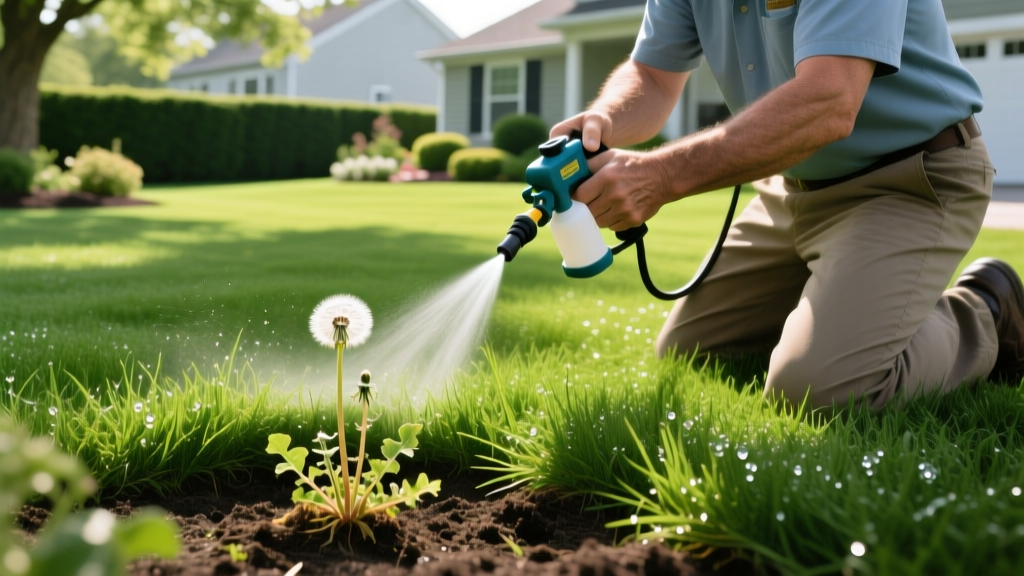
How to Spot-Treat Stubborn Weeds in Maryland Lawns
The Transition Zone Challenge: Maryland's Unique Weed Profile
Maryland sits squarely in the turfgrass transition zone, meaning lawns here endure hot, humid summers and freezing winters. While Tall Fescue and Kentucky Bluegrass dominate the state's residential lawns, the climate creates a dual-threat weed environment. Homeowners must battle both cool-season perennials and aggressive warm-season annuals. Broadcast spraying entire lawns with broad-spectrum herbicides is not only environmentally irresponsible but often leads to turf thinning and chemical resistance. Spot-treatment—applying targeted herbicides directly to specific weed colonies—is the professional standard for maintaining dense, healthy turf in USDA Hardiness Zones 6b through 8a.
According to the University of Maryland Extension, targeted weed management reduces chemical load by up to 80% compared to broadcast applications. This guide provides exact active ingredients, dilution rates, and seasonal timing for spot-treating the most problematic weeds in Maryland.
Critical Turf Safety Warning: Before mixing any herbicide, identify your grass type. Tall Fescue is highly tolerant of most selective herbicides. However, Kentucky Bluegrass can suffer phytotoxicity (yellowing) from high rates of Quinclorac, and warm-season grasses like Bermudagrass (found in southern Maryland) are highly sensitive to 2,4-D and Dicamba. Always check the product label for your specific turfgrass species.
Summer Annual Grasses: Crabgrass and Goosegrass
Smooth crabgrass (Digitaria ischaemum) and large crabgrass (Digitaria sanguinalis) are the most pervasive summer annuals in Maryland. Goosegrass (Eleusine indica) often appears in compacted, high-traffic areas where crabgrass fails to thrive. While pre-emergent applications in early spring (when soil temperatures hit 55°F) are the best defense, post-emergent spot-treatment is necessary when breaks in the pre-emergent barrier occur.
The Quinclorac Protocol
For post-emergent spot-treatment of crabgrass and goosegrass, Quinclorac (commonly sold as Drive XLR8 or generic Quinclorac 75 DF) is the industry standard. Quinclorac mimics auxin growth hormones, causing the weed to grow itself to death.
- Mixing Rate: 0.75 fluid ounces of Quinclorac 75 DF per 1 gallon of water.
- Coverage: 1 gallon of mixed solution covers approximately 1,000 square feet when spot-spraying.
- Surfactant Requirement: Quinclorac requires a Methylated Seed Oil (MSO) surfactant to penetrate the waxy cuticle of mature crabgrass. Add 0.5% v/v of MSO (roughly 2.5 teaspoons per gallon).
- Timing: Apply when crabgrass is young (1-3 tiller stage). Mature crabgrass with seed heads will require a second application 14-21 days later.
The Invasive Threat: Japanese Stiltgrass
Japanese stiltgrass (Microstegium vimineum) is an aggressive, shade-tolerant invasive annual that has become a massive problem in Maryland's wooded suburbs and shaded lawn edges. It features a distinct silvery midrib on its pale green leaves and spreads rapidly via stolons.
Spot-Treating Stiltgrass Without Killing Fescue
Non-selective herbicides like glyphosate will kill stiltgrass, but they will also destroy your Tall Fescue lawn. For selective spot-treatment, use Fenoxaprop-p-ethyl (sold as Acclaim Extra). This active ingredient targets grassy weeds while leaving broadleaf plants and most cool-season turfgrasses unharmed.
- Mixing Rate: 0.4 fluid ounces of Acclaim Extra per 1 gallon of water.
- Application Window: Late May through June. Stiltgrass is highly susceptible to fenoxaprop-p-ethyl during its early vegetative growth stage.
- Edge Case: If stiltgrass has already produced seed heads by late August, chemical control is ineffective. Hand-pull the patches before the seeds drop, as stiltgrass seeds can remain viable in the soil seed bank for up to five years.
Targeted Broadleaf Weed Eradication
Broadleaf weeds in Maryland range from simple taproot invaders like dandelions to complex, creeping perennials like ground ivy. The UMD Turfgrass Program emphasizes that matching the active ingredient to the specific weed's biology is critical for success.
| Weed Species | Identification Marker | Primary Active Ingredient | Optimal Spot-Treat Window |
|---|---|---|---|
| Dandelion | Deep taproot, yellow flower, jagged rosette leaves | 2,4-D + Dicamba + MCPP (Trimec) | Spring (May) or Early Fall |
| Broadleaf Plantain | Ribbed, oval leaves growing in tight basal rosettes | 2,4-D + Dicamba | Late Spring |
| Creeping Charlie (Ground Ivy) | Scalloped leaves, minty odor, creeping stolons | Triclopyr + 2,4-D | Early Fall (Sept 15 - Oct 15) |
| Wild Violet | Heart-shaped leaves, purple/white flowers, waxy cuticle | Triclopyr + MSO Surfactant | Fall (post-first frost) |
The Waxy Leaf Problem: Wild Violets and Creeping Charlie
Wild violets and Creeping Charlie are notoriously difficult to kill because they possess thick, waxy leaf cuticles that cause standard water-based herbicide sprays to bead up and roll off. Furthermore, these perennials spread via deep rhizomes and stolons.
To spot-treat these species effectively, you must use a Triclopyr-based herbicide (often labeled as Chickweed, Clover, and Oxalis Killer). Triclopyr is highly effective against tough broadleaf weeds. However, the chemical alone is not enough. You must add a high-quality non-ionic surfactant (NIS) or a methylated seed oil (MSO) to your tank mix. The surfactant breaks the surface tension of the water, allowing the triclopyr to spread evenly across the waxy leaf and penetrate the tissue.
Pro Tip for Fall Broadleaf Control: The absolute best time to spot-treat Creeping Charlie and Wild Violets in Maryland is between September 15 and October 15. During this window, perennial weeds are actively pulling carbohydrates down into their root systems to prepare for winter. When you spray the leaves, the plant naturally translocates the herbicide directly into the roots, ensuring total kill rather than just top-growth burn.
Step-by-Step Spot-Treatment Protocol
Improper mixing and application are the leading causes of herbicide failure and turf damage. Follow this exact protocol for mixing and applying spot-treatments in your Maryland lawn.
- Calibrate Your Sprayer: Use a dedicated 1-gallon or 2-gallon pump sprayer for spot treatments. Do not use a sprayer that has previously held glyphosate or soil sterilants, as residue will kill your turf.
- Measure Precisely: Use a dedicated syringe or measuring cup for herbicides. Guessing the concentration leads to turf phytotoxicity (chemical burn).
- Mix Order (WALES Method): Fill the tank halfway with water, add Wetting agents (surfactants), Agitate, add Liquid herbicides, then add Extra water to the fill line. This prevents chemical clumping.
- Apply to Point of Drip: Spray the weed until the leaves are uniformly wet, but stop before the liquid runs off onto the soil. Herbicide runoff wastes product and increases soil contamination.
- Observe Weather Constraints: Do not spot-treat if rain is expected within 24 hours. More importantly, avoid spraying 2,4-D or Dicamba when Maryland's summer temperatures exceed 85°F. High heat causes these chemicals to volatilize (turn into a gas), which can drift and severely damage nearby ornamental shrubs, tomato plants, and flower beds.
Environmental and Regulatory Considerations
Maryland has strict environmental regulations regarding pesticide use, particularly near the Chesapeake Bay watershed. The EPA Safe Pest Control guidelines and Maryland Department of Agriculture mandate that homeowners prevent herbicide runoff into storm drains and waterways. Never spot-treat weeds growing directly in street gutters, driveway cracks, or within 10 feet of a storm drain. For weeds in these hardscape areas, manual extraction or targeted, non-selective organic acids (like horticultural vinegar, though less effective on deep roots) are the legally and environmentally sound choices.
By shifting from broadcast spraying to precise, chemically-targeted spot-treatments, Maryland homeowners can maintain pristine Tall Fescue and Kentucky Bluegrass lawns while minimizing environmental impact and reducing annual chemical expenditures by hundreds of dollars.

