
Lawn Care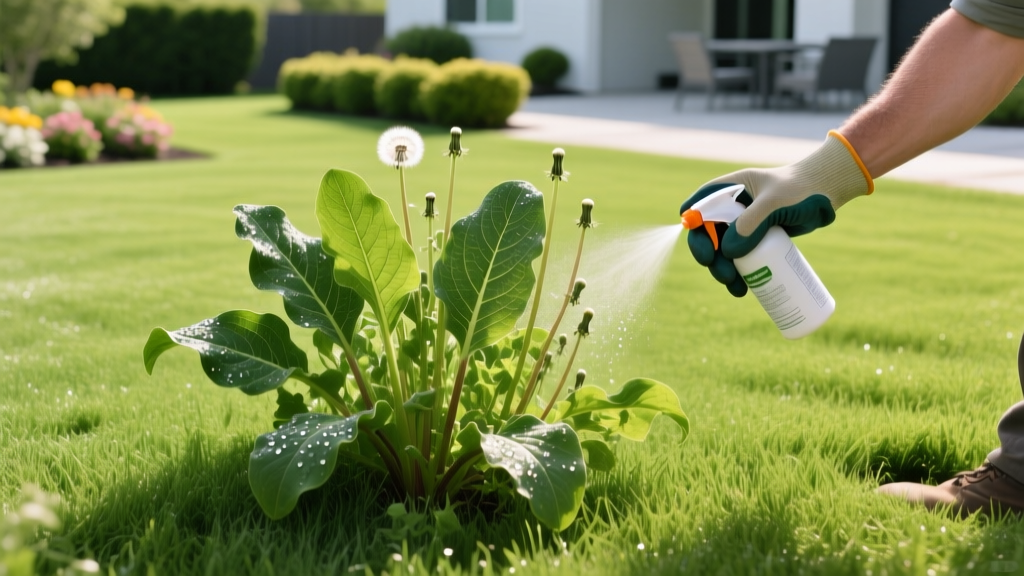
How to Spot-Treat Tall Large Leaf Weeds in Your Lawn
The Biology of Giant Invaders: Why Standard Broadcast Sprays Fail
When tall large leaf weeds breach your turf canopy, they do more than just look unsightly. Species like pokeweed, common ragweed, and jimsonweed can grow between 3 to 8 feet tall, casting dense shade that rapidly thins out your desirable grass. However, the primary reason homeowners fail to eradicate these giants using standard broadcast herbicide applications lies in their plant biology.
As broadleaf weeds mature and grow tall, they develop a thick, waxy epicuticular layer on their leaves to retain moisture. This waxy cuticle acts as a physical barrier, causing water-based broadcast sprays to bead up and roll off onto the soil. Furthermore, the sheer volume of herbicide required to thoroughly cover a 6-foot-tall plant makes broadcast spraying economically wasteful and highly risky for surrounding desirable turf. According to University of Minnesota Extension, targeted spot-treatment using specific systemic chemistries and surfactants is the only reliable method for eliminating mature, deep-rooted broadleaf invaders without damaging the surrounding lawn.
Identification Matrix: The "Big Four" Tall Broadleaf Weeds
Before mixing any chemicals, accurate identification is critical. Different root structures dictate which herbicide will translocate effectively to kill the plant entirely. Use this matrix to identify the most common towering weeds in North American lawns:
| Weed Species | Max Height | Leaf Characteristics | Root Structure | Primary Eradication Challenge |
|---|---|---|---|---|
| Pokeweed (Phytolacca americana) | 6–10 ft | Broad, oval, smooth edges, prominent veins | Massive fleshy taproot | Regrows from taproot fragments; highly toxic berries |
| Common Ragweed (Ambrosia artemisiifolia) | 3–4 ft | >Fern-like, deeply lobed, hairy stemsShallow branching taproot | Prolific seed producer; rapid growth in late summer | |
| Canada Thistle (Cirsium arvense) | 2–4 ft | >Lance-shaped, heavily spined marginsExtensive creeping rhizomes | Spreads laterally underground; contact sprays only burn tops | |
| Jimsonweed (Datura stramonium) | 3–5 ft | >Large, toothed, ovate, foul-smelling when crushedFibrous with shallow taproot | Thick waxy cuticle repels standard amine herbicides |
⚠️ Toxicity Warning: Pokeweed and Jimsonweed are highly toxic to humans and pets. All parts of the pokeweed plant, especially the deep taproot and dark purple berries, contain phytolaccatoxin. Always wear heavy-duty nitrile gloves (not latex, which can degrade and allow chemical absorption) when handling or pulling these species manually.
The Spot-Treatment Protocol: Step-by-Step Eradication
Spot-treating tall large leaf weeds requires a shift from volume-based application to precision chemistry. Follow this protocol to ensure the herbicide penetrates the waxy cuticle and translocates down to the root system.
Step 1: Herbicide Selection and Formulation Chemistry
Standard "weed and feed" granules or basic 2,4-D amine liquid concentrates will only burn the top foliage of mature giants, leading to frustrating regrowth within 14 days. You must use an ester-based systemic herbicide. Ester formulations are lipophilic (fat-soluble), allowing them to easily dissolve through the waxy leaf cuticle of mature weeds.
- For Pokeweed and Jimsonweed: Use a Triclopyr ester formulation (e.g., Triclopyr 4 EC or Chaser 2 AEC). Triclopyr excels at moving through the phloem of woody-stemmed and fleshy-rooted broadleaves.
- For Canada Thistle: Use a Clopyralid and 2,4-D mix (e.g., Lontrel). Clopyralid mimics plant hormones specifically in the Asteraceae family, causing fatal cellular overgrowth in thistles.
- For Isolated Weeds in Garden Beds: If the weed is not in the turf but in a mulch bed, a non-selective 2% Glyphosate solution applied via a wick applicator is the safest route to avoid turf drift.
Step 2: Mixing with Surfactants for Cuticle Penetration
Never spray tall weeds with herbicide and water alone. You must add a surfactant to lower the surface tension of the spray droplet, allowing it to spread flat across the leaf rather than beading up. According to the EPA's guidelines on safe pest control, adjuvants significantly increase herbicide efficacy, reducing the total amount of active ingredient needed in the environment.
💡 Pro Mixing Ratio: For ester-based herbicides, use a Methylated Seed Oil (MSO) rather than a standard Non-Ionic Surfactant (NIS). Mix 1 ounce of MSO per gallon of finished spray solution. Add the MSO to the water before adding the herbicide concentrate to prevent excessive foaming in your pump sprayer.
Step 3: Application Techniques for Mature Specimens
Timing and technique dictate success. Do not spray when temperatures exceed 85°F, as ester herbicides will volatilize (turn into a gas) and drift onto desirable trees and shrubs, causing severe leaf cupping and damage.
- The "Collar" Method: For weeds growing directly in the middle of your lawn, cut a hole in the bottom of a plastic solo cup or use a piece of cardboard with a slit. Slide it around the base of the weed to shield the surrounding grass from overspray.
- Target the Rosette and Stem: Do not just mist the top leaves. Aim your pump sprayer wand at the center rosette (the newest growth) and the lower 12 inches of the main stem. The bark of the lower stem on plants like pokeweed is highly absorbent.
- Wet to Glisten, Not Drip: Apply the solution until the leaves glisten. If the liquid is dripping off the leaf edges onto the soil, you are wasting chemical and risking root uptake by nearby desirable plants.
Post-Eradication Lawn Recovery and Soil Remediation
When a 5-foot-tall weed finally dies and collapses, it leaves behind a massive bare spot in your turf. These bare patches are prime real estate for the thousands of seeds the weed likely dropped before dying. Proper recovery is essential to prevent a secondary invasion.
Overseeding with Pre-Emergent Compatibility
Standard pre-emergent herbicides (like Prodiamine) will prevent grass seed from germinating. If you need to overseed the bare spot immediately, use Mesotrione (Tenacity). Applied at a rate of 4 fluid ounces per acre (roughly 1/2 teaspoon per 1,000 square feet for homeowners), Mesotrione acts as a selective pre-emergent that inhibits photosynthesis in broadleaf weeds and crabgrass, but is entirely safe for germinating Kentucky Bluegrass, Tall Fescue, and Perennial Ryegrass.
Soil De-compaction
Tall weeds often thrive in compacted, poorly draining soil where turf grass roots struggle to penetrate. Before dropping seed, use a hand lawn aerator or a digging fork to pierce the soil in the bare spot to a depth of 4 inches. Top-dress with 1/4 inch of screened compost to introduce soil microbes that will break down any residual dead root matter from the eradicated weed.
Frequently Asked Questions
Q: Can I just pull tall large leaf weeds by hand?
A: You can pull common ragweed and jimsonweed if the soil is moist, but pokeweed and Canada thistle will almost certainly regrow from root fragments left in the soil. Manual removal of pokeweed requires digging at least 12 inches deep to extract the entire fleshy taproot.
Q: How long does it take for the spot-treatment to work?
A: Systemic ester herbicides take 14 to 21 days to fully translocate and kill the root system. You will notice the leaves curling, yellowing, and necrotic tissue forming at the margins within 5 to 7 days. Do not reapply if you see initial curling; give the chemistry time to work.
Q: Will vinegar or organic herbicides kill these tall weeds?
A: No. Horticultural vinegar (20% acetic acid) is strictly a contact burn-down agent. It will instantly scorch the large leaves of a mature weed but will not travel down to the roots. The plant will simply push out new growth from the base within a week.

