
Lawn Care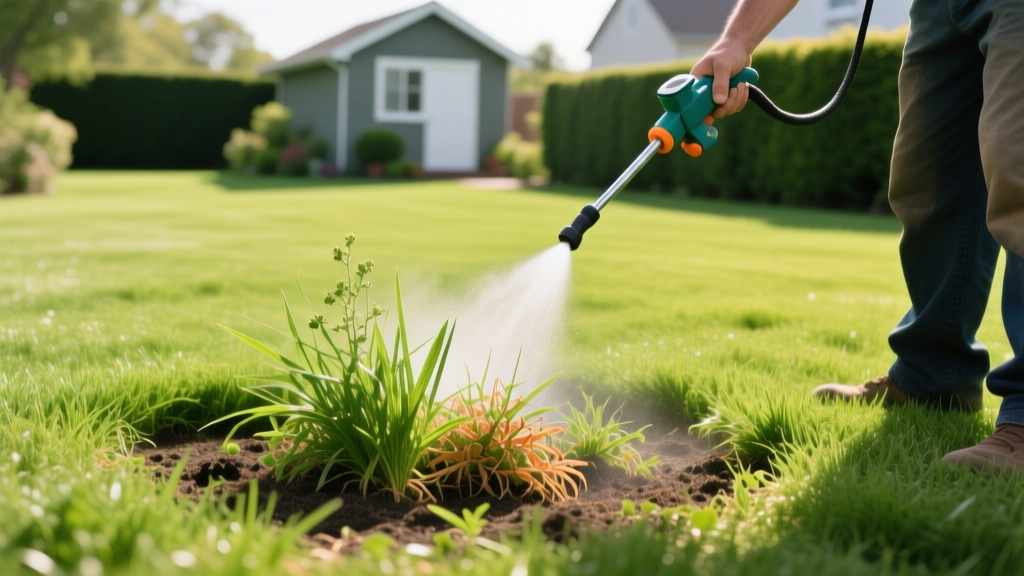
How to Spot-Treat Weeds and Crabgrass Without Killing Your Lawn
Blanket-spraying your entire lawn with herbicides is an outdated, expensive, and ecologically heavy-handed approach to turf management. When dealing with localized infestations of weeds and crabgrass, spot-treatment is the superior strategy. It reduces chemical usage by up to 85%, protects soil microbiology, and prevents unnecessary stress on your desirable turfgrass. However, spot-treating requires a precise understanding of weed biology, selective herbicide chemistry, and application mechanics. A single miscalculation in mixing ratios or timing can result in severe phytotoxicity to your lawn or complete failure to eradicate the target weed.
The Biology of the Enemy: Why Crabgrass and Broadleaf Weeds Require Different Tactics
The fundamental rule of selective weed control is exploiting the biological differences between monocots (grasses) and dicots (broadleaf plants). Your lawn—whether it is Kentucky Bluegrass, Tall Fescue, or Bermuda—is a monocot. Broadleaf weeds like dandelions, clover, and creeping charlie are dicots. Herbicides like 2,4-D and Dicamba mimic plant growth hormones that only exist in dicots, causing them to grow themselves to death while leaving your monocot lawn unharmed.
Crabgrass (Digitaria sanguinalis), however, is a monocot. It is biologically in the same family as your lawn. To kill crabgrass without killing your turf, you must use highly specific synthetic auxins or photosystem inhibitors, such as Quinclorac or Mesotrione, which target metabolic pathways unique to crabgrass.
⚠️ Critical Germination Data: Crabgrass seeds begin germinating when soil temperatures at a 2-inch depth reach 50°F to 55°F for three consecutive days. If you are spot-treating in early spring, you are likely looking at winter annuals like Poa annua, not crabgrass. True crabgrass spot-treatments occur from late May through August.
Spot-Treatment Decision Matrix: Matching the Herbicide to the Weed
Selecting the wrong active ingredient is the most common reason homeowners fail to eradicate weeds and crabgrass. Use the matrix below to match your specific infestation with the correct chemical profile and exact mixing rates for a standard 1-gallon pump sprayer.
| Target Weed | Active Ingredient | Product Example | Mixing Rate (per 1 Gal) | Turf Safety Profile |
|---|---|---|---|---|
| Smooth Crabgrass (1-3 tillers) | Quinclorac | Drive XLR8 / Bayer Advanced | 0.73 oz + 1 tsp MSO | Safe on Fescue, Bluegrass, Bermuda. Do not use on St. Augustine or Centipede. |
| Dandelion, Plantain, Clover | 2,4-D + Dicamba + MCPP | Trimec Classic / Ortho WeedClear | 1.5 fl oz | Safe on almost all cool-season and warm-season lawns at labeled rates. |
| Creeping Charlie (Ground Ivy) | Triclopyr + 2,4-D | T-Zone / Ortho Chickweed Killer | 2.0 fl oz | Caution on warm-season grasses; highly effective on cool-season turf. |
| Crabgrass in St. Augustine | Mesotrione | Tenacity | 1/2 tsp + 1 tsp NIS | Safe on St. Augustine, Centipede, and Cool-season grasses. Causes temporary bleaching. |
Step-by-Step Spot-Spraying Protocol for Maximum Efficacy
Professional turf managers do not just mix chemicals and spray; they engineer the application environment to ensure maximum foliar absorption. Follow this exact protocol when treating weeds and crabgrass.
Step 1: Calibration and Mixing Order
Always use a dedicated 1-gallon or 2-gallon pump sprayer (like the Chapin 20V Lithium-Ion sprayer, approx. $65) rather than a hose-end sprayer. Hose-end sprayers cannot be calibrated for spot treatments and will overdose your soil. Follow the W.A.L.E.S. mixing order to prevent chemical clumping:
- Wettable powders (if using)
- Agitate (shake the tank)
- Liquid flowables
- Emulsifiable concentrates
- Surfactants (add last)
Step 2: The Surfactant Secret
Crabgrass leaves are coated in a thick, waxy cuticle designed to repel water and retain moisture. If you spray Quinclorac without a surfactant, the droplets will bead up and roll off the leaf onto the soil, where the herbicide is largely ineffective. You must add a Non-Ionic Surfactant (NIS) or Methylated Seed Oil (MSO). Add exactly 1/2 teaspoon of NIS per gallon of mixed solution. This breaks the surface tension, allowing the chemical to spread evenly across the weed's foliage and penetrate the stomata.
Step 3: Application Technique
Adjust your sprayer nozzle to a low-pressure, coarse mist setting. High-pressure fine mists cause herbicide drift, which can land on and burn your desirable turf or neighboring ornamental plants. Hold the wand 18 to 24 inches from the target weed. Spray until the leaves are uniformly damp, but not dripping. Once the liquid reaches the drip point, the leaf cannot absorb any more, and you are simply wasting chemical and increasing soil residual toxicity.
"The most common mistake homeowners make with post-emergent crabgrass control is waiting too long. Quinclorac is highly effective on crabgrass in the 1-to-3 tiller stage. Once the crabgrass reaches the 5-tiller stage or begins producing seed heads in late July, its metabolic rate slows, and the herbicide will fail to translocate to the roots."
— Adapted from NC State University TurfFiles weed management guidelines.
Critical Edge Case: Post-Emergent Crabgrass in Late Summer
If you are reading this in August and your lawn is heavily infested with mature, sprawling crabgrass, do not waste money on Quinclorac. Mature crabgrass is highly resistant to post-emergent herbicides. Furthermore, spraying high rates of herbicide in late-summer heat (above 85°F) will almost certainly cause severe phytotoxicity to your surrounding lawn.
The Late-Summer Protocol:
- Manual Extraction: For isolated patches, use a stand-up weeder tool (like the Fiskars Uproot Weeder, ~$35) to physically remove the mature plants, ensuring you extract the shallow fibrous root crown.
- The Fallback Strategy: Accept the cosmetic damage for the remaining season. Crabgrass is an annual; it will naturally die at the first hard frost. Your immediate priority must shift to applying a fall pre-emergent (like Prodiamine) in late August to stop the seeds the current plants just dropped from germinating next spring.
Cost Analysis: Spot-Treating vs. Blanket Application
From a financial perspective, spot-treating weeds and crabgrass offers massive ROI, especially for lawns with less than 15% weed coverage. Here is a real-world cost breakdown for a standard 5,000 square foot lawn, based on average 2026 retail pricing for professional-grade concentrates.
Blanket Application
- Herbicide (e.g., Trimec 1-gal jug): $65.00
- Surfactant: $12.00
- Chemical used per app: ~6 oz ($30.00)
- Total Cost: $107.00 (First year)
- Subsequent years: $30.00
Targeted Spot-Treatment
- Herbicide (8 oz bottle concentrate): $18.00
- Surfactant (small bottle): $8.00
- Chemical used per app: ~0.5 oz ($1.12)
- Total Cost: $27.12 (First year)
- Subsequent years: $1.12
Common Spot-Treatment Failure Modes (And How to Fix Them)
If you applied the correct chemical at the correct rate and the weeds and crabgrass are still thriving, you likely fell victim to one of these environmental or mechanical failure modes.
1. Mowing Too Soon After Application
Systemic herbicides need time to translocate from the leaves down to the root system. If you mow your lawn 12 hours after spraying, you are physically removing the treated foliage before the chemical has reached the roots. Fix: Wait at least 48 hours after spot-treating before mowing. Conversely, do not mow 24 hours before spraying; you need maximum leaf surface area to catch the spray.
2. Watering or Rain Interference
Most post-emergent herbicides require 6 to 8 hours of dry time to become rainfast. If you run your irrigation system the morning after you spray, you will wash the chemical off the leaf and into the soil, rendering it useless. Fix: Check the 7-day forecast. Only spot-treat when you have a guaranteed 24-hour window of zero precipitation, and turn off your automated sprinkler zones for that specific area.
3. Ignoring Soil pH and Nutrient Deficiencies
Weeds and crabgrass are opportunistic; they thrive in compacted, low-nitrogen, or acidic soils where desirable turf struggles to compete. According to University of Minnesota Extension, treating the weed without fixing the soil is a temporary band-aid. Fix: Conduct a soil test. If your pH is below 6.0, apply pelletized lime. If your soil is compacted, schedule core aeration in the fall to give your turf the biological advantage it needs to naturally choke out future weed germination.
Frequently Asked Questions
Can I mix crabgrass killer and broadleaf weed killer in the same sprayer?
Yes, you can tank-mix Quinclorac (for crabgrass) with a 3-way herbicide like Trimec (for broadleaf weeds) to create a broad-spectrum spot treatment. However, you must read both labels to ensure the combined active ingredients do not exceed the maximum allowable application rates for your specific turfgrass species, and always add the surfactant last.
Why did my Tenacity application turn my crabgrass white instead of killing it?
Mesotrione (Tenacity) is a HPPD inhibitor. It works by blocking chlorophyll production, which causes the crabgrass to turn stark white (bleaching) as it starves. This bleaching is a sign the product is working. The crabgrass will typically die and brown out within 14 to 21 days. Do not reapply just because it turned white.
Is it safe to spot-treat weeds and crabgrass near my vegetable garden?
No. Herbicides like 2,4-D and Dicamba are highly volatile and can vaporize in warm weather, drifting into your garden and causing severe twisting and deformity in tomatoes, peppers, and other broadleaf vegetables. Maintain a minimum 15-foot buffer zone between your lawn spot-treatments and any edible crops, and never spray when wind speeds exceed 5 mph.

