
Lawn Care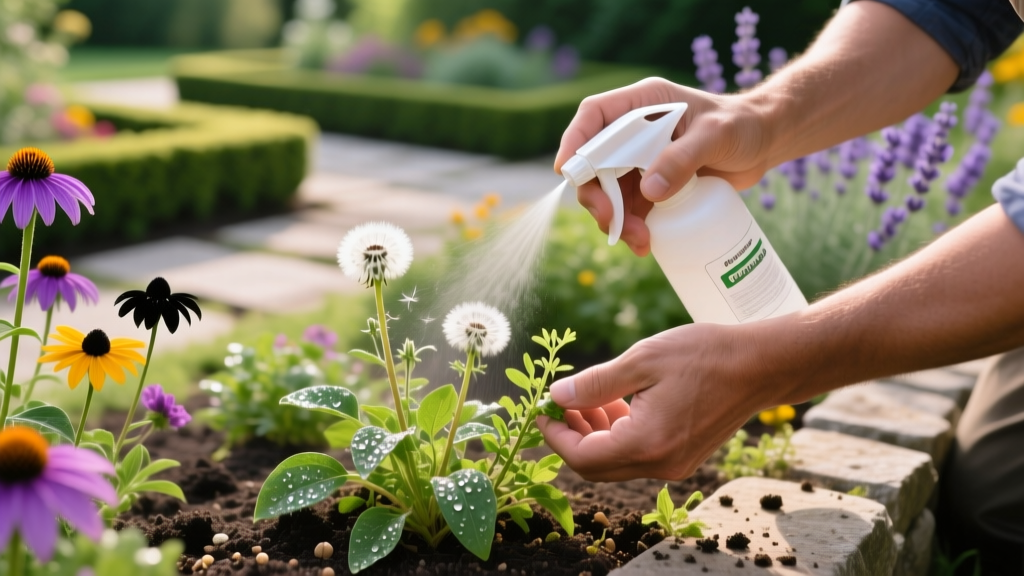
How to Spot-Treat Weeds in Flower Beds Without Killing Plants
The Hidden Danger of Herbicide Drift in Ornamental Beds
Managing weeds in flower beds requires a fundamentally different approach than lawn care. In a turf environment, selective herbicides can target broadleaf weeds without harming the grass. In an ornamental bed, however, you are dealing with a complex mix of desirable broadleaf plants, shrubs, and grassy invaders. Using a non-selective post-emergent herbicide like glyphosate via a standard pump sprayer introduces severe risks of particle drift and vapor drift.
Warning: Temperature and Vapor Drift
According to the Penn State Extension, ester formulations of herbicides can volatilize and drift when temperatures exceed 85°F, causing severe phytotoxicity to nearby ornamental foliage. Always use amine formulations if chemical spot-treatment is necessary, and apply only during early morning hours when temperatures are below 80°F and wind speeds are under 5 mph.
According to the Penn State Extension, ester formulations of herbicides can volatilize and drift when temperatures exceed 85°F, causing severe phytotoxicity to nearby ornamental foliage. Always use amine formulations if chemical spot-treatment is necessary, and apply only during early morning hours when temperatures are below 80°F and wind speeds are under 5 mph.
Identifying Your Flower Bed Invaders
Accurate identification dictates your spot-treatment strategy. Misidentifying a sedge as a grassy weed will result in wasted chemical applications and continued infestation. Use this diagnostic matrix to categorize the intruders before selecting a treatment protocol.
| Weed Category | Common Species | Key Identification Trait | Root Structure |
|---|---|---|---|
| Grassy Weeds | Crabgrass, Poa annua | Flat, wide leaf blades; distinct midrib | Fibrous, shallow root mass |
| Sedges | Yellow Nutsedge, Purple Nutsedge | Triangular stem (rolls between fingers) | Deep rhizomes with nutlets |
| Broadleaf Weeds | Dandelion, Bindweed, Spurge | Net-like veins; wide, flat leaves | Deep taproots or creeping stolons |
Targeted Chemical Spot-Treatments by Weed Category
When manual removal fails or the infestation is too dense, targeted chemical intervention is required. The key is utilizing active ingredients that exploit the biological differences between the weed and your desirable ornamentals.
Grassy Weeds in Broadleaf Beds
If your flower beds consist of broadleaf ornamentals (hostas, daylilies, roses) and are invaded by crabgrass or bermudagrass, utilize Fluazifop-p-butyl. This active ingredient is an aryloxyphenoxypropionate herbicide that specifically targets grassy weeds while leaving broadleaf plants entirely unharmed.
- Product Example: Ortho Grass B Gon Garden Grass Killer.
- Application Cost: Approximately $22 to $28 for a 24 oz ready-to-spray bottle.
- Protocol: Spray directly onto the grassy weed foliage until wet. Do not apply to desirable ornamental grasses (like fescue or liriope), as it will kill them. Allow 7 to 10 days for the grass to yellow and die back to the root.
Sedges and Nutgrass
Sedges are neither grasses nor broadleaf weeds; they require specialized chemistry. Halosulfuron-methyl is the industry standard for post-emergent nutsedge control in and around ornamental beds.
- Product Example: SedgeHammer Turf Herbicide (safe for use as a directed spray around established ornamentals).
- Application Cost: $35 to $40 per 1.33 oz packet (yields up to 1,000 sq ft of coverage when mixed).
- Protocol: Mix 1 packet with 1 gallon of water and add 0.5 oz of non-ionic surfactant. Use a shielded spray nozzle to apply directly to the nutsedge. The weed will stop growing within 48 hours, though visual necrosis takes up to 21 days.
Broadleaf Weeds: The Wick Applicator Method
When broadleaf weeds (like dandelions or bindweed) emerge directly through the crown of a desirable shrub, spraying is impossible without causing collateral damage. Instead, use a glyphosate wick applicator or a sponge glove.
- Mix a concentrated 2% glyphosate solution (2.6 oz of 41% glyphosate per 1 gallon of water).
- Saturate the sponge glove or wick applicator with the solution.
- Physically wipe the sponge directly onto the leaves of the target weed. The herbicide is absorbed through the cuticle and translocated to the taproot without any risk of aerosol drift.
Mechanical and Thermal Extraction Protocols
Chemical treatments are not always viable, particularly in beds containing edible plants or highly sensitive ornamentals. The University of California Statewide IPM Program heavily advocates for mechanical and thermal controls as primary defenses in sensitive landscape zones.
Precision Manual Extraction
Standard trowels often sever taproots, guaranteeing the weed will resprout in three weeks. Upgrade to a 420 Stainless Steel Hori Hori Knife with a 7-inch serrated blade. The narrow profile allows you to plunge the blade 6 inches deep directly alongside a dandelion taproot, leveraging the weed out intact without disturbing the root ball of the adjacent ornamental plant. For creeping weeds like bindweed, use a CobraHead Original Weeder to hook and pull the subterranean stolons.
Thermal Weeding (Flame Weeding)
Thermal weeding is highly effective in gravel beds, stone borders, or along concrete edging where chemical runoff is a concern.
Expert Tip: Boil the Cell Sap, Do Not Incinerate
A common mistake is burning the weed until it turns to ash. According to Purdue University Turfgrass Science, the goal of thermal weeding is to heat the plant tissue to 175°F - 200°F. This boils the water inside the plant cells, causing them to rupture. The weed will look slightly wilted and dark green immediately after treatment, and will dry out completely within 48 hours. Use a 100,000 BTU propane torch (like the Red Dragon 100K) and keep the flame moving at a steady walking pace.
A common mistake is burning the weed until it turns to ash. According to Purdue University Turfgrass Science, the goal of thermal weeding is to heat the plant tissue to 175°F - 200°F. This boils the water inside the plant cells, causing them to rupture. The weed will look slightly wilted and dark green immediately after treatment, and will dry out completely within 48 hours. Use a 100,000 BTU propane torch (like the Red Dragon 100K) and keep the flame moving at a steady walking pace.
Pre-Emergent Strategies for Mulched Beds
Spot-treating weeds after they emerge is reactive. Proactive management requires a pre-emergent barrier tailored for ornamental beds. Standard lawn pre-emergents like Dimension (dithiopyr) can stunt the growth of certain shallow-rooted ornamentals.
For flower beds, Isoxaben (sold commercially as Gallery 75 DF) is the premier choice. It specifically prevents broadleaf weed seeds from germinating but does not harm established ornamental roots. Apply at a rate of 0.75 to 1.0 lb of active ingredient per acre (roughly 0.5 oz per 1,000 sq ft for residential beds) in early spring before soil temperatures consistently reach 55°F. Water the granules in with 0.5 inches of irrigation to activate the chemical barrier in the top inch of the mulch layer.
Frequently Asked Questions
Will landscape fabric permanently stop weeds in my flower beds?
No. While landscape fabric blocks initial soil-borne weeds, wind-blown organic matter and dust will accumulate on top of the fabric, creating a shallow soil layer where weed seeds germinate. Furthermore, aggressive perennial weeds like bindweed and bermudagrass will easily puncture standard woven fabrics. A 3-inch layer of coarse arborist wood chips is vastly superior for suppressing weeds while improving soil biology.
Can I use vinegar to kill weeds around my roses?
Horticultural vinegar (20% to 30% acetic acid) is a non-selective contact burn-down herbicide. It will destroy the top growth of any plant it touches, including rose foliage. Furthermore, repeated applications of high-concentration acetic acid will severely lower the soil pH, potentially locking up essential nutrients like phosphorus and calcium, leading to long-term ornamental health decline. Stick to targeted mechanical extraction or wick-applied glyphosate near sensitive shrubs.
How often should I spot-treat my flower beds during the growing season?
Inspect beds every 14 days. Weeds are easiest to eradicate when they are in the cotyledon (seedling) stage, possessing less than 20% of their mature root mass. A quick pass with a hula hoe or hand torch every two weeks takes a fraction of the time required to extract mature, deeply rooted weeds later in the summer.

