
Lawn Care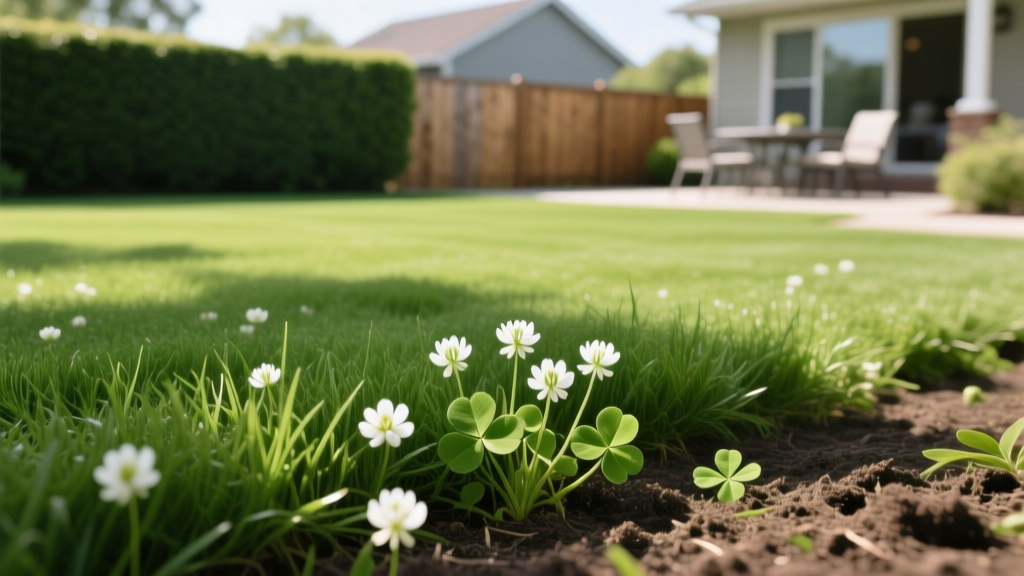
Effective Spot-Treatment Guide for White Clover Flowers
The Biology of Flowering White Clover: Why Timing Matters
White clover (Trifolium repens) is a perennial, stoloniferous broadleaf weed that thrives in nitrogen-deficient, compacted soils. When you notice white clover flowers in your turfgrass, the plant has transitioned from a purely vegetative growth phase into its reproductive stage. This biological shift presents two distinct challenges for lawn care professionals and homeowners.
First, the plant redirects its metabolic energy toward seed production. A single mature white clover plant can produce up to 5,000 seeds, which can remain viable in the soil seed bank for several years. Second, as the plant matures and flowers, it develops a thicker, waxy cuticle on its trifoliate leaves to conserve moisture. This epicuticular wax actively repels water-based herbicide solutions, causing standard spray applications to bead up and roll off the leaf surface without penetrating the plant tissue.
⚠️ Warning: Temperature Volatilization
Never apply broadleaf herbicides containing 2,4-D or Dicamba when ambient temperatures exceed 85°F (29°C). At high temperatures, these active ingredients can volatilize (turn into a gas) and drift onto nearby ornamental shrubs, tomatoes, or garden beds, causing severe phytotoxicity and leaf cupping.
Never apply broadleaf herbicides containing 2,4-D or Dicamba when ambient temperatures exceed 85°F (29°C). At high temperatures, these active ingredients can volatilize (turn into a gas) and drift onto nearby ornamental shrubs, tomatoes, or garden beds, causing severe phytotoxicity and leaf cupping.
Herbicide Selection Matrix for Flowering Clover
Standard pre-emergents will not stop flowering clover, and weak contact herbicides will only burn the top of the flower head without killing the deep taproot and stolons. You need a systemic post-emergent herbicide formulated specifically for mature broadleaf weeds. According to turfgrass research from the University of Minnesota Extension, combinations of three or four active ingredients yield the highest control rates for mature, flowering clover.
| Active Ingredient Profile | Product Example | Approx. Cost (2026) | Efficacy on Flowers | Best Grass Types |
|---|---|---|---|---|
| Carfentrazone + 2,4-D + MCPP + Dicamba | SpeedZone Broadleaf Herbicide | $55 / pint | Very High (Rapid burn + systemic) | Cool-season (Fescue, Bluegrass) |
| Triclopyr + 2,4-D + Dicamba | Ortho WeedClear Lawn Weed Killer | $18 / quart | High (Systemic root kill) | Cool & Warm-season (Check label) |
| Quinclorac + 2,4-D + Dicamba | Bayer Advanced All-In-One | $22 / quart | Moderate-High | Warm-season (Bermuda, Zoysia) |
| Fluroxypyr + Triclopyr | Turflon Ester Ultra | $65 / quart | High (Excellent on mature clover) | Cool-season turf only |
Step-by-Step Spot-Treatment Protocol
To successfully eradicate white clover flowers without wasting chemical or damaging surrounding turf, follow this precise application protocol. Spot-treating is highly effective for isolated patches and reduces the overall chemical load on your lawn ecosystem.
Step 1: Preparation and Mowing
Mow your lawn 48 hours before application. This removes the upper canopy of the turfgrass, exposing the lower-growing clover stolons and flower heads to the spray. Do not water the lawn for 24 hours prior to spraying; slightly moisture-stressed clover actively pulls liquids down into its root system, increasing herbicide translocation.
Step 2: Mixing the Surfactant Secret
Because flowering clover leaves are heavily waxed, a Non-Ionic Surfactant (NIS) is mandatory. The surfactant breaks the surface tension of the water, allowing the herbicide to spread evenly across the leaf and penetrate the cuticle. Add 0.25% v/v of a high-quality NIS (such as Southern Ag Surfactant, approx. $15/pint) to your tank mix. If a commercial NIS is unavailable, a few drops of liquid dish soap per gallon is a temporary substitute, though it lacks the penetrating power of a professional alkylpolyoxyethylene ether surfactant.
Step 3: Calibration and Application
- Calibrate your sprayer: Use a 1- or 2-gallon pump sprayer equipped with a flat-fan nozzle (e.g., TeeJet 8002VS). This ensures an even, overlapping spray pattern rather than a concentrated stream that causes soil runoff.
- Mix the solution: For SpeedZone, mix 1.0 to 1.5 fluid ounces of herbicide per gallon of water. This volume is calibrated to cover approximately 1,000 square feet.
- Apply to the point of wetness: Spray the white clover flowers and leaves until they are visibly wet, but not dripping. Dripping indicates you have exceeded the leaf's absorption capacity and are wasting product on the soil.
- Observe the weather window: Apply in the early morning after the dew has dried, or in the late afternoon. Ensure no rain is forecast for at least 4 to 6 hours post-application to allow for complete foliar absorption.
💡 Pro Tip: The "Twist and Spray" Technique
For dense, fist-sized mats of flowering clover, gently step on the center of the patch to splay the stolons outward, then spray. This exposes the hidden lower leaves and nodes to the herbicide, ensuring the entire stolon network receives a lethal dose.
For dense, fist-sized mats of flowering clover, gently step on the center of the patch to splay the stolons outward, then spray. This exposes the hidden lower leaves and nodes to the herbicide, ensuring the entire stolon network receives a lethal dose.
Post-Treatment Lawn Recovery and Prevention
According to the Clemson University Home & Garden Information Center, white clover is a legume that fixes atmospheric nitrogen into the soil. When you kill a large patch of clover, the decaying root nodules will release a temporary flush of nitrogen into the soil, but you will be left with a bare dirt patch. If left untreated, this bare soil will quickly be colonized by crabgrass or spurge during the summer months.
Overseeding the Dead Zones
Wait 7 to 10 days after spraying for the clover to completely brown and desiccate. Rake out the dead vegetative matter to expose the soil. Overseed the bare spots with a turfgrass that matches your existing lawn. For cool-season lawns, use a blend of Perennial Ryegrass and Fine Fescue at a rate of 5 to 8 lbs per 1,000 sq ft. Keep the seed consistently moist (watering lightly 2-3 times daily) until germination occurs, typically within 5 to 7 days for ryegrass.
Fixing the Underlying Soil Deficiencies
Clover is an indicator weed. Its presence, especially in large, flowering patches, signals that your turfgrass is starving for nitrogen and that the soil may be compacted.
- Aeration: Perform core aeration in the fall (for cool-season grasses) or late spring (for warm-season grasses) to relieve soil compaction and allow oxygen to reach turfgrass roots.
- Fertilization: Implement a fertilization program using a high-nitrogen, low-phosphorus fertilizer (e.g., a 20-0-10 or 24-0-10 NPK ratio). Apply 1 lb of nitrogen per 1,000 sq ft during the turf's peak growing season to encourage dense canopy growth that naturally shades out and suppresses new clover seedlings.
Frequently Asked Questions
Will pulling white clover flowers by hand work?
Hand-pulling is rarely effective for mature, flowering white clover. The plant spreads via above-ground stolons that root at the nodes, and it possesses a deep taproot. Pulling usually snaps the stolons, leaving the root system and lower nodes intact to regenerate new shoots within weeks. Furthermore, disturbing the soil brings dormant clover seeds to the surface, triggering a new flush of germination.
How long does it take for the herbicide to kill the flowers?
Products containing Carfentrazone (like SpeedZone) will cause visible wilting and necrosis of the flower heads within 24 to 48 hours. However, complete systemic translocation to the roots and stolons takes 10 to 14 days. Do not reapply herbicide if the plant still looks partially green after one week; allow the chemistry time to work.
Can I use vinegar or organic herbicides on flowering clover?
Horticultural vinegar (20% to 30% acetic acid) is a non-selective contact burn-down herbicide. It will desiccate the white clover flowers and top growth rapidly, but it lacks systemic action. It will not kill the deep taproot or the stolon network, meaning the clover will resprout from the base within a week. Additionally, high-concentration acetic acid lowers soil pH drastically and can harm surrounding turfgrass and soil microbiology.

