
Lawn Care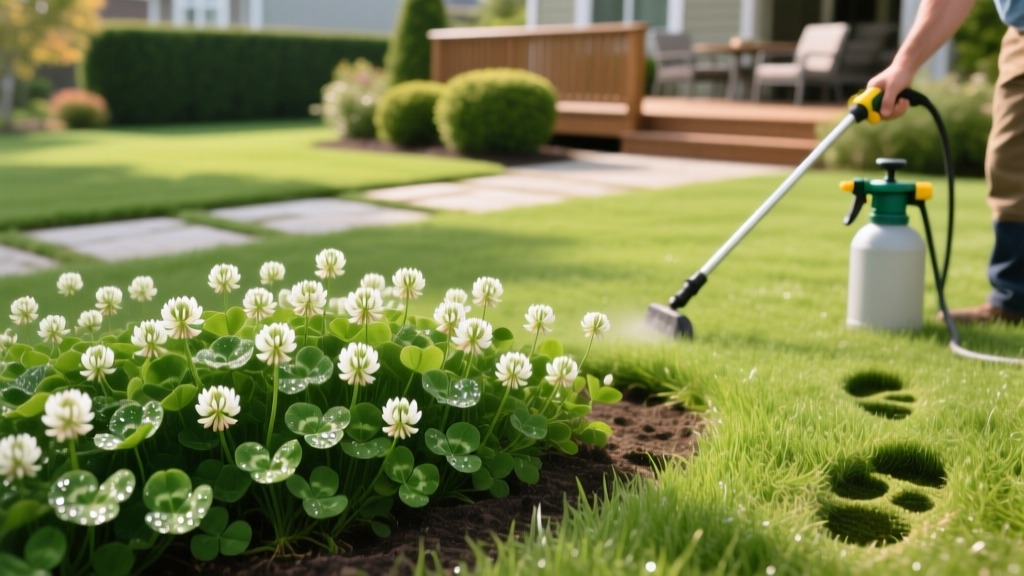
Spot-Treating White Dutch Clover: The Complete Lawn Guide
White dutch clover (Trifolium repens) is one of the most resilient broadleaf perennials encountered in residential turf. Unlike annual weeds that die off with the first frost, clover establishes a persistent root system and spreads aggressively via above-ground creeping stems called stolons. Because it fixes its own atmospheric nitrogen through symbiotic Rhizobium bacteria in its root nodules, it thrives in nutrient-poor soils where desirable turfgrass starves. Standard high-nitrogen fertilization programs will not outcompete it, making targeted spot-treatment a mandatory protocol for effective eradication.
Why White Dutch Clover Defeats Standard Lawn Care
Many homeowners attempt to eliminate clover by simply raising their mower deck or applying generic weed-and-feed products. These methods fail due to the plant's specific biological adaptations:
- Low-Growth Evasion: Clover maintains a prostrate growth habit, often creeping just below the cutting height of a standard rotary mower set at 2.5 to 3 inches.
- Waxy Leaf Cuticle: Mature clover leaves develop a thick, waxy cuticle that causes water-based herbicide droplets to bead up and roll off, preventing systemic absorption.
- Stolon Network: Even if the central taproot is destroyed, the stolon nodes can generate new adventitious roots and shoots, allowing the colony to regenerate from fragmented stem pieces left in the soil.
White Dutch Clover Identification Checklist:
- Leaves: Trifoliate (three leaflets), typically featuring a distinct white or pale green "V" or chevron watermark near the base of each leaflet.
- Flowers: Spherical, white to pale pink heads, roughly 0.5 to 1 inch in diameter, blooming continuously from late spring through early fall.
- Growth Habit: Creeping stolons that root at the nodes, forming dense, low-lying mats that choke out surrounding grass.
The Chemistry of Clover Control: Active Ingredients That Work
Not all broadleaf herbicides are created equal when it comes to Trifolium repens. Products relying solely on 2,4-D will cause temporary leaf curl but rarely achieve root kill. For complete eradication, you need a multi-active-ingredient formulation or a specific chemistry known for high efficacy on leguminous weeds. According to the University of California Integrated Pest Management program, combinations of synthetic auxins (growth regulators) provide the most reliable control.
| Active Ingredient | Clover Efficacy | Best For Grass Type | Est. Cost per 1,000 sq ft |
|---|---|---|---|
| Triclopyr | Excellent | Cool-season & Bermuda | $0.15 - $0.25 |
| Fluroxypyr | Excellent | All turfgrasses | $0.20 - $0.30 |
| 2,4-D + Dicamba + MCPP | Good (Requires Surfactant) | Most turfgrasses | $0.05 - $0.10 |
| FeHEDTA (Chelated Iron) | Moderate (Requires 2 Apps) | All turfgrasses | $1.50 - $2.00 |
Step-by-Step Chemical Spot-Treatment Protocol
For homeowners opting for synthetic control, a liquid concentrate applied via a pump sprayer offers the most precise and cost-effective spot-treatment. Ready-to-spray hose-end attachments are generally too diluted and lack the surfactant necessary to penetrate the clover's waxy cuticle.
Step 1: Select the Correct Herbicide and Surfactant
Choose a professional-grade concentrate like SpeedZone Broadleaf Herbicide for Turf (containing carfentrazone, 2,4-D, MCPP, and dicamba), which retails for approximately $45 for a 20 oz bottle. Crucially, you must pair this with a Non-Ionic Surfactant (NIS). The surfactant breaks the surface tension of the water, allowing the chemical to spread evenly across the clover leaf and penetrate the cuticle. The EPA's guidelines on pesticide selection emphasize that adjuvants like surfactants are critical for maximizing the efficacy of systemic herbicides while minimizing environmental runoff.
Step 2: Mix at Exact Rates
Do not eyeball your measurements. Over-mixing will burn the surrounding grass; under-mixing will result in herbicide resistance. For a standard 1-gallon pump sprayer targeting localized clover patches:
- Add 1.5 fluid ounces of SpeedZone concentrate to the tank.
- Add 0.25 fluid ounces (approximately 1.5 teaspoons) of a high-quality Non-Ionic Surfactant.
- Fill the tank halfway with clean water, agitate gently, then fill to the 1-gallon mark.
Step 3: Application Technique and Timing
Timing is everything. Apply the treatment in early fall (September to October) when clover is actively pulling nutrients down into its root system for winter storage, which carries the herbicide directly to the roots. Spring applications (April to May) are secondary and may require a follow-up treatment.
- Spray Pattern: Use a fine fan nozzle. Spray the clover until the leaves are uniformly wet, but stop before the liquid begins to drip off the edges.
- Temperature Constraints: Apply when daytime temperatures are between 65°F and 85°F. Applications above 85°F risk volatilization, where the chemical turns into a gas and drifts onto desirable ornamental plants.
- Mowing and Watering: Do not mow for 48 hours before or after application. Do not water the lawn or apply if rain is expected within 24 hours.
Organic and Non-Chemical Eradication Tactics
For homeowners managing organic lawns or those with strict environmental constraints near waterways, synthetic auxins are not an option. Organic control requires more labor and precise timing.
Iron HEDTA (Chelated Iron) Applications
FeHEDTA (Iron ethylenediamine-N,N'-bis(2-hydroxyphenylacetic acid)) is an organically approved active ingredient that exploits the differing iron metabolism between broadleaf weeds and monocot grasses. Products like Fiesta Turf Weed Killer (retailing around $65 for 2.5 gallons) cause rapid oxidative stress and tissue necrosis in clover within hours. However, FeHEDTA is primarily a contact burner. You must apply it at a rate of 3 to 5 fluid ounces per gallon of water, and a second application is almost always required 14 to 21 days later to kill the regenerating stolon nodes.
Manual Extraction and Stolon Severing
Hand-pulling white dutch clover is only viable for very small, newly established patches. Because the stolons root at every node, simply pulling the central plant will leave dozens of rooted nodes behind. Use a specialized weeding tool, such as a CobraHead weeder or a narrow Hori-Hori knife, to trace the stolon network and sever the roots at each node. Extracting the entire network is labor-intensive but 100% effective if done meticulously.
Post-Treatment Lawn Recovery and Prevention
Killing the clover is only half the battle. The eradication process leaves bare voids in the turf canopy. If these voids are not immediately filled with desirable grass, new clover seeds (which can remain viable in the soil seedbank for up to 30 years) will germinate in the exposed sunlight.
Within 7 to 10 days of the clover turning brown and collapsing, rake out the dead organic matter. Overseed the bare spots with a grass variety matched to your existing lawn. Apply a starter fertilizer high in phosphorus (e.g., a 10-18-10 NPK ratio) to accelerate root development in the new seedlings. Once the new grass is established, maintain a strict fertilization schedule. While clover fixes its own nitrogen, a dense, well-fertilized turfgrass canopy creates heavy shade at the soil level, which physically blocks the sunlight required for clover seed germination.
Frequently Asked Questions
Will vinegar kill white dutch clover?
Horticultural vinegar (20% to 30% acetic acid) will burn the top growth of clover, but it is entirely non-selective and will severely burn your surrounding grass. Furthermore, it does not translocate to the roots, meaning the clover will regrow from the stolons within two weeks. It is not recommended for spot-treatment in established lawns.
Does white dutch clover indicate poor soil?
Yes. A heavy infestation is a primary bio-indicator of nitrogen-deficient soil, compacted earth, or a soil pH that has dropped below 6.0. Conducting a soil test and correcting the underlying pH and nutrient deficiencies is the ultimate long-term preventative measure.

