
Lawn Care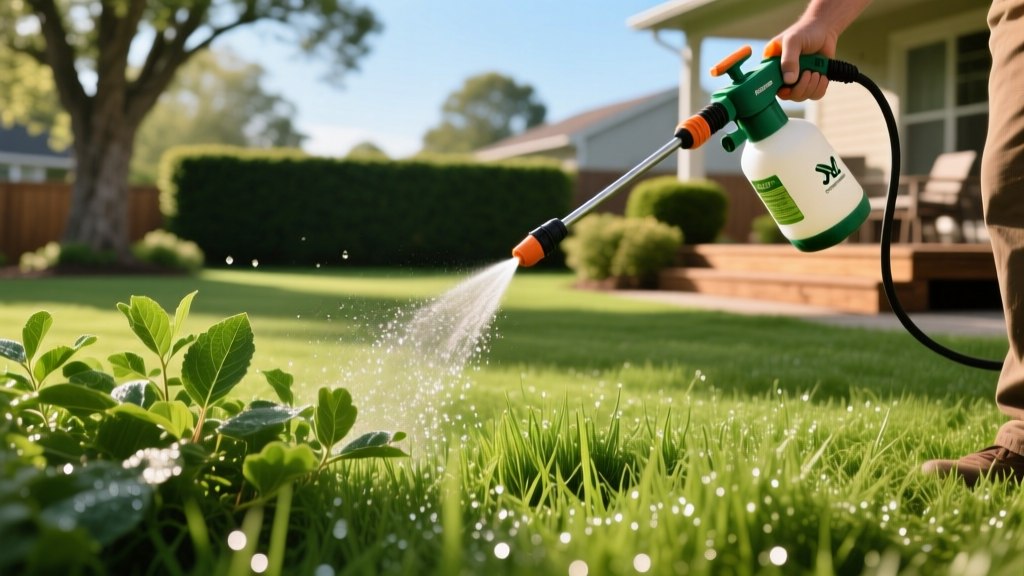
Spot-Treating Broadleaf Weeds With Liquid Weed and Feed for Lawns
The Shift from Broadcast to Targeted Spot-Treatment
Applying a broadcast spray of liquid weed and feed for lawns across an entire 5,000-square-foot property is often an inefficient use of active ingredients and foliar fertilizers. While broadcast applications make sense for severe, uniform infestations, most residential lawns suffer from localized patches of stubborn broadleaf weeds. By pivoting to a calibrated spot-treatment strategy using liquid concentrates, homeowners can reduce chemical runoff by up to 80%, save $40 to $60 annually on wasted product, and deliver precise nutritional support only to the recovering turf zones.
Spot-treating requires a fundamental understanding of herbicide chemistry, water conditioning, and precise pump calibration. This guide details the exact protocols for identifying, mixing, and eradicating specific weed species using targeted liquid applications.
Formulation Chemistry: Amine vs. Ester Salts
The efficacy of your liquid weed and feed for lawns depends heavily on the salt formulation of the active ingredients—most commonly 2,4-D, Dicamba, and MCPP. These systemic herbicides are manufactured in two primary forms:
- Amine Salts: Water-soluble and highly stable. Amine formulations do not volatilize (turn into gas) in high heat, making them the mandatory choice for late spring and summer spot-treatments when temperatures exceed 80°F. They penetrate plant tissue slightly slower but carry zero risk of vapor drift damaging nearby ornamental shrubs.
- Ester Salts: Lipid-soluble, allowing them to rapidly penetrate the waxy cuticles of mature weeds. Esters are highly effective in cool weather (50°F–75°F) but become dangerously volatile above 80°F. Using an ester-based liquid weed and feed in July will result in vapor drift that can curl the leaves of nearby tomato plants and hydrangeas.
2026 Regulatory Update: Following recent EPA volatility restrictions on over-the-top Dicamba applications, residential liquid concentrates have largely shifted to low-volatility amine formulations or alternative synthetics like Triclopyr. Always verify the active ingredient salt type on the product label before mixing.
The Hard Water Tie-Up Problem (And How to Fix It)
The most common failure mode in DIY liquid weed and feed applications is 'hard water tie-up.' Municipal water sources often contain high levels of calcium, magnesium, and iron (exceeding 150 ppm calcium carbonate). These positively charged cations bind to the negatively charged 2,4-D and Glyphosate molecules in your tank, neutralizing the herbicide before it ever reaches the weed.
The Solution: Add Ammonium Sulfate (AMS) to your sprayer before adding the herbicide. AMS saturates the water with ammonium cations, which the herbicide molecules preferentially bind to, preventing the calcium from neutralizing the active ingredient.
'Conditioning your spray water with AMS at a rate of 1 pound per 100 gallons—or roughly 0.16 ounces per 1-gallon pump sprayer—can increase broadleaf weed mortality rates by 30% to 50% in hard water regions.' — Texas A&M AgriLife Extension
Weed Species Identification and Spot-Treatment Matrix
Different weed species possess varying leaf cuticle thicknesses and root structures. Matching your active ingredient to the specific invader is critical for total eradication. Below is a targeted matrix for the most resilient lawn weeds.
| Weed Species | Optimal Active Ingredients | Mixing Rate (Per 1 Gallon) | Surfactant Requirement |
|---|---|---|---|
| Dandelion (Taraxacum officinale) | 2,4-D Amine + Dicamba | 2.5 oz concentrate | Non-Ionic Surfactant (NIS) |
| White Clover (Trifolium repens) | MCPP + Quinclorac | 3.0 oz concentrate | Methylated Seed Oil (MSO) |
| Ground Ivy (Glechoma hederacea) | Triclopyr + 2,4-D | 2.0 oz concentrate | NIS + AMS Water Conditioner |
| Wild Violet (Viola papilionacea) | Triclopyr + Dicamba | 3.5 oz concentrate | MSO (Critical for waxy leaf) |
For a comprehensive overview of regional weed life cycles and cultural prevention methods, refer to the Penn State Extension Weed Control Guide.
Step-by-Step Calibration for 1-Gallon Pump Sprayers
Spot-treating is not about drenching the weed until the liquid runs off into the soil. Systemic herbicides must be absorbed through the foliar tissue. Follow this exact calibration sequence for a standard 1-gallon poly pump sprayer:
- Condition the Water: Fill the sprayer halfway with water. Add 0.16 oz of Ammonium Sulfate (AMS) if your water is hard. Agitate gently.
- Add the Herbicide: Pour the precise ounce measurement of your liquid weed and feed concentrate into the tank. (e.g., 2.5 oz for standard 2,4-D amine).
- Incorporate the Surfactant: Add 0.5 oz of a high-quality Non-Ionic Surfactant (NIS) or Methylated Seed Oil (MSO). Surfactants break the surface tension of the water droplet, forcing the chemical to spread flat across the weed's leaf rather than beading up and rolling off.
- Add Dye Marker: Add 3-4 drops of blue turf indicator dye. This prevents accidental double-spraying and highlights exactly which turf zones have received the liquid fertilizer component.
- Pressurize and Spray: Pump to 40 PSI. Hold the wand 12 to 18 inches from the target weed. Spray in a steady, sweeping motion until the leaves are uniformly glistening, but not dripping.
The 'Feed' Component: Managing Foliar Nutrition in Spot Zones
The 'feed' in liquid weed and feed for lawns typically consists of fast-acting foliar nitrogen (urea or ammonium sulfate) and chelated iron. When broadcasted, this provides a uniform green-up. When spot-treated, you are only feeding the weed and the immediate 6-inch radius of surrounding turf.
Information Gain: Because the herbicide will kill the broadleaf weed within 14 to 21 days, the foliar nitrogen is actually intended to stimulate the surrounding desirable grass (like Kentucky Bluegrass or Bermudagrass) to aggressively spread via rhizomes and stolons, filling the void left by the dying weed. If your spot-treatment zones are larger than 3 feet in diameter, the localized liquid feed will not provide sufficient NPK (Nitrogen-Phosphorus-Potassium) to the broader root zone. In these cases, supplement the spot-treatment with a targeted application of a granular 20-0-5 starter fertilizer directly over the dying weed patch to accelerate turf recovery.
Common Spot-Treatment Failure Modes
Even with perfect calibration, environmental factors can derail a spot-treatment. Avoid these critical edge cases:
- Mowing Too Soon: Systemic herbicides require 48 to 72 hours to translocate from the leaf tissue down to the taproot. Mowing 12 hours after application physically removes the chemical reservoir, resulting in top-kill only. The weed will regenerate from the root crown within three weeks.
- Temperature Inversions: Never spot-spray early in the morning when a temperature inversion traps moisture and chemical vapors close to the ground. Wait until the sun breaks the inversion layer (usually by 9:00 AM) to prevent off-target drift.
- Drought-Stressed Weeds: Weeds suffering from severe drought close their stomata (leaf pores) to conserve water. If you spray a drought-stressed dandelion, the herbicide cannot enter the plant tissue. Irrigate the lawn deeply 24 hours before your spot-treatment to ensure the weeds are actively growing and absorbing liquids.
Safety & Environmental Compliance: Always adhere to EPA guidelines for residential pesticide use. Wear nitrile gloves and protective eyewear when handling liquid concentrates, and never rinse spray equipment near storm drains, wells, or bodies of water.
Frequently Asked Questions
Can I mix liquid weed and feed with liquid iron for extra greening?
Yes, but only if both products are amine-based and share a compatible pH range (typically 4.5 to 6.0). Perform a jar test first: mix small proportions in a glass jar. If the mixture clumps or forms a gel-like precipitate, the chemicals are incompatible and will clog your sprayer nozzle.
How long until I see results from a spot-treatment?
Visible leaf curling and epinasty (twisting) occur within 48 to 72 hours. Complete root death and browning of the weed typically take 14 to 21 days, depending on soil temperatures and the weed's growth stage.

