
Lawn Care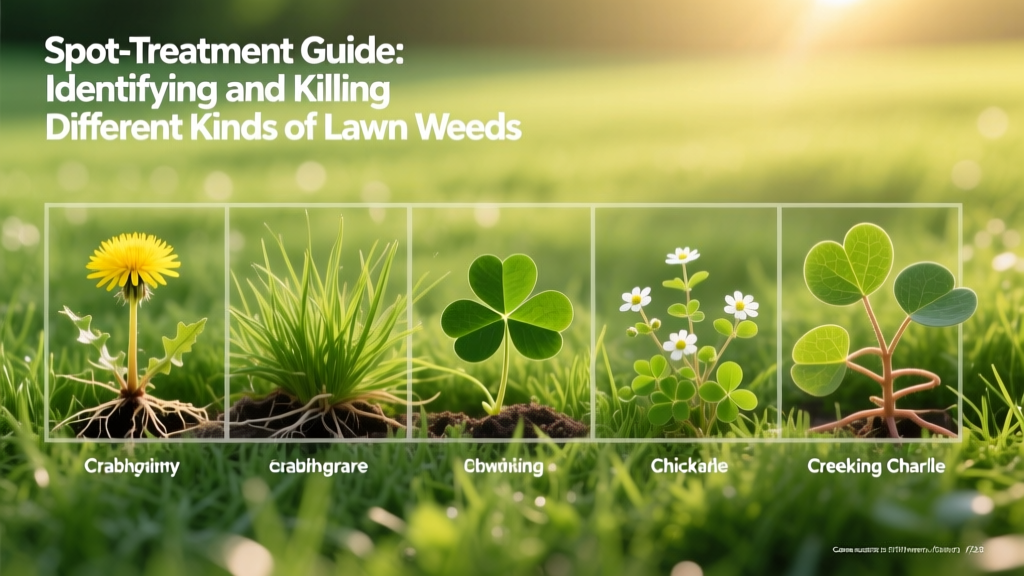
Spot-Treatment Guide: Identifying and Killing Different Kinds of Lawn Weeds
The 3-Category Weed Identification Framework
Blanket-spraying an entire lawn with non-selective herbicides is a relic of outdated turf management. Modern spot-treatment requires precise identification. When managing a turf ecosystem, understanding the different kinds of lawn weeds is the prerequisite for effective chemical control. Weeds are broadly classified into three botanical categories, each requiring a completely different active ingredient and surfactant strategy.
| Weed Category | Visual Identification Cues | Root / Reproductive System | Primary Active Ingredients |
|---|---|---|---|
| Broadleaf | Wide leaves, net-like veins, distinct flowering structures. | Taproots or fibrous shallow roots. | 2,4-D, Dicamba, Triclopyr, Carfentrazone. |
| Grassy | Narrow leaves, parallel veins, hollow rounded stems. | Fibrous roots, aggressive stolons, or seed-head reliance. | Quinclorac, Mesotrione, Fenoxaprop-p-ethyl. |
| Sedges | Narrow leaves, triangular solid stems ('sedges have edges'). | Rhizomes and underground tubers (nutlets). | Halosulfuron-methyl, Sulfentrazone, Imazaquin. |
According to the NC State University TurfFiles weed database, misidentifying a sedge as a grassy weed is the most common failure point in residential lawn care, leading to wasted chemicals and turf damage.
Spot-Treating Broadleaf Weeds (Dandelion, Clover, Plantain)
Broadleaf weeds are generally the easiest to control via spot treatment because their physiology differs vastly from your turfgrass, allowing for highly selective systemic herbicides. The industry standard for residential broadleaf spot-treatment is a three-way herbicide mixture.
Formulation Recommendation: Use a commercial concentrate like Trimec Classic or SpeedZone (which includes Carfentrazone for a faster visual burn-down). Avoid ready-to-use aerosol cans; they lack the concentration required to translocate the chemical down to the taproot of mature dandelions.
Application Parameters for Broadleafs
- Mixing Rate: 1.5 fluid ounces of three-way concentrate per 1 gallon of water.
- Surfactant: Add 0.25% v/v (roughly 1/2 teaspoon per gallon) of a non-ionic surfactant. Broadleaf leaves have waxy cuticles; without a surfactant, the herbicide beads up and rolls off.
- Temperature Window: Apply when daytime highs are between 65°F and 85°F. Applications above 90°F risk vapor drift, which can curl the leaves of nearby desirable ornamental shrubs.
- Visual Timeline: Expect leaf curling within 48 hours and complete root necrosis in 14 to 21 days.
Spot-Treating Grassy Weeds (Crabgrass, Goosegrass, Poa Annua)
Grassy weeds are notoriously difficult to spot-treat because their cellular structure mimics your actual lawn. You must use selective post-emergent grassy weed herbicides that exploit specific metabolic vulnerabilities in the weed.
The Quinclorac vs. Mesotrione Decision Matrix
Choosing the right chemical depends entirely on your turf type and the weed's growth stage.
| Active Ingredient | Brand Example | Safe For Turf Types | Target Weeds & Growth Stage |
|---|---|---|---|
| Quinclorac | Drive XLR8 | Bermuda, Zoysia, Fescue, Kentucky Bluegrass. | Crabgrass (all tiller stages), Foxtail. |
| Mesotrione | Tenacity | Cool-season grasses ONLY (Fescue, Bluegrass, Ryegrass). | Crabgrass (pre-tiller), Goosegrass, Poa Annua. |
Critical Warning for Warm-Season Lawns: Never apply Quinclorac or Mesotrione to St. Augustine or Centipede grass. Quinclorac will cause severe phytotoxicity (yellowing and stunting) in St. Augustine, while Mesotrione will bleach and kill it. For grassy weeds in St. Augustine, your only safe spot-treatment option is manual extraction or careful painting of a non-selective glyphosate gel directly onto the weed leaf.
Execution Steps for Grassy Weed Spot-Treatment
- Calibrate the Sprayer: A standard 1-gallon pump sprayer should cover exactly 1,000 square feet when walking at a normal pace. For spot treatment, you are only treating the weed cluster, but you must maintain this dilution ratio to avoid burning the surrounding turf.
- Add Crop Oil (For Mesotrione only): If using Tenacity, you must include a Crop Oil Concentrate (COC) at 1% v/v (1.25 oz per gallon). Without COC, Mesotrione will fail to penetrate the grassy weed cuticle.
- Target the Center: Spray the crown of the crabgrass clump until just wet. Do not spray to the point of runoff.
Spot-Treating Sedges (Yellow and Purple Nutsedge)
Nutsedge is not a grass; it is a sedge. It reproduces via underground tubers (nutlets) that can survive in the soil profile for up to three years. Pulling nutsedge by hand actually stimulates dormant nutlets to sprout, worsening the infestation. The University of California Statewide IPM Program emphasizes that chemical translocation is the only viable control method for mature nutsedge colonies.
The Halosulfuron-Methyl Protocol
The undisputed standard for nutsedge spot-treatment is Halosulfuron-methyl (commonly sold as SedgeHammer). It inhibits the ALS enzyme, starving the sedge of essential amino acids and eventually killing the underground nutlets.
- Dosage: One 13.5-gram water-soluble packet of SedgeHammer treats 1,000 square feet. For spot-treating a 10x10 foot patch, you will use roughly 1/8th of a packet (approx. 1.7 grams) mixed into 1 quart of water.
- Surfactant Requirement: SedgeHammer requires a specific non-ionic surfactant (often included in the box). Do not substitute with crop oil or methylated seed oil, as this can cause turf burn.
- The 6-Week Rule: Halosulfuron-methyl is slow-acting. The nutsedge will stop growing within 48 hours, but it will take 2 to 3 weeks to show visible necrosis. Do not reapply if the weed looks green at day 14. A second application is only permitted 6 to 8 weeks after the first, targeting newly emerged shoots from surviving nutlets.
Mixing and Application Precision for Spot Treatments
The most common reason spot-treatments fail is improper mixing. Herbicides are not 'more is better' compounds; exceeding the label rate will burn the leaf tissue before the chemical can translocate to the root system, resulting in a top-kill that allows the weed to regenerate.
The 1-Gallon Pump Sprayer Calibration Method
To ensure your spot-treatment mixture is accurately diluted, use the University of Minnesota Extension's simplified calibration technique:
- Fill your 1-gallon tank with plain water.
- Mark a 10-foot by 10-foot area (100 sq ft) on your driveway or sidewalk.
- Spray the water over the area at your normal walking pace and pumping cadence.
- Measure how much water was used. If you used 1 quart (32 oz) to cover 100 sq ft, your tank will cover 400 sq ft per gallon. Adjust your chemical concentrate accordingly.
Troubleshooting Common Spot-Treatment Failures
Diagnostic Check: Did your crabgrass turn stark white but continue to grow? This is the intended bleaching effect of Mesotrione (Tenacity). It means the chemical is working by inhibiting photosynthesis. The weed will starve and die within 21 days. Do not apply a second dose while it is white.
Failure Mode 1: Broadleaf weed turned black and crispy in 24 hours, but grew back a month later.
Cause: You applied the herbicide during a temperature spike (above 90°F) or used too high a concentration. The chemical burned the leaf tissue instantly, preventing systemic translocation to the taproot. Always mix at the exact label rate and apply during cooler morning hours.
Failure Mode 2: Nutsedge returned in the exact same spot after a successful kill.
Cause: The original plant had multiple deep nutlets. The first application killed the mother plant and the primary nutlet, but a secondary, deeper nutlet broke dormancy. This is normal. Execute your second spot-treatment application at the 6-week mark to exhaust the tuber bank.
Failure Mode 3: Sprayed weeds are curling, but the surrounding Kentucky Bluegrass is also stunting and yellowing.
Cause: Herbicide drift or over-spray. When spot-treating, use a sprayer nozzle that produces a coarse, heavy droplet pattern rather than a fine mist. Fine mists drift on micro-currents of wind, depositing sub-lethal doses of broadleaf herbicides onto your desirable turf.

