
Lawn Care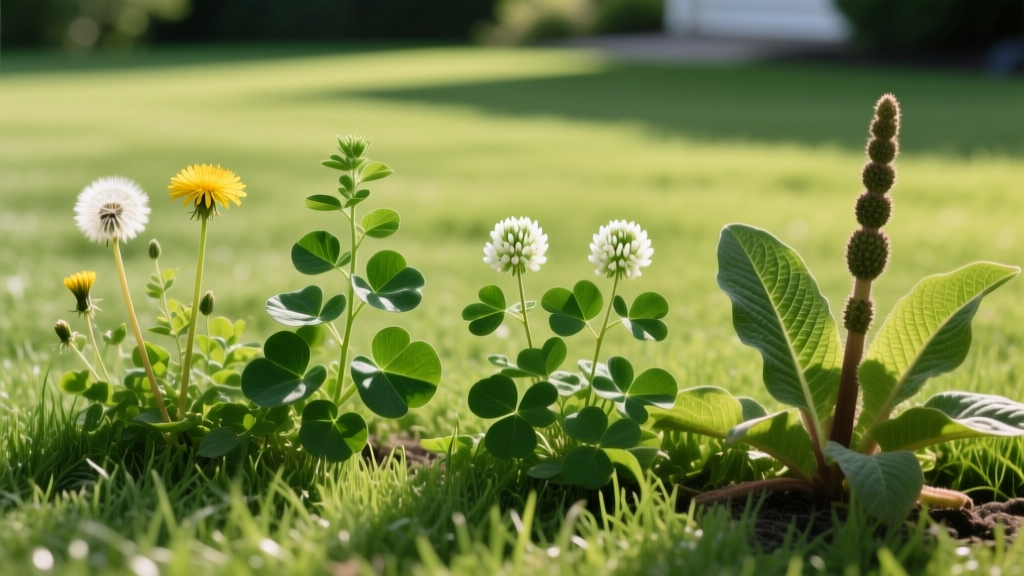
Spot-Treatment Guide for Different Weed Types in Home Lawns
Broadcast spraying herbicides across an entire lawn is an outdated, expensive, and ecologically damaging practice. Modern turf management relies on precise spot-treatments tailored to the specific botanical classification of the invading weed. Identifying and targeting different weed types with the correct active ingredient, surfactant, and application timing reduces chemical usage by up to 80% while achieving superior kill rates. This guide provides exact formulations, product recommendations, and failure-mode analysis for eradicating the three primary weed categories: broadleaf, grassy, and sedges.
The Botanical Breakdown: Categorizing Different Weed Types
Effective spot-treatment begins with accurate identification. Herbicides are highly selective; a chemical that dissolves the waxy cuticle of a broadleaf weed will have zero effect on the cellular structure of a grassy weed. According to NC State University Turfgrass Science, misidentification is the leading cause of herbicide failure in residential lawns. Weeds are divided into three distinct biological groups:
- Broadleaf Weeds: Dicots with wide leaves and net-like veins (e.g., Dandelion, White Clover, Plantain).
- Grassy Weeds: Monocots that mimic turfgrass with parallel veins and hollow, round stems (e.g., Crabgrass, Poa Annua, Goosegrass).
- Sedges and Rushes: Monocots with solid, triangular stems and a preference for wet, compacted soils (e.g., Yellow Nutsedge, Purple Nutsedge).
Broadleaf Weed Spot-Treatment Protocols
Broadleaf weeds are generally the easiest to control post-emergence, but they require specific synthetic auxins (growth regulators) to induce fatal cellular overgrowth. The industry standard for broadleaf spot-treatment is a multi-active-ingredient approach to prevent resistance and ensure complete translocation to the root system.
The 'Big Three' Broadleaf Targets
- Dandelion (Taraxacum officinale): Features a deep taproot. Requires a systemic herbicide that translocates downward. 2,4-D is highly effective when applied in the fall when the plant is actively storing carbohydrates in its roots.
- White Clover (Trifolium repens): Features a thick, waxy cuticle and spreads via stolons. Standard 2,4-D often fails here. You must use Triclopyr or Fluroxypyr to penetrate the leaf surface.
- Broadleaf Plantain (Plantago major): Thrives in compacted soil. Requires a combination of Dicamba and MCPP for complete control.
Pro Formulation Recommendation: For a comprehensive broadleaf spot-treatment mix, use SpeedZone (Active ingredients: Carfentrazone-ethyl, 2,4-D, MCPP, Dicamba). It provides rapid visual burndown (within 24 hours) via Carfentrazone, while the systemic auxins kill the roots. Current pricing averages $120 per gallon, but the spot-treatment mixing rate is only 1.5 fl oz per gallon of water, making the cost per application roughly $0.15 per square foot.
Grassy Weed Eradication: The Toughest Category
Because grassy weeds share the same biological makeup as your desired turf, selective post-emergent control is highly complex. The herbicide must target an enzyme or metabolic pathway unique to the weed without harming the lawn.
Crabgrass and Goosegrass Control
Crabgrass (smooth and large) and Goosegrass are summer annuals. Once they tiller (produce secondary stems), they become highly resistant to standard treatments.
- Quinclorac (Drive XLR8): The premier post-emergent crabgrass killer. It is highly effective on mature crabgrass but carries a strict warning: Quinclorac will severely stunt or discolor Bermuda grass and St. Augustine grass. It is safe for Kentucky Bluegrass, Fescue, and Ryegrass. Cost: ~$75 for 2.5 gallons.
- Fenoxaprop-p-ethyl (Acclaim Extra): The safest option for warm-season lawns (Bermuda, Zoysia). It inhibits fatty acid synthesis in the weed. It must be applied to young, pre-tillered crabgrass for optimal results. Cost: ~$90 per 28 oz bottle.
Poa Annua (Annual Bluegrass)
Poa Annua is a winter annual that plagues cool-season lawns. Post-emergent control in a cool-season lawn is nearly impossible without damaging the turf. The most effective strategy is a fall pre-emergent application of Prodiamine (Barricade) at a rate of 1.15 lbs per 1,000 sq ft when soil temperatures drop to 70°F. If post-emergent spot treatment is absolutely necessary in a cool-season lawn, Tenacity (Mesotrione) at 5 ml per gallon will bleach and kill Poa Annua, though it will also temporarily bleach surrounding Fescue or Bluegrass.
Sedge and Rush: The Moisture Indicators
Sedges are not grasses; they belong to the Cyperaceae family. A common turf adage is 'sedges have edges'—if you roll the stem between your fingers and feel a distinct triangle, you are dealing with a sedge. Standard grass and broadleaf herbicides will not touch them.
Yellow and Purple Nutsedge Protocols
Nutsedge reproduces via underground tubers (nutlets). Pulling them by hand usually snaps the stem, leaving the tubers intact to regenerate. Chemical control requires specific ALS-inhibitor herbicides.
- Halosulfuron-methyl (SedgeHammer): The gold standard for nutsedge. It halts amino acid production. Critical application note: Halosulfuron is slow-acting. You will not see necrosis for 14 to 21 days. Do not mow for 48 hours before or after application to allow maximum foliar absorption. Cost: ~$25 for a 5-pack of 0.033 oz water-soluble packets.
- Sulfentrazone (Dismiss): Offers a much faster burndown (visible in 3 to 5 days) and is excellent for Purple Nutsedge, which is notoriously harder to kill than Yellow Nutsedge. Cost: ~$110 per 12 oz bottle.
Spot-Treatment Decision Matrix
Use this matrix to select the correct chemistry based on your specific weed and turfgrass combination.
| Target Weed Type | Primary Active Ingredient | Top Product (2026) | Safe For Turf Types | Mix Rate (per Gallon) |
|---|---|---|---|---|
| Dandelion, Plantain | 2,4-D + Dicamba + MCPP | SpeedZone | All Cool & Warm Season | 1.5 fl oz |
| White Clover, Oxalis | Triclopyr + Fluoroxypyr | Turflon Ester Ultra | Cool Season, Bermuda, Zoysia | 1.0 fl oz |
| Crabgrass (Cool Season Lawn) | Quinclorac | Drive XLR8 | Fescue, Bluegrass, Ryegrass | 1.5 fl oz |
| Crabgrass (Warm Season Lawn) | Fenoxaprop-p-ethyl | Acclaim Extra | Bermuda, Zoysia | 0.4 fl oz |
| Yellow/Purple Nutsedge | Halosulfuron-methyl | SedgeHammer | All Cool & Warm Season | 1 packet (0.033 oz) |
Advanced Application Techniques & Failure Modes
Even with the correct chemical, poor application mechanics will result in treatment failure. According to the University of California Statewide IPM Program, environmental factors and water chemistry frequently neutralize herbicides before they reach the target plant.
Warning: Ester Volatilization
Many broadleaf herbicides (like Triclopyr and 2,4-D) are formulated as 'esters' for better leaf penetration. However, esters volatilize (turn into a gas) when ambient temperatures exceed 85°F. This gas can drift and severely damage nearby ornamental shrubs, trees, and garden vegetables. Always switch to an 'amine' formulation or spray during early morning hours when temperatures are below 80°F.
Many broadleaf herbicides (like Triclopyr and 2,4-D) are formulated as 'esters' for better leaf penetration. However, esters volatilize (turn into a gas) when ambient temperatures exceed 85°F. This gas can drift and severely damage nearby ornamental shrubs, trees, and garden vegetables. Always switch to an 'amine' formulation or spray during early morning hours when temperatures are below 80°F.
Overcoming Hard Water Tie-Up
If your municipal or well water has a high pH (above 7.5) or contains high levels of calcium and magnesium (hard water), these cations will bind to the herbicide molecules, rendering them inactive. This is particularly problematic with Glyphosate and 2,4-D. The Fix: Add Ammonium Sulfate (AMS) to your spray tank. Add 2.5 ounces of AMS per gallon of water before adding the herbicide. The AMS conditions the water and prevents cation tie-up, increasing kill rates by up to 30%.
The Necessity of Non-Ionic Surfactants (NIS)
Weeds like clover and plantain have evolved hydrophobic (water-repelling) leaf surfaces. If your chosen herbicide label requires a surfactant, do not skip it. A high-quality Non-Ionic Surfactant (like Methylated Seed Oil or a standard NIS at 0.25% v/v) reduces the surface tension of the water droplet, causing it to flatten and spread across the leaf rather than bead up and roll off onto the soil.
Frequently Asked Questions
Can I mix pre-emergent and post-emergent herbicides in the same tank?
Yes, but with caveats. You can tank-mix a liquid pre-emergent like Prodiamine with a post-emergent like SpeedZone to save time. However, the post-emergent requires you to spray the foliage of the weed, while the pre-emergent needs to reach the soil surface. When spot-treating, this dual-action is inefficient. Reserve tank-mixing for broadcast applications where blanket coverage is intended.
Why did my nutsedge turn yellow but then come back two weeks later?
This is a classic symptom of treating mature nutsedge without a follow-up. The initial application killed the visible 'mother' plant and the primary nutlet, but the secondary dormant nutlets deeper in the soil profile were stimulated to grow by the death of the parent plant. You must plan for a mandatory second application of Halosulfuron-methyl 21 to 28 days after the first treatment to eliminate the secondary flush.
Is it safe to spot-treat weeds when my lawn is drought-stressed?
No. When turfgrass and weeds are drought-stressed, the weeds close their stomata (leaf pores) to conserve moisture. This prevents systemic herbicides from entering the plant tissue. Furthermore, applying herbicides to drought-stressed turf can cause severe phytotoxicity (chemical burn) to your desired grass. Always irrigate the lawn deeply 24 hours before spot-treating to ensure the weeds are actively growing and absorbing the chemistry.

