
Lawn Care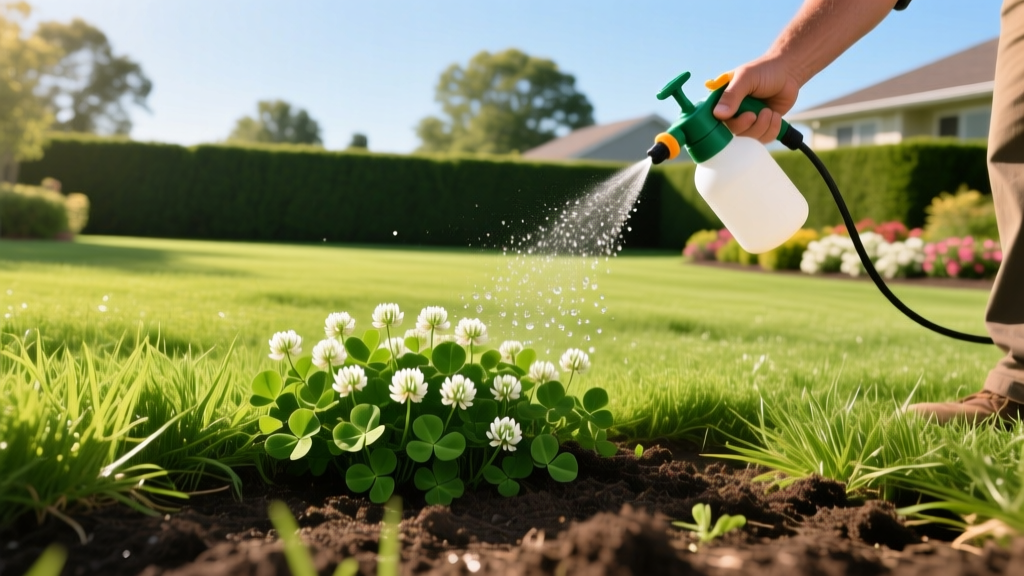
Reclaiming Your Turf: Spot-Treating a Field of Clovers
The Agronomic Reality of a Clover Takeover
Looking out at your yard and realizing you are managing a field of clovers rather than a turfgrass lawn is a common frustration for homeowners. White clover (Trifolium repens) is a perennial broadleaf weed that thrives in environments where your desired grass is struggling. Clover is a legume, meaning it hosts Rhizobium bacteria in its root nodules to fix atmospheric nitrogen. When your soil is nitrogen-deficient, compacted, or subjected to low mowing heights, clover gains a massive competitive advantage. Spot-treating a localized field of clovers requires a strategic approach that combines precise chemical or organic applications with immediate cultural corrections to prevent reinvasion.
The Nitrogen Paradox: While clover fixes nitrogen for itself, it does not share this nutrient with surrounding turfgrass in a competitive lawn setting. According to University of Minnesota Extension, a dense clover canopy actively shades out turfgrass crowns, reducing photosynthesis and ultimately killing the grass, which creates more bare soil for the next generation of clover seeds to germinate.
Spot-Treatment Decision Matrix
Before mixing any solutions, evaluate the severity of your field of clovers and your lawn's grass type. Use this matrix to select the optimal eradication protocol.
| Treatment Type | Best For | Active Ingredients | Estimated Cost per 1,000 sq ft |
|---|---|---|---|
| Synthetic 3-Way | Cool-season lawns (Fescue, Bluegrass) with moderate-to-heavy clover | 2,4-D, Dicamba, MCPP | $0.05 - $0.10 |
| Synthetic Ester | Early spring/late fall spot treatments in cooler weather (under 60°F) | Triclopyr, Fluroxypyr | $0.12 - $0.18 |
| Organic Iron (FeHEDTA) | Warm-season lawns (Bermuda, Zoysia) or organic-only landscapes | Chelated Iron (FeHEDTA) | $0.80 - $1.20 |
| Mechanical | Micro-invasions (less than 5% of total lawn area) | Stand-up weeding tools | $0.00 (Time intensive) |
Chemical Spot-Treatment Protocols
When your yard has devolved into a field of clovers, systemic synthetic herbicides are the most efficient remediation tool. Clover leaves possess a waxy cuticle that repels water-based sprays, making the inclusion of a surfactant non-negotiable.
Mixing and Application Rates
For a professional-grade spot treatment, use a 3-way amine herbicide like PBI Gordon Trimec Classic (approximately $48 per gallon). This formulation is safe for most cool-season grasses and St. Augustinegrass.
- Herbicide Rate: Mix 1.5 fluid ounces of Trimec Classic per 1,000 square feet.
- Surfactant Rate: Add a Non-Ionic Surfactant (NIS) at a 0.25% volume-to-volume ratio (roughly 1/2 teaspoon per gallon of mixed spray solution).
- Water Volume: Use 1.5 to 2.0 gallons of water per 1,000 square feet to ensure thorough coverage without excessive runoff.
Warning: Temperature Inversions and Volatilization
Do not apply ester-based herbicides (like those containing Triclopyr) when daytime temperatures exceed 85°F. High heat causes the chemical to vaporize and drift, which can severely damage nearby ornamental shrubs, tomato plants, and desirable broadleaf vegetation.
Do not apply ester-based herbicides (like those containing Triclopyr) when daytime temperatures exceed 85°F. High heat causes the chemical to vaporize and drift, which can severely damage nearby ornamental shrubs, tomato plants, and desirable broadleaf vegetation.
Timing the Application
The optimal window for spot-treating clover is when soil temperatures are consistently between 55°F and 75°F. In most temperate zones, this aligns with mid-to-late spring and early autumn. During the heat of summer, clover enters a semi-dormant state, slowing its metabolic rate and reducing the translocation of systemic herbicides down to the taproot. Applying herbicides during summer dormancy will burn the top growth but leave the root system intact, guaranteeing a rapid resurgence.
Organic Eradication: Chelated Iron (FeHEDTA)
If you maintain a warm-season lawn like Bermudagrass or Zoysia, or if you strictly avoid synthetic chemicals, Iron HEDTA (hydroxyethylenediaminetriacetic acid) is your primary weapon. Products like Natria Lawn Weed Control or Fiesta Turf Weeder utilize chelated iron to induce fatal oxidative stress in broadleaf weeds while remaining largely safe for monocot grasses.
Application Strategy for FeHEDTA
Unlike synthetic herbicides that require precise micro-dosing, iron-based herbicides require heavy, drenching coverage. You must physically coat the clover leaves to achieve a burn-down.
- Rate: Apply 5 to 7 fluid ounces of FeHEDTA solution per 1,000 square feet. Do not dilute heavily; use the ready-to-spray formulation or mix concentrates exactly to label directions.
- Frequency: Iron herbicides do not translocate well to the roots. You must plan for a minimum of two applications spaced 14 to 21 days apart to kill the initial growth and the subsequent flush from the root crown.
- Visual Result: Expect the clover to turn black and desiccate within 48 hours. Note that FeHEDTA will also temporarily darken your turfgrass, giving it a deep, almost blue-green hue for about a week.
Post-Treatment Turf Recovery
Eradicating the weed is only 50% of the battle. If you eliminate a field of clovers without addressing the underlying soil deficiencies, you will simply create bare patches primed for crabgrass or a new flush of clover seeds. According to Penn State Extension, clover dominance is a primary indicator of low soil fertility and poor turf density.
The 30-Day Recovery Protocol
Follow this strict timeline after your final herbicide application to secure the turf canopy:
- Day 7 (Soil Testing): Pull core samples and submit them to a local university extension lab. You are specifically looking for phosphorus and potassium levels, as well as soil pH. Clover tolerates acidic soils (pH 5.5) better than Kentucky Bluegrass or Fescue (which prefer 6.2 to 6.8).
- Day 14 (Nitrogen Injection): Apply a fast-release nitrogen source, such as Urea (46-0-0), at a rate of 0.5 lbs of actual nitrogen per 1,000 square feet. This forces the surviving turfgrass to rapidly expand its lateral growth and fill the voids left by the dead clover.
- Day 21 (Core Aeration & Overseeding): If bare patches exceed 3 inches in diameter, rent a core aerator to relieve the soil compaction that initially favored the clover. Immediately overseed these zones with a shade-tolerant, disease-resistant turf blend at 6 to 8 lbs per 1,000 square feet.
Common Spot-Treatment Failure Modes
Homeowners frequently report that their field of clovers 'always comes back.' This is rarely due to herbicide resistance and almost always due to application errors.
- Omitting the Surfactant: Without a non-ionic surfactant or methylated seed oil (MSO), the water-based spray beads up and rolls off the waxy clover leaf, delivering a sub-lethal dose to the plant.
- Mowing Too Soon: Never mow your lawn for 48 hours before or 48 hours after applying a systemic herbicide. You need maximum leaf surface area to absorb the chemical, and you need time for the chemical to translocate to the stolon and root nodes before you sever the plant.
- Ignoring the Seed Bank: White clover produces seeds that remain viable in the soil for up to 15 years. Even if you kill the mature plants, pre-emergent herbicides (like Prodiamine) do not effectively stop clover germination. You must rely on a thick, dense turf canopy to physically block sunlight from reaching the soil surface to prevent seed germination.
Frequently Asked Questions
Can I just let the clover grow as a natural lawn?
Yes, 'microclover' blends are gaining traction for low-input landscapes. However, standard white clover creates a highly uneven, slippery surface when wet, stains clothing and skin with its sap, and attracts stinging insects like bees during its flowering phase, making it a liability for high-traffic recreational lawns.
Will pulling clover by hand work?
Manual extraction is only viable for isolated patches. White clover spreads via stolons (above-ground runners) that root at the nodes. If you pull the plant and snap the stolon, the remaining rooted nodes will simply sprout new crowns. If you choose mechanical removal, use a stand-up weeder with a deep forked tip to extract the entire taproot.

