
Lawn Care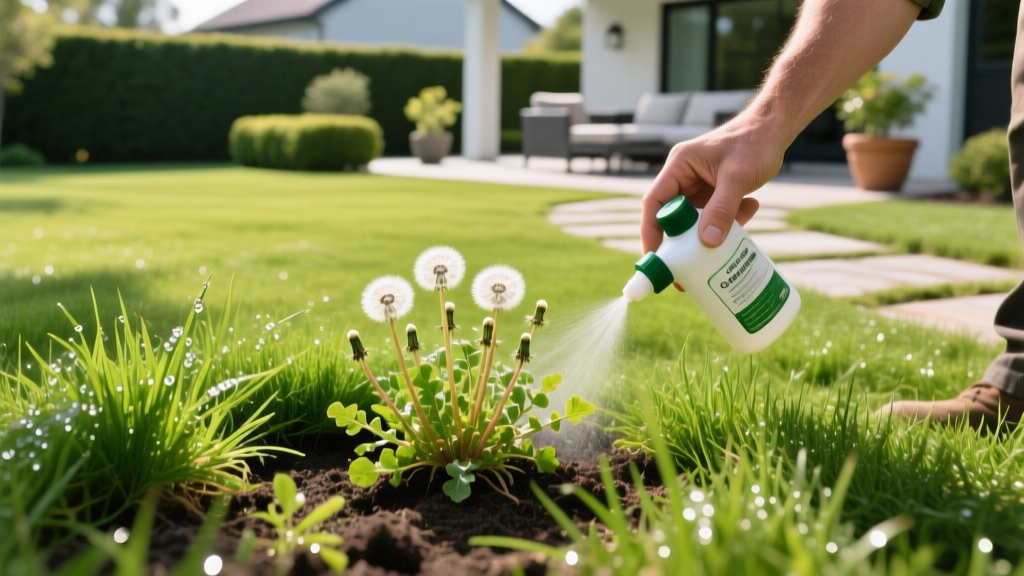
Weeds Taking Over Grass? A Spot-Treatment Guide for Lawn Invaders
When you notice weeds taking over grass, the immediate instinct is often to broadcast-spray the entire lawn with a hose-end herbicide. This is a costly mistake that stresses desirable turf, wastes expensive chemicals, and leaves your soil microbiome compromised. Spot-treatment targets the invaders directly, preserving the health of your primary grass species while eradicating the competition. However, successful spot-treatment requires precise chemical selection, accurate calibration, and strict adherence to temperature and timing windows.
Diagnostic Matrix: Identifying the Primary Lawn Invaders
Before mixing any chemicals, you must correctly identify the weed category. Applying a broadleaf herbicide to a grassy weed will result in zero efficacy and wasted product. Use the matrix below to identify the four most common species responsible for weeds taking over grass in residential lawns.
| Weed Species | Category | Key Visual Identifier | Primary Active Ingredient |
|---|---|---|---|
| Crabgrass | Grassy (Annual) | Prostrate growth, light green, star-shaped center | Quinclorac |
| Yellow Nutsedge | Sedge (Perennial) | Triangular stem, grows 2x faster than turf, yellow-green | Halosulfuron-methyl |
| White Clover | Broadleaf (Perennial) | Trifoliate leaves with white crescent, creeping stolons | Triclopyr + 2,4-D |
| Broadleaf Plantain | Broadleaf (Perennial) | Thick, ribbed oval leaves in a dense basal rosette | Dicamba + MCPP |
The Chemistry of Spot-Treatment: Selective vs. Non-Selective
To stop weeds taking over grass without killing the grass itself, you must rely on selective systemic herbicides. These chemicals exploit physiological differences between monocots (grasses) and dicots (broadleaves), or target specific enzyme pathways absent in desirable turf.
Selective Systemic Herbicides
- 2,4-D Amine: The backbone of broadleaf control. It mimics auxin (a plant growth hormone), causing dicots to grow uncontrollably until their vascular tissue collapses. It is highly effective on dandelions and clover but will not harm established Kentucky bluegrass or tall fescue.
- Quinclorac: One of the few post-emergent chemicals effective against mature crabgrass. It disrupts cellulose biosynthesis in grassy weeds. Note: Quinclorac can cause temporary stunting in St. Augustinegrass and Centipedegrass.
- Halosulfuron-methyl: An ALS-inhibitor specifically designed for sedges. It halts amino acid production in nutsedge, starving the underground tubers (nutlets) over a 3-to-4-week period.
⚠️ CRITICAL WARNING: Temperature Volatility
Never apply herbicides containing 2,4-D or Dicamba when daytime temperatures exceed 85°F. At high temperatures, these chemicals volatilize (turn into a gas) and drift onto nearby ornamental shrubs, trees, and garden beds, causing severe cupping and necrosis. Always spot-treat in the early morning when temperatures are between 65°F and 80°F.
Step-by-Step Spot-Treatment Protocol
Achieving a lethal dose on the weed while avoiding turf burn requires precise mixing. Most ready-to-use aerosol sprayers lack the surfactant required to penetrate waxy weed cuticles. For professional results, use a 1-gallon or 2-gallon polyethylene pump sprayer (such as the Chapin 20000 series, typically $25-$35).
- Calibrate Your Sprayer: Fill the tank with exactly 1 gallon of water. Spray a 1,000 square foot area (e.g., 20x50 feet) at your normal walking pace. If you run out of water before finishing, you are walking too slow or your nozzle is too open. Adjust until 1 gallon covers exactly 1,000 sq ft.
- Add Surfactant First: Add 0.5 ounces of a non-ionic surfactant (NIS) to the 1 gallon of water. Surfactants reduce the surface tension of the water droplet, allowing the herbicide to spread and stick to the weed's leaf rather than beading up and rolling off. This is mandatory for plantain and mature crabgrass.
- Mix the Active Ingredient: Add the exact rate specified on the label for a 1-gallon mix. For example, if using a liquid Triclopyr/2,4-D concentrate (like Ortho WeedClear for Lawns, ~$15/pint), the spot-treatment rate is typically 1.5 to 2.0 fluid ounces per gallon of water.
- Apply to the Point of Runoff: Spray the weed until the leaves are visibly wet and glistening, but not dripping onto the soil. Systemic herbicides are absorbed through the foliage, not the roots.
Species-Specific Spot-Treatment Playbook
Scenario A: Nutsedge is Choking Out Your Turf
If yellow nutsedge is the primary culprit for weeds taking over grass, physical removal is counterproductive. Pulling nutsedge snaps the rhizome, leaving the nutrient-rich nutlets in the soil to activate and produce multiple new shoots. According to the University of California Statewide IPM Program, chemical intervention with halosulfuron-methyl (sold as SedgeHammer, approx. $28 for a 5-pack of 0.9g water-soluble bags) is the gold standard. Apply when the nutsedge has reached the 3-to-5 leaf stage. Expect the weed to yellow and necrotize slowly over 21 to 28 days. Do not reapply or mow the area for at least two weeks post-application to allow full translocation to the tubers.
Scenario B: Broadleaf Weeds in Low-Nitrogen Soil
White clover and black medic aggressively invade lawns suffering from nitrogen deficiency. While spot-treating with a 3-way broadleaf herbicide (2,4-D + MCPP + Dicamba) will kill the existing weeds, it does not fix the underlying soil deficiency. Spot-treat the weeds, wait 48 hours, and then apply a high-nitrogen fertilizer (such as a 30-0-2 NPK ratio) at a rate of 1 lb of actual nitrogen per 1,000 sq ft. As the Penn State Extension notes, maintaining dense, vigorously growing turf is the most effective long-term biological barrier against broadleaf weed germination.
Post-Treatment Recovery and Overseeding Timelines
Once the targeted weeds die back, they leave bare patches in the turf. If left untreated, these bare spots will immediately be colonized by new weed seeds. You must overseed these patches, but herbicide residual activity dictates your timeline.
Overseeding Wait-Time Cheat Sheet
- Mesotrione (Tenacity): Can be applied at the exact time of seeding. (Cost: ~$65 for 8 oz; highly cost-effective for large properties).
- 2,4-D / Triclopyr / Dicamba: Wait 14 to 21 days before overseeding tall fescue or ryegrass.
- Quinclorac: Wait 21 days for tall fescue, but up to 28 days for Kentucky bluegrass. Seeding too early will result in severe seedling root stunting.
Expert FAQ: Troubleshooting Spot-Treatment Failures
Why did the weed turn red but refuse to die?
If crabgrass turns purple or red after a Quinclorac application but remains rooted, you likely applied the herbicide when the weed was under drought stress. Stressed weeds shut down their phloem transport system to conserve water, preventing the systemic herbicide from moving to the roots. Always irrigate the lawn deeply 24 hours before spot-treating to ensure the weeds are actively translocating nutrients.
Is it safe to spot-treat near vegetable gardens?
No. Even with careful spot-treatment, accidental drift or soil runoff during heavy rain can introduce persistent herbicides (like Quinclorac or Clopyralid) into garden beds. These chemicals can cause severe deformities in tomatoes, peppers, and legumes. Maintain a strict 10-foot buffer zone between treated lawn areas and edible gardens, using a physical shield on your spray wand when working near borders.
How many spot-treatments are required for a heavy infestation?
For mature perennial weeds with deep taproots (like curly dock or mature plantain), a single application rarely achieves 100% kill. Plan for a follow-up spot-treatment 21 days after the initial application. The second application targets the weakened regrowth before the plant can rebuild its root carbohydrate reserves.

