
Lawn Care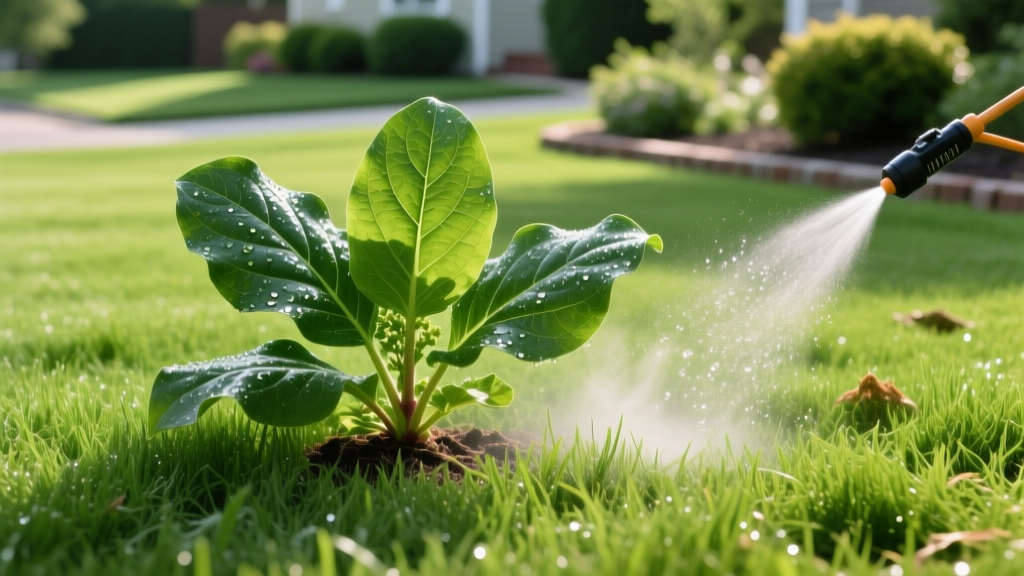
How to Kill Weeds With Very Large Leaves: Spot-Treatment Guide
The Challenge of Giant Broadleaf Weeds in Turfgrass
Most standard lawn weeds, like dandelions or clover, are relatively easy to manage with routine maintenance. However, weeds with very large leaves present a unique and aggressive challenge to turfgrass health. These oversized invaders cast dense, localized shade that rapidly starves underlying grass of sunlight, creating bare patches that invite further infestation. Furthermore, the species that produce massive foliage typically develop extensive, deep taproots or rhizome networks that store immense energy reserves, allowing them to survive superficial mowing and resist weak herbicide applications.
Broadcast spraying your entire lawn to target a few isolated giant weeds is both economically wasteful and environmentally irresponsible. This guide details the precise identification, chemical formulation, and mechanical spot-treatment protocols required to permanently eradicate these oversized pests without damaging your surrounding cool- or warm-season turf.
Identifying the Most Common Weeds With Very Large Leaves
Before selecting a treatment, you must accurately identify the intruder. Misidentifying a grassy weed for a broadleaf weed, or confusing a shallow-rooted annual with a deep-rooted perennial, will result in treatment failure. Below are the three most common large-leaved weeds found in North American lawns and garden edges.
1. Broadleaf Plantain (Plantago major)
Often found in highly compacted soils and high-traffic areas, broadleaf plantain forms a low-lying rosette. Its oval, dark green leaves can reach up to 12 inches in length and 4 inches in width, characterized by prominent, parallel ribbed veins. According to the UC Statewide IPM Program, plantain thrives where turfgrass struggles due to soil compaction, making aeration a critical long-term preventative measure.
2. Giant Ragweed (Ambrosia trifida)
While often associated with agricultural fields, giant ragweed frequently invades neglected lawn borders and ditch lines. Its leaves are massive, often spanning 12 inches across, featuring a distinct three-lobed (trifid) shape and a fuzzy, sandpaper-like texture. The University of Minnesota Extension notes that this annual weed can grow up to 12 feet tall if left unmowed, dropping thousands of seeds that remain viable in the soil seed bank for years.
3. Common Burdock (Arctium minus)
Burdock produces elephant-ear-like basal leaves that can exceed 24 inches in length and 14 inches in width. These leaves are dark green on top and woolly or grayish-white underneath. Burdock is a biennial; it spends its first year growing this massive leaf rosette and a deep, fleshy taproot (often 2 to 3 feet deep), before bolting and producing its infamous burr-like seed heads in the second year.
| Weed Species | Max Leaf Dimensions | Root Structure | Preferred Soil Condition | Life Cycle |
|---|---|---|---|---|
| Broadleaf Plantain | 12' L x 4' W | Fibrous, shallow taproot | Highly compacted, heavy clay | Perennial |
| Giant Ragweed | 12' W x 8' L | Taproot with lateral branching | Moist, fertile, disturbed edges | Summer Annual |
| Common Burdock | 24' L x 14' W | Deep, fleshy taproot (up to 3') | Rich, moist, loamy soils | Biennial |
Chemical Spot-Treatment: Herbicide Selection and Mixing
When dealing with weeds with very large leaves, the sheer surface area of the foliage can actually work to your advantage—if you use the right chemistry. The large leaf area absorbs more active ingredient, translocating it down into the root system. However, you must use a systemic, selective broadleaf herbicide. Contact herbicides (like diquat or pelargonic acid) will only burn the massive leaves off at the surface, guaranteeing a rapid regrowth from the intact root crown.
Recommended Active Ingredients
- 2,4-D + Dicamba + MCPP (The Standard Trio): Found in consumer products like Ortho WeedClear Lawn Weed Killer ($16 to $20 per gallon). This combination is highly effective on Broadleaf Plantain and young Giant Ragweed.
- Triclopyr (The Heavy Hitter): For mature Burdock or stubborn plantain, Triclopyr is superior. Products like Hi-Yield Triclopyr Ester ($30 to $35 per pint) provide aggressive systemic action that penetrates thick, waxy leaf cuticles and travels deep into fleshy taproots.
- Quinclorac: While primarily known for crabgrass, quinclorac aids in the control of certain large broadleaves and is often included in premium commercial mixes like Drive XLR8 ($85 for 2.5 oz), though it is usually overkill for simple residential spot treatments.
⚠️ Critical Formulation Rule: The Surfactant Multiplier
Weeds with very large leaves, particularly Burdock and Plantain, develop thick, waxy cuticles to retain moisture. If you spray herbicide without a non-ionic surfactant, the droplets will bead up and roll off the massive leaves onto the soil, wasting the chemical and risking root uptake by your turf. Always add a non-ionic surfactant (like Southern Ag Surfactant, $12 per quart) at a rate of 0.5 teaspoons per gallon of mixed herbicide. This breaks the surface tension, ensuring the chemical coats the entire leaf surface evenly.
Weeds with very large leaves, particularly Burdock and Plantain, develop thick, waxy cuticles to retain moisture. If you spray herbicide without a non-ionic surfactant, the droplets will bead up and roll off the massive leaves onto the soil, wasting the chemical and risking root uptake by your turf. Always add a non-ionic surfactant (like Southern Ag Surfactant, $12 per quart) at a rate of 0.5 teaspoons per gallon of mixed herbicide. This breaks the surface tension, ensuring the chemical coats the entire leaf surface evenly.
Step-by-Step Spot Application Protocol
Follow this exact procedure to maximize kill rates while minimizing herbicide drift and turf damage.
- Stage the Weed: Treat weeds when they are in the active vegetative growth stage (rosette or early bolting). Do not treat giant weeds that have already flowered or are under severe drought stress, as they will shut down their vascular systems and fail to translocate the herbicide to the roots.
- Calibrate the Sprayer: Use a dedicated 1-gallon or 2-gallon pump sprayer (like the Chapin Premier 1-Gallon Sprayer, $35). Equip it with a flat-fan nozzle rather than a cone nozzle to ensure an even, directed spray pattern that minimizes wind drift.
- Mix the Solution: Add water to the tank first, then add the surfactant, and finally the herbicide. For a standard 2,4-D/Dicamba mix, use 2.0 fluid ounces per gallon of water. For Triclopyr ester, use 1.0 to 1.5 fluid ounces per gallon. Agitate the tank thoroughly.
- Apply to the Point of Glistening: Spray the large leaves until they are uniformly wet and glistening, but not dripping. Dripping indicates you have exceeded the leaf's absorption capacity and are simply washing the chemical into the soil profile.
- Hold Off on Mowing: Do not mow the lawn for at least 48 hours before and 48 hours after application. The weed needs its full leaf surface area intact to absorb and process the chemical.
Mechanical Removal: When and How to Dig
Chemical treatments are highly effective, but some homeowners prefer organic or mechanical removal, especially near vegetable gardens or water features. The primary failure mode of pulling weeds with very large leaves is snapping the foliage off at the crown while leaving the taproot intact.
Choosing the Right Extraction Tool
Standard hand trowels are insufficient for deep-rooted giants like Burdock. You need specialized extraction tools that leverage the soil to pull the entire root mass.
- Fiskars Uproot Weeder and Remover ($38): Features a serrated, claw-like head that penetrates deeply around the taproot. Best for Broadleaf Plantain in moderately compacted soil.
- Radius Garden 20202 Ergo Weed Puller ($30): Uses a unique curved blade design that slices through lateral roots and leverages the deep taproot out with minimal bending. Ideal for mature Burdock.
- Water and Wait Method: If the soil is dry and hard, mechanical removal will fail. Deeply water the targeted weed area with 1 to 2 gallons of water, wait 24 hours for the soil to soften, and then extract. The fleshy roots of large-leaved weeds will slide out intact when the soil is properly lubricated.
Cultural Controls: Preventing the Return of Giant Weeds
Eradicating the current weed is only half the battle. Weeds with very large leaves are opportunistic; they exploit specific weaknesses in your lawn's ecosystem. To prevent their return, you must alter the environment to favor turfgrass.
✓ Core Aeration for Plantain Control
Broadleaf plantain is a biological indicator of soil compaction. Its massive leaves act as solar panels to outcompete grass in hard-packed dirt where grass roots cannot penetrate. Performing core aeration in the fall (for cool-season grasses) or late spring (for warm-season grasses) physically relieves compaction, allowing turf roots to expand and naturally choke out future plantain seedlings.
Broadleaf plantain is a biological indicator of soil compaction. Its massive leaves act as solar panels to outcompete grass in hard-packed dirt where grass roots cannot penetrate. Performing core aeration in the fall (for cool-season grasses) or late spring (for warm-season grasses) physically relieves compaction, allowing turf roots to expand and naturally choke out future plantain seedlings.
Additionally, maintain proper mowing heights. Cutting your grass too short (scalping) opens the canopy, allowing sunlight to hit the soil surface and trigger the germination of giant weed seeds. Keep cool-season grasses like Tall Fescue and Kentucky Bluegrass at 3.0 to 4.0 inches, and warm-season grasses like Bermudagrass at 1.5 to 2.5 inches. A dense, tall turf canopy is the ultimate biological defense against the establishment of oversized broadleaf weeds.
Frequently Asked Questions
Will household vinegar kill weeds with very large leaves?
No. Household vinegar (5% acetic acid) is a weak contact burn-down agent. While it might singe the edges of a massive plantain or ragweed leaf, it will not penetrate the thick cuticle or translocate to the root system. The weed will regenerate new foliage from the crown within 7 to 10 days. Horticultural vinegar (20% to 30% acetic acid) is slightly more effective but poses severe burn risks to your skin, eyes, and surrounding turf, and still lacks systemic root-killing action.
Can I just mow over giant ragweed and burdock repeatedly?
Mowing will prevent giant ragweed from producing seeds, which is crucial for stopping the spread. However, repeated mowing of burdock or plantain will not kill them. These perennials and biennials will simply adapt by growing their massive leaves flatter against the ground, below the mower blade, while continuing to store energy in their deep taproots. You must use chemical translocation or deep mechanical extraction to achieve a permanent kill.

