
Lawn Care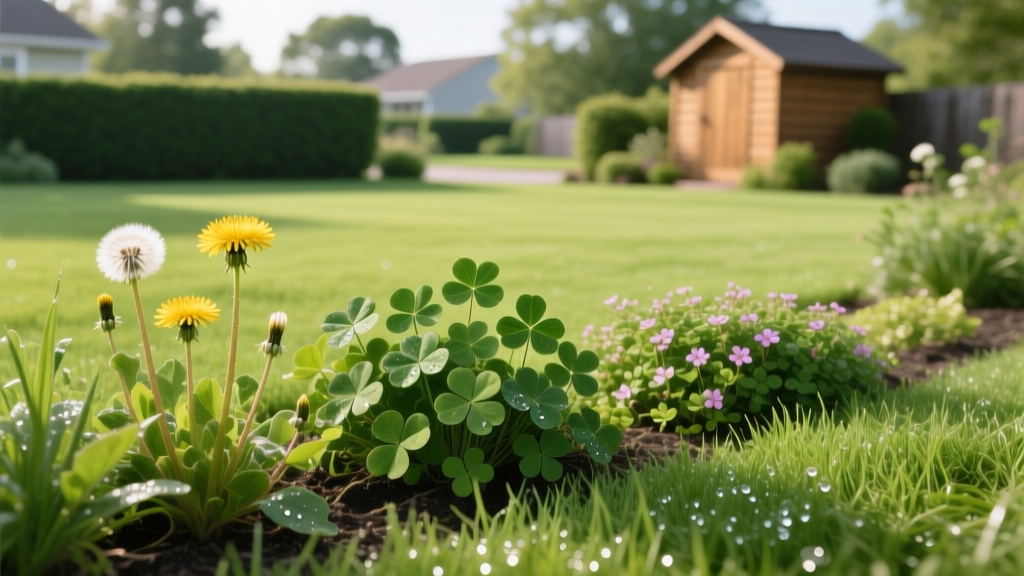
Spot-Treatment Guide for Common Lawn Weed Varieties
Blanket spraying your entire yard with synthetic herbicides wastes money, stresses your turfgrass, and increases chemical runoff. When dealing with isolated patches of invasive plants, targeted application is the gold standard. However, accurately identifying specific lawn weed varieties is the critical first step; applying a broadleaf herbicide to a grassy weed or a sedge will yield zero results and leave the invader untouched. This spot-treatment guide breaks down the exact chemical protocols, surfactant requirements, and application techniques needed to eradicate the most stubborn turf invaders without damaging your surrounding grass.
The Taxonomy of Turf Invaders: Quick Identification Matrix
Before mixing any chemicals, you must categorize the weed. Turf weeds fall into three distinct botanical families, each requiring a completely different mode of action to disrupt their cellular growth.
| Weed Category | Visual Identifiers | Root Structure | Primary Active Ingredients |
|---|---|---|---|
| Broadleaf | Wide leaves, net-like veins, showy flowers | Taproots or trailing rhizomes | 2,4-D, Triclopyr, Dicamba, MCPP |
| Grassy | Narrow leaves, parallel veins, mimics turf | Fibrous roots, stolons | Quinclorac, Fenoxaprop-p-ethyl |
| Sedge | Triangular stems, glossy light-green leaves | Deep tubers (nutlets) | Halosulfuron-methyl, Sulfentrazone |
Broadleaf Lawn Weed Varieties: Taproots and Trailing Stems
Broadleaf weeds are the most common targets for spot treatments. The primary failure mode for DIYers here is under-dosing the root system or spraying during temperature inversions.
Dandelion and Broadleaf Plantain
Dandelions (Taraxacum officinale) feature a deep, brittle taproot that can extend 10 to 15 inches into compacted soil. If you only kill the crown, the weed will regenerate in 14 days. For spot-treating mature dandelions, use a concentrated amine formulation of 2,4-D mixed with Mecoprop-p (MCPP). Products like Ortho WeedClear for Lawns (approximately $15 per gallon ready-to-use) are effective for small patches. For severe taproot infestations, a professional-grade ester formulation penetrates the waxy leaf cuticle faster, translocating down to the root tip within 48 hours.
White Clover and Creeping Charlie (Ground Ivy)
These trailing weeds spread via stolons (above-ground runners) and root at every node. Standard 2,4-D often causes leaf cupping but fails to kill the nodes. You need Triclopyr, a synthetic auxin that specifically targets woody and viny broadleaf plants. Look for concentrates containing at least 8% Triclopyr (e.g., Turflon Ester Ultra, roughly $85 per quart). Apply at a rate of 0.5 to 1.0 fl oz per gallon of water. Because Creeping Charlie has a highly hydrophobic leaf surface, adding a non-ionic surfactant (NIS) at 0.25% v/v (about 1 teaspoon per gallon) is mandatory to break the surface tension.
Pro Tip: The Coin Test
When spot-treating broadleaf varieties, avoid drenching the plant to the point of runoff. Spray the leaves until they are lightly coated with fine droplets—roughly the size of a dime. Excess liquid drips into the soil, wasting chemical and potentially harming shallow turfgrass roots.
When spot-treating broadleaf varieties, avoid drenching the plant to the point of runoff. Spray the leaves until they are lightly coated with fine droplets—roughly the size of a dime. Excess liquid drips into the soil, wasting chemical and potentially harming shallow turfgrass roots.
Grassy Weed Varieties: Mimics and Annual Invaders
Grassy weeds are notoriously difficult to spot-treat because most herbicides that kill them will also kill your desirable turfgrass. Selective post-emergent control requires precise chemistry.
Crabgrass and Foxtail
Smooth and large crabgrass (Digitaria spp.) are summer annuals that thrive in thin, hot turf. Once crabgrass passes the 3-leaf stage, standard pre-emergents are useless. For post-emergent spot treatment, Quinclorac is the industry standard. It is safe for most cool-season grasses and Bermuda grass, but will severely damage St. Augustine and Centipede grass. Quinclorac requires a Methylated Seed Oil (MSO) surfactant, not a standard NIS, to penetrate the thick, hairy leaf sheaths of mature crabgrass. Expect to pay around $65 for a pound of Quinclorac 75 DF, which will treat multiple acres when diluted at 0.36 oz per 1,000 sq ft.
Annual Bluegrass (Poa Annua)
Poa Annua produces thousands of seeds and thrives in cool, wet, compacted soil. Spot-treating Poa Annua in a cool-season lawn (like Fescue or Kentucky Bluegrass) is nearly impossible without collateral damage. If you are spot-treating in a warm-season lawn (Bermuda, Zoysia), Foramsulfuron or Flazasulfuron (e.g., Katana Turf Herbicide, ~$120 per bottle) will selectively eliminate Poa Annua. For cool-season lawns, the only viable spot-treatment is a careful, shielded application of Glyphosate using a sponge applicator or a cardboard shield, followed immediately by overseeding the bare spot.
Temperature Volatility Warning
Never apply ester-based herbicides (like Triclopyr or 2,4-D esters) when daytime temperatures exceed 85°F. At high temperatures, these chemicals vaporize and drift through the air, causing severe twisting and cupping damage to nearby ornamental shrubs, tomato plants, and desirable trees. Always spot-treat in the early morning when temps are below 80°F.
Never apply ester-based herbicides (like Triclopyr or 2,4-D esters) when daytime temperatures exceed 85°F. At high temperatures, these chemicals vaporize and drift through the air, causing severe twisting and cupping damage to nearby ornamental shrubs, tomato plants, and desirable trees. Always spot-treat in the early morning when temps are below 80°F.
Sedge Varieties: The Triangle-Stemmed Nightmares
Sedges are not grasses, and they are not broadleaves. They belong to the Cyperaceae family. The classic identification method is the 'sedge is edge' rule: if you roll the stem between your fingers and feel a distinct triangle, you are dealing with a sedge.
Yellow and Purple Nutsedge
Nutsedge reproduces via underground tubers (nutlets) that can survive in the soil for up to three years. Pulling them by hand usually snaps the rhizome, leaving the nutlet behind to sprout a new plant. Standard broadleaf and grassy herbicides have zero effect on sedges. You must use Halosulfuron-methyl (e.g., SedgeHammer+, roughly $25 for a 5-pack of 13.5g water-soluble bags). Halosulfuron inhibits the ALS enzyme, starving the sedge of essential amino acids. It is absorbed through the foliage and translocates down to the tuber. For heavy purple nutsedge infestations, which produce interconnected tuber chains, a follow-up application of Sulfentrazone (e.g., Dismiss NXT) 21 days later is required to prevent the secondary tubers from breaking dormancy.
The Professional Spot-Treatment Protocol
To ensure maximum efficacy and prevent turf burn, follow this exact calibration and application sequence:
- Calibrate Your Sprayer: Use a 1-gallon or 2-gallon pump sprayer. Adjust the nozzle to a pin-stream or narrow cone setting, never a wide fan. You want surgical precision, not broadcast coverage.
- Mix the Surfactant First: Fill the tank halfway with water. Add your liquid surfactant (NIS or MSO depending on the weed) and agitate. This prevents excessive foaming when you add the herbicide.
- Add the Herbicide: Measure the concentrate using a dedicated syringe or graduated cylinder. Add it to the tank and fill the rest with water.
- Pressurize to 25-30 PSI: Pump the sprayer until the pressure relief valve just begins to hiss. Over-pressurizing (above 40 PSI) creates micro-droplets that drift onto desirable plants.
- Apply and Wait: Spray the target weed until lightly coated. Do not mow the lawn for 48 hours before application, and wait 48 hours after application to allow maximum foliar absorption and root translocation.
Frequently Asked Questions
How long does it take for spot treatments to show results?
Broadleaf weeds treated with synthetic auxins (2,4-D, Triclopyr) will show visible leaf curling and twisting within 24 to 48 hours, with complete necrosis in 10 to 14 days. Sedges treated with Halosulfuron-methyl act much slower; you will not see yellowing and stunting until 7 to 10 days post-application, with full death taking up to 3 weeks.
Can I mix multiple herbicides together for a 'kill-all' spot spray?
Tank-mixing is common in professional turf care (e.g., mixing a 3-way broadleaf herbicide with Quinclorac), but it requires strict adherence to label rates. Mixing too many active ingredients, or combining incompatible surfactants, can cause 'antagonism'—where the chemicals bind together and cancel each other out, or cause severe phytotoxicity (chemical burn) to your desirable turfgrass.
Should I spot-treat before or after rain?
Always apply spot treatments when no rain is forecast for at least 24 hours. If it rains within 4 hours of application, the herbicide will wash off the leaf surface before it can penetrate the cuticle, rendering the treatment useless. Furthermore, avoid treating drought-stressed weeds; when weeds lack moisture, they close their stomata and shut down translocation, meaning the herbicide will not move down to the roots.
For further reading on turfgrass science and weed identification, consult resources from University of Minnesota Extension and the NC State Extension TurfFiles. Always read and follow the manufacturer's label instructions, as the label is the law. For safety data and environmental guidelines, refer to the EPA's Safe Pest Control portal.

