
Lawn Care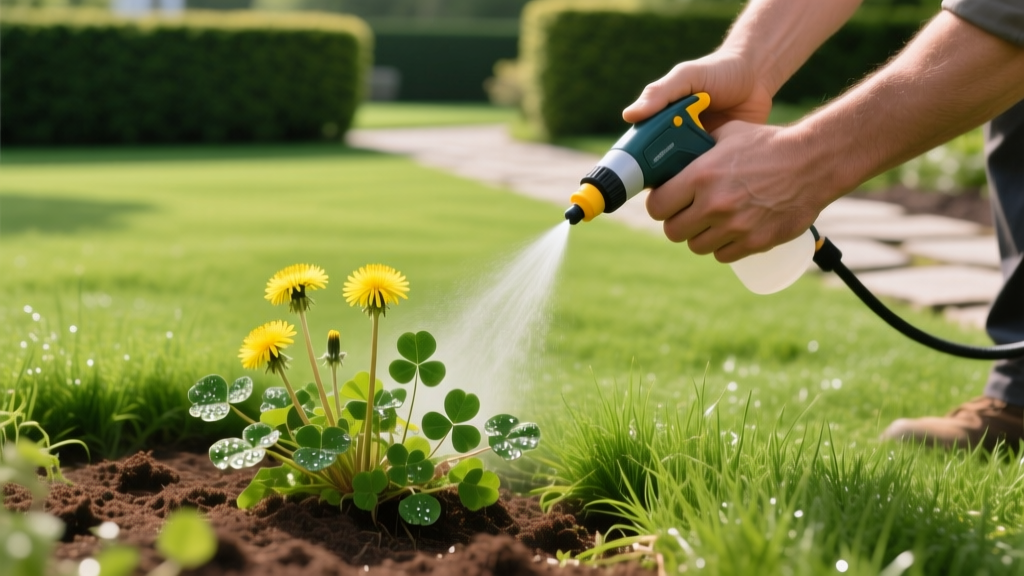
How to Spot-Treat Common Garden Weeds Without Harming Grass
Broadcast spraying herbicides across an entire lawn is an inefficient, expensive, and ecologically damaging approach to weed management. When dealing with common garden weeds, spot-treatment is the superior strategy. It reduces chemical usage by up to 85%, preserves soil microbiology, and prevents the accidental thinning of desirable turfgrass. However, spot-treating requires a precise understanding of weed biology, root structures, and herbicide chemistry. A generic 'weed and feed' product will not eradicate a mature taproot or bypass the waxy cuticle of a broadleaf invader.
This guide provides exact chemical protocols, equipment calibrations, and post-treatment timelines for eliminating the most persistent weeds found in residential lawns, based on current turfgrass science and 2026 herbicide formulations.
The Spot-Treatment Decision Matrix
Before mixing any chemicals, you must correctly identify the weed's classification. Applying a grassy weed herbicide to a broadleaf plant will waste product and stress your lawn. Use this matrix to select the correct active ingredient.
| Weed Species | Classification | Root Structure | Primary Active Ingredient | Surfactant Required? |
|---|---|---|---|---|
| Dandelion | Broadleaf | Deep Taproot (10-15 in) | 2,4-D Amine + Dicamba | Optional (Amine form) |
| Crabgrass | Grassy | Fibrous / Shallow | Quinclorac | Yes (Methylated Seed Oil) |
| Yellow Nutsedge | Sedge | Rhizomes + Nutlets | Sulfentrazone | No |
| White Clover | Broadleaf | Stolons + Shallow Roots | Triclopyr + MCPA | Yes (Non-Ionic Surfactant) |
| Broadleaf Plantain | Broadleaf | Fibrous / Crown | 2,4-D + Mecoprop (MCPP) | Yes (Non-Ionic Surfactant) |
Deep-Dive Protocols for the Most Common Garden Weeds
1. Dandelion (Taraxacum officinale)
Dandelions are notoriously difficult to kill permanently because their brittle taproots can regenerate from fragments left just two inches below the soil surface. For spot treatment, use a systemic broadleaf herbicide containing 2,4-D amine and Dicamba.
- Mixing Ratio: 0.75 oz of concentrate per gallon of water.
- Application Technique: Spray the center of the rosette until the leaves are uniformly wet but not dripping. The herbicide must translocate down to the taproot, which takes 7 to 14 days.
- Temperature Constraint: If ambient temperatures are below 60°F, switch from an amine formulation to an ester formulation (e.g., 2,4-D ester), which penetrates leaf tissue more effectively in cold weather.
2. Crabgrass (Digitaria)
While pre-emergents are the best defense, post-emergent spot treatment is necessary for breakthroughs. The industry standard is Quinclorac (often sold as Drive XLR8 for professionals, or consumer equivalents). Quinclorac mimics plant hormones, causing the crabgrass to grow itself to death.
- Timing: Apply when crabgrass is young (1 to 3 tillers). Mature crabgrass with seed heads requires two applications spaced 14 days apart.
- The MSO Factor: Quinclorac must be mixed with a Methylated Seed Oil (MSO) surfactant at 0.5% v/v (roughly 1.5 tablespoons per gallon). Without MSO, the herbicide will bead off the hairy crabgrass leaves.
3. Yellow Nutsedge (Cyperus esculentus)
Nutsedge is neither a grass nor a broadleaf weed; it is a sedge. Pulling it by hand is counterproductive, as it snaps at the rhizome, leaving the underground 'nutlets' intact to sprout multiple new plants. According to NCSU Turfgrass Extension, the most effective spot-treatment active ingredient is Sulfentrazone or Halosulfuron-methyl.
- Visual ID: Look for a triangular stem ('sedges have edges') and a lime-green color that grows faster than surrounding turf.
- Application: Spray directly onto the foliage. Sulfentrazone works rapidly, often showing necrosis (browning) within 24 to 48 hours. It is highly safe for most cool- and warm-season turfgrasses when used at label rates (0.25 oz per gallon for spot treatments).
4. White Clover (Trifolium repens)
Clover thrives in nitrogen-poor soils and features a waxy leaf cuticle that repels water-based herbicides. To spot-treat clover, you need a combination of Triclopyr and MCPA, heavily assisted by a Non-Ionic Surfactant (NIS).
- Preparation: Mow the lawn two days before treatment to remove the older, heavily waxed leaves, forcing the clover to push out new, more susceptible growth.
- Mixing: Add 0.5 oz of NIS (like Preference or R-11) per gallon of water. The surfactant reduces the surface tension of the spray droplets, allowing them to spread flat across the clover leaf rather than rolling off.
5. Broadleaf Plantain (Plantago major)
Plantain grows in a tight, low-lying rosette that often survives mower blades. Its thick, ribbed leaves are highly resistant to chemical uptake. Use a three-way herbicide containing 2,4-D, Mecoprop (MCPP), and Dicamba.
- Mechanical Scarification: Before spraying, lightly scuff the center of the plantain rosette with the toe of your boot or a wire brush. Breaking the physical barrier of the leaf cuticle dramatically increases herbicide absorption.
- Volume: Plantain requires higher spray volumes. Ensure thorough coverage of the lower, older leaves near the soil line.
Equipment Calibration: Avoiding Herbicide Drift
The most common failure in spot-treatment is herbicide drift—where fine mist carries onto desirable grass, causing curling, yellowing, or death. Proper equipment calibration is non-negotiable.
⚠️ Warning: Pump Sprayer Pressure Limits
Never over-pressurize a 1-gallon or 2-gallon pump sprayer. High pressure (above 30 PSI) atomizes the herbicide into a fine, drift-prone mist. Pump the sprayer only 15 to 20 times to maintain an optimal 15 to 20 PSI. This produces larger, heavier droplets that fall directly onto the target weed.
Never over-pressurize a 1-gallon or 2-gallon pump sprayer. High pressure (above 30 PSI) atomizes the herbicide into a fine, drift-prone mist. Pump the sprayer only 15 to 20 times to maintain an optimal 15 to 20 PSI. This produces larger, heavier droplets that fall directly onto the target weed.
Nozzle Selection: Swap the standard adjustable cone nozzle that comes with most hardware store sprayers for a Flat Fan Nozzle (such as the TeeJet 8002VS or 110-degree XR TeeJet). Flat fan nozzles produce a uniform, overlapping spray pattern with minimal fine droplets, drastically reducing the risk of chemical drift onto your turfgrass.
Post-Treatment Recovery and Overseeding Timelines
Herbicides leave active residuals in the soil that can prevent grass seed from germinating. If your spot-treatment areas require overseeding to fill in the bare spots left by dead weeds, you must respect the herbicide's waiting period. The University of Minnesota Extension emphasizes that ignoring these timelines results in total seed failure.
- 2,4-D and Dicamba: Wait 14 to 21 days before overseeding.
- Triclopyr (Clover control): Wait 21 to 28 days. Triclopyr has a longer soil residual than 2,4-D.
- Quinclorac (Crabgrass control): Wait a minimum of 28 days. Quinclorac is highly active in the soil and will severely stunt young grass seedlings.
- Sulfentrazone (Nutsedge control): Generally safe for overseeding immediately or within 24 hours, making it an excellent choice for late-summer fall seeding windows.
By targeting common garden weeds with precise chemistry, correct surfactants, and calibrated equipment, you can maintain a pristine lawn while minimizing chemical load and preserving the long-term health of your soil ecosystem. Always consult the EPA's Safe Pest Control guidelines for the most current safety and disposal regulations regarding residential herbicide use.

