
Lawn Care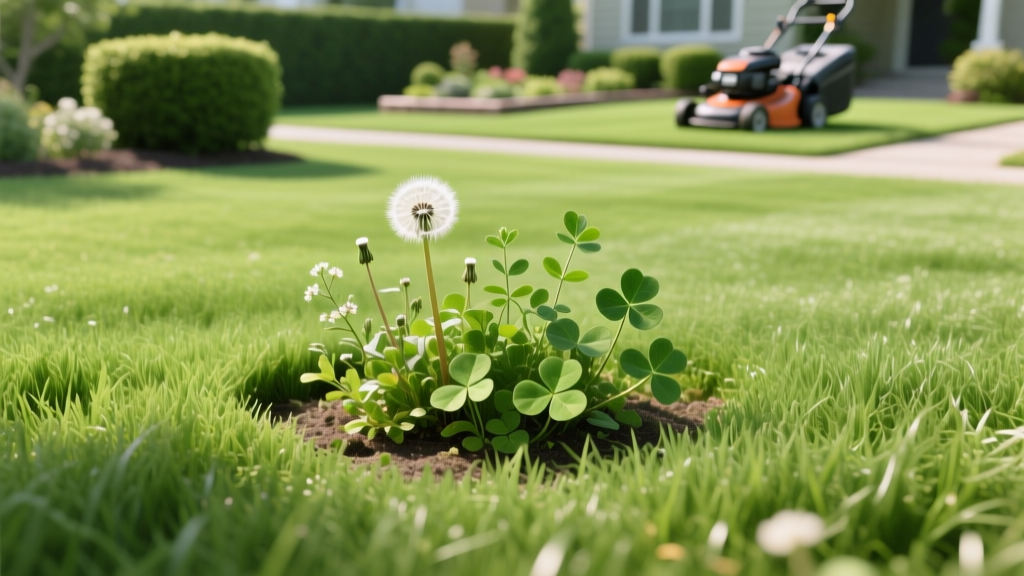
Spot-Treating Weeds in Grass: A Species-by-Species Guide
When managing weeds in grass, blanket-spraying an entire lawn is often a waste of chemicals, money, and environmental capital. If your turf has less than 30% weed coverage, spot-treatment is the professional standard. This guide breaks down the exact chemical protocols, mixing ratios, and timing required to eradicate the three main weed categories—broadleaf, grassy, and sedges—without damaging your desirable turfgrass.
The Economics and Ecology of Spot-Treatment
According to the University of Minnesota Extension, targeted weed control minimizes herbicide runoff and preserves soil microbiome health. Blanket applications of broad-spectrum herbicides can stress desirable turf, especially during summer heat. Spot-treating isolates the chemical to the weed's foliage, reducing the total active ingredient introduced to the soil by up to 90% on lawns with sparse weed populations.
The 30% Rule: If weeds cover more than 30% of your lawn, spot-treatment becomes inefficient. At that threshold, a blanket application followed by core aeration and overseeding is the recommended protocol to reclaim the turf canopy.
Broadleaf Weeds: Identification and Chemical Controls
Broadleaf weeds are the most common and easiest to control. They feature distinct net-like veins and broad leaves, making them visually distinct from turfgrass. The most effective post-emergent controls rely on synthetic auxins (growth regulators) that cause the weed to grow itself to death.
Dandelion (Taraxacum officinale) and Plantain
These taproot weeds require systemic herbicides that translocate down to the root crown. A 3-way herbicide containing 2,4-D, Mecoprop-p (MCPP), and Dicamba is the gold standard. Consumer equivalents include Ortho WeedClear or Bayer Advanced Lawn Weed and Crabgrass Killer. Professional-grade options include Trimec Classic.
- Mixing Ratio: 1.5 fluid ounces of 3-way concentrate per 1 gallon of water.
- Application: Spray until the leaves are uniformly damp, but not dripping.
- Failure Mode: Spraying mature dandelions that have already gone to seed. The plant will die, but the seeds will remain viable in the soil.
White Clover and Ground Ivy (Creeping Charlie)
These stoloniferous weeds spread horizontally. While 2,4-D works on clover, Ground Ivy requires the addition of Triclopyr for effective control. Products like Ortho GroundClear or professional Celsius WG (which contains thiencarbazone, iodosulfuron, and dicamba) are highly effective on tough creeping weeds.
Grassy Weeds: The Toughest Competitors
Grassy weeds are biologically similar to your lawn, making selective control highly complex. You must use herbicides that exploit subtle metabolic differences between the weed and the turf. According to Michigan State University Extension, timing is critical; grassy weeds are best controlled when they are young and actively tillering.
| Weed Species | Active Ingredient | Trade Name Example | Turf Safety Warning |
|---|---|---|---|
| Crabgrass | Quinclorac | Drive XLR8, Ortho WeedClear for Crabgrass | Can stunt St. Augustine and Bermudagrass; avoid use on these species. |
| Poa Annua (Annual Bluegrass) | Foramsulfuron / Ammonium Nonanoate | Revolver (Pro), AXXE (Organic burn-down) | Best managed via pre-emergent; post-emergent options are limited and expensive. |
| Dallisgrass | MSMA (Restricted) / Fluazifop | Ornamec 170 (Pro), Grass-B-Gon (Consumer) | Fluazifop will kill desirable cool-season grasses (Fescue, Kentucky Bluegrass). |
Sedges: The Imposters
Sedges are neither broadleaf nor grassy weeds; they are a distinct botanical family. As detailed by NC State Extension, sedges thrive in poorly drained, compacted soils. You can identify them by their triangular stems ('sedges have edges') and rapid vertical growth that outpaces the surrounding turf.
Yellow and Purple Nutsedge
Standard broadleaf and grassy herbicides will not kill nutsedge. You must use a specific chemistry, primarily Halosulfuron-methyl or Sulfentrazone.
- Top Product: SedgeHammer (Halosulfuron-methyl 5%).
- Dosage: One 0.9g packet per 1 to 2 gallons of water, treating up to 1,000 sq ft.
- Crucial Additive: Halosulfuron requires a non-ionic surfactant (NIS) to penetrate the waxy cuticle of the nutsedge leaf. Use 0.25% v/v (approx. 1/2 teaspoon per gallon).
The 4-Step Spot-Treatment Protocol
Even the best chemistry will fail if applied incorrectly. Follow this exact sequence for maximum translocation and minimum turf stress.
- Mow First, Spray Later: Mow the lawn 24 hours before application. This removes excess leaf tissue from the desirable grass and exposes the weed's growing points, ensuring the herbicide contacts the target.
- Mix with Surfactant: Always add a non-ionic surfactant (NIS) or a methylated seed oil (MSO) to your tank mix unless the product label explicitly states it contains a built-in adjuvant. Surfactants break the surface tension of the water, allowing the chemical to spread across the leaf rather than beading up and rolling off.
- Respect the Thermometer: Never apply ester-based herbicides (like many 2,4-D formulations) when temperatures exceed 85°F. High heat causes the chemical to volatilize (turn into a gas), which can drift and severely burn nearby ornamental plants, trees, and desirable turf.
- Delay Watering and Mowing: Wait a minimum of 48 hours after spraying before irrigating or mowing. The herbicide needs this time to translocate from the leaves down to the root system.
Real-World Cost Analysis: Spot vs. Blanket
Understanding the financial impact of targeted weed control highlights why professionals prefer spot-treating for maintained lawns. Below is a cost breakdown for a standard 5,000 sq ft suburban lawn with 10% weed coverage.
Cost Comparison (5,000 sq ft Lawn):
• Blanket Application: Requires treating the entire 5,000 sq ft. Using a standard 3-way concentrate, chemical costs average $45.00 - $60.00.
• Spot-Treatment: Requires treating only 500 sq ft (10% coverage). Chemical costs drop to $4.50 - $6.00, plus a $15 one-time investment in a quality 2-gallon pump sprayer.
• Verdict: Spot-treating saves up to 90% on chemical costs per application while drastically reducing environmental load.
• Blanket Application: Requires treating the entire 5,000 sq ft. Using a standard 3-way concentrate, chemical costs average $45.00 - $60.00.
• Spot-Treatment: Requires treating only 500 sq ft (10% coverage). Chemical costs drop to $4.50 - $6.00, plus a $15 one-time investment in a quality 2-gallon pump sprayer.
• Verdict: Spot-treating saves up to 90% on chemical costs per application while drastically reducing environmental load.
Troubleshooting Common Spot-Treatment Failures
The Weed Turned White but Didn't Die
This usually indicates you used a contact herbicide (like carfentrazone or ammonium nonanoate) on a perennial weed with a deep root system. The chemical burned the top growth, but the roots remain intact. Switch to a systemic auxin (2,4-D or Triclopyr) for the follow-up application.
The Surrounding Grass Turned Yellow
Turf yellowing (chlorosis) after spot-treating is often caused by herbicide overlap. When using a pump sprayer, it is easy to accidentally over-spray the edges of the weed. Use a cardboard shield or a specialized spray cone nozzle to confine the chemical strictly to the weed's foliage.

