
Lawn Care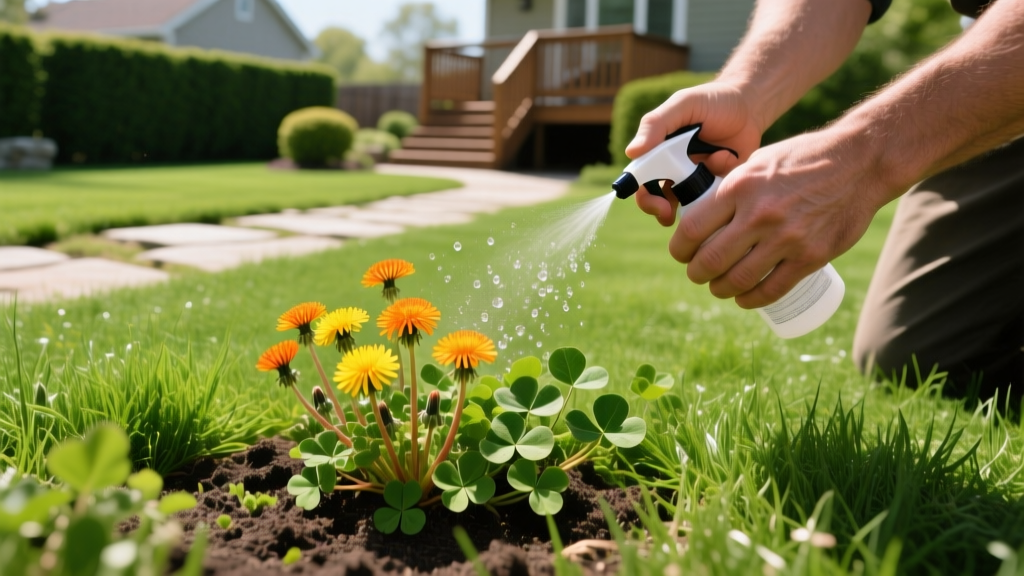
How to Spot-Treat the Most Stubborn Weeds in Yard Turf
Broadcast spraying entire lawns with broad-spectrum herbicides is an outdated practice that wastes chemicals, harms soil microbiomes, and accelerates herbicide resistance. Modern integrated pest management (IPM) relies on precise spot-treatments. When dealing with isolated weeds in yard spaces, identifying the specific species and applying the correct active ingredient at the exact mixing ratio is the most cost-effective and environmentally responsible strategy.
This guide details the exact chemical protocols, surfactant requirements, and environmental constraints for eradicating the four most resilient turf invaders.
The Spot-Treatment Decision Matrix
Before mixing any chemicals, correctly identify the invader. Using the wrong active ingredient will result in superficial burn without killing the root system. Refer to this matrix to select your chemical approach.
| Weed Species | Primary Active Ingredient | Surfactant Required | Approx. Cost per 1,000 sq ft |
|---|---|---|---|
| Crabgrass (Digitaria) | Quinclorac | Methylated Seed Oil (MSO) | $0.12 - $0.18 |
| Yellow Nutsedge (Cyperus) | Halosulfuron-methyl | Non-Ionic Surfactant (NIS) | $0.25 - $0.35 |
| Wild Violet (Viola sororia) | Triclopyr + 2,4-D Ester | Methylated Seed Oil (MSO) | $0.20 - $0.30 |
| Dandelion (Taraxacum) | 2,4-D Amine + Dicamba | Non-Ionic Surfactant (NIS) | $0.05 - $0.10 |
Tackling Grassy Weeds in Yard Lawns
Grassy weeds are notoriously difficult to spot-treat because they share similar biological pathways with your desirable turf. Selective post-emergent herbicides are mandatory here to avoid killing the surrounding lawn.
Crabgrass (Digitaria sanguinalis)
Crabgrass is an annual grassy weed that thrives in compacted, warm soil. Once it tillers (spreads laterally), standard weed-and-feed products fail. The industry standard for post-emergent spot treatment is Quinclorac (commercially available as Drive XLR8). Quinclorac mimics auxin, causing rapid, unregulated growth and epinasty (twisting) that eventually starves the plant.
- Mixing Rate: 0.73 fluid ounces of Quinclorac per 1,000 square feet.
- Surfactant: You must use a Methylated Seed Oil (MSO) at 0.5% v/v (roughly 1.5 tablespoons per gallon of water). MSO penetrates the hairy leaf sheath of crabgrass.
- Timing: Apply when crabgrass is young (1-3 leaf stage). If it has already tillered, a second application is required 21 days later.
Yellow Nutsedge (Cyperus esculentus)
Nutsedge is technically a sedge, not a grass, identifiable by its triangular stem ('sedges have edges'). It reproduces via underground tubers (nutlets). Pulling it by hand leaves the nutlets behind, triggering regrowth. The most effective spot-treatment is Halosulfuron-methyl (SedgeHammer), an ALS inhibitor that stops amino acid synthesis.
- Mixing Rate: 0.5 ounces (one water-soluble bag) per 1 to 2 gallons of water.
- Surfactant: Non-Ionic Surfactant (NIS) at 0.25% v/v. Do not use MSO, as it can cause severe phytotoxicity to surrounding cool-season turf.
- Patience Required: Halosulfuron-methyl is a slow-acting systemic. Expect to see yellowing in 7-10 days and complete necrosis in 3-4 weeks. Do not reapply prematurely.
Eradicating Broadleaf and Perennial Nightmares
Broadleaf weeds are generally easier to distinguish from turfgrass, but perennial varieties possess deep taproots or aggressive rhizome networks that require systemic translocation to eradicate fully. According to University of Minnesota Extension, timing broadleaf applications during active growth phases is critical for root kill.
Wild Violet (Viola sororia)
Wild violets are the bane of cool-season lawns. They feature a thick, waxy leaf cuticle that repels standard water-based herbicides, and they spread via underground rhizomes. Standard 2,4-D amine formulations will only burn the top growth.
Expert Protocol for Violets: Use an ester-based formulation. Mix Triclopyr (Turflon Ester) at 0.75 fl oz per gallon with a 2,4-D Ester. The ester formulation penetrates the waxy cuticle far more effectively than amines. Apply in the fall (September/October) when violets are actively storing carbohydrates in their rhizomes for winter.
Dandelion (Taraxacum officinale)
Dandelions possess a thick taproot that can extend 10-15 inches deep. If the crown is not destroyed, the weed will regenerate within weeks. A combination of 2,4-D Amine and Dicamba (found in products like SpeedZone) provides rapid visual burndown and systemic root kill.
- Mixing Rate: 1.5 to 2.0 fluid ounces per gallon of water.
- Application Technique: Do not just mist the leaves. Spray until the leaves are wet but not dripping (to the point of runoff). The chemical must be absorbed in high enough quantities to travel down the 12-inch taproot.
Equipment Calibration for Spot Spraying
The 1-Gallon Rule
A common failure mode in spot-treating weeds in yard environments is over-application, which damages the soil profile. To calibrate your 1-gallon pump sprayer:
- Fill the sprayer with plain water.
- Spray a 10x10 foot area (100 sq ft) on your driveway at your normal walking pace.
- Measure how much water was used. If you used 32 ounces (1 quart), your application rate is 1 gallon per 400 sq ft.
- Adjust your chemical mixing ratios based on this exact output, not the generic label assumptions.
Application Rules for Maximum Efficacy
Even the right chemical will fail if environmental conditions are ignored. Follow these strict parameters when spot-treating:
- Temperature Constraints: Never apply 2,4-D or Dicamba when temperatures exceed 85°F. At high heat, these chemicals volatilize (turn into a gas) and drift, causing severe damage to nearby ornamental trees and garden beds.
- Mowing Schedule: Mow the lawn 24 hours before application to maximize leaf surface area. Wait at least 48 hours after application before mowing again to allow for complete foliar absorption.
- Rainfast Period: Ensure no rain is forecasted for at least 6 hours post-application. Halosulfuron-methyl requires up to 8 hours to become fully rainfast.
- Drought Stress: Do not spray weeds that are drought-stressed. When weeds lack moisture, they close their stomata to conserve water, preventing the herbicide from entering the plant's vascular system. Irrigate the lawn lightly the day before treating.
For further reading on identifying regional turfgrass invaders and understanding local herbicide restrictions, consult the Purdue University Turfgrass Weed Identification database, which provides high-resolution imagery and localized management calendars.
Frequently Asked Questions
Can I mix Quinclorac and Halosulfuron-methyl in the same tank?
Yes, tank-mixing Quinclorac and Halosulfuron-methyl is physically compatible and highly effective if you have a mixed infestation of crabgrass and nutsedge. However, you must use an MSO surfactant to satisfy the Quinclorac requirement, and you should reduce the Halosulfuron-methyl rate by 25% to prevent temporary yellowing of sensitive cool-season grasses like Kentucky Bluegrass.
Why did my dandelions come back three weeks after spraying?
If the dandelion leaves curled and died but the plant returned, you likely achieved only a 'top-kill'. This happens when the herbicide concentration was too low, the plant was drought-stressed, or you mowed too soon after spraying. The taproot survived. Wait for the new growth to reach 2 inches and reapply a 2,4-D/Dicamba ester formulation.
Is spot-treating more expensive than using a granular weed-and-feed?
Initially, purchasing professional-grade liquid concentrates (like a $150 gallon of Drive XLR8) has a higher upfront cost than a $30 bag of granular weed-and-feed. However, liquid concentrates treat acres of turf. The actual cost per 1,000 square feet for liquid spot-treatment is often under $0.20, making it drastically cheaper over a single season while providing superior, targeted results.

