
Lawn Care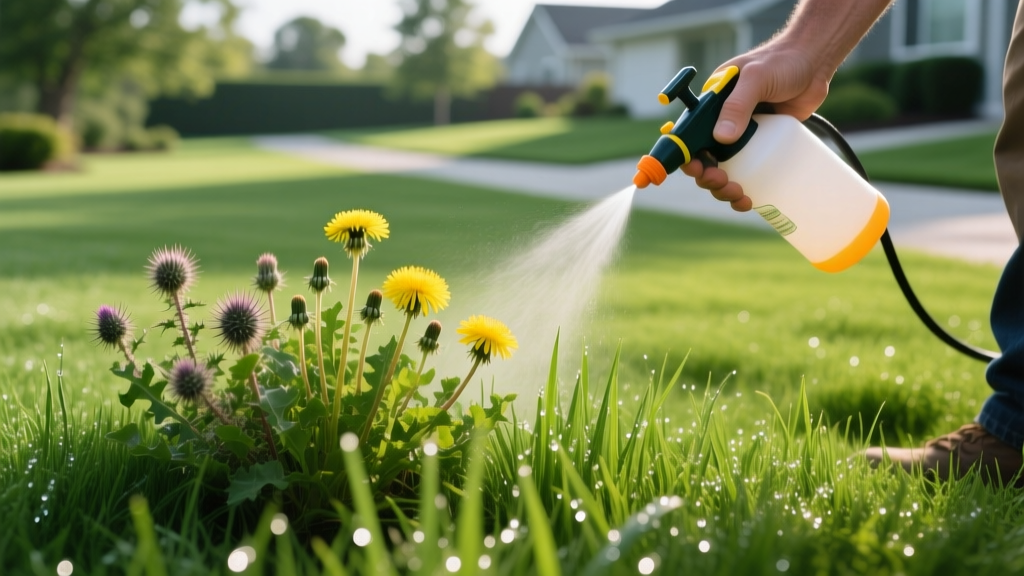
How to Spot-Treat Tall Weeds in Lawns Without Killing Grass
When tall weeds breach the turfgrass canopy—often exceeding 6 to 12 inches in height—they signal a critical failure in lawn density and competition. Broadcast spraying these overgrown invaders with non-selective herbicides will devastate your desirable grass, while ignoring them allows deep taproots and aggressive rhizomes to establish. Spot-treatment is the only viable protocol for eliminating tall weeds without causing collateral damage to your lawn.
This guide details the exact herbicide chemistries, calibration metrics, and mechanical strategies required to eradicate tall, mature weeds in both cool-season and warm-season turfgrasses.
Identifying Common Tall Weeds in Turfgrass
Effective spot-treatment begins with accurate identification. Tall weeds generally fall into two categories: aggressive annuals that bolt quickly, and perennial grasses/broadleaves with extensive underground storage organs. Misidentifying a grassy weed as a broadleaf weed will result in herbicide failure and wasted chemical.
| Weed Species | Type | Mature Height | Root System | Primary Challenge |
|---|---|---|---|---|
| Johnsongrass (Sorghum halepense) | Perennial Grass | 36 - 60 inches | Deep rhizomes | Resists most selective broadleaf herbicides; requires systemic grass killers. |
| Canada Thistle (Cirsium arvense) | Perennial Broadleaf | 24 - 48 inches | Extensive creeping roots | Regenerates from root fragments; requires translocated systemic herbicides. |
| Dallisgrass (Paspalum dilatatum) | Perennial Grass | 12 - 24 inches | Short rhizomes/taproot | Highly tolerant of standard 2,4-D applications; requires specialized chemistries. |
| Common Ragweed (Ambrosia artemisiifolia) | Annual Broadleaf | 24 - 36 inches | Fibrous taproot | Bolts rapidly in late summer; thick cuticle resists herbicide penetration without surfactants. |
According to the University of California Integrated Pest Management (UC IPM) program, perennial grasses like Johnsongrass can produce rhizomes that penetrate up to 4 feet deep, making mechanical pulling ineffective and necessitating chemical translocation to the root zone.
Choosing the Right Herbicide Chemistry
When weeds are tall and mature, their vascular systems are fully developed, which is actually an advantage for systemic herbicides. However, you must select a chemistry that targets the specific weed type without harming the surrounding turf.
Selective vs. Non-Selective Spot Treatments
Pro Tip: The Surfactant Multiplier
Tall weeds develop thick, waxy cuticles to retain moisture. Always add a Non-Ionic Surfactant (NIS) or Methylated Seed Oil (MSO) at a rate of 0.25% v/v (approximately 1 teaspoon per gallon of mixed solution). This reduces surface tension, allowing the herbicide to spread and penetrate the leaf tissue rather than beading up and rolling off. A quart of high-quality NIS costs about $15 and treats hundreds of gallons of mix.
Tall weeds develop thick, waxy cuticles to retain moisture. Always add a Non-Ionic Surfactant (NIS) or Methylated Seed Oil (MSO) at a rate of 0.25% v/v (approximately 1 teaspoon per gallon of mixed solution). This reduces surface tension, allowing the herbicide to spread and penetrate the leaf tissue rather than beading up and rolling off. A quart of high-quality NIS costs about $15 and treats hundreds of gallons of mix.
| Herbicide Active Ingredient | Target Weeds | Turf Safety | Est. Cost (Retail) | Mode of Action |
|---|---|---|---|---|
| 2,4-D + Dicamba + MCPP (e.g., SpeedZone) | Tall Broadleaves (Thistle, Ragweed) | Safe for most cool/warm grasses | $45 / pint | Systemic synthetic auxin |
| Fluazifop-butyl (e.g., Ornamec 170) | Tall Grassy Weeds (Johnsongrass) | Safe for tall fescue, zoysia, bermuda | $85 / 8 oz | Systemic ACCase inhibitor |
| Mesotrione (e.g., Tenacity) | Dallisgrass, Crabgrass | Safe for cool-season grasses; whitens bermuda | $60 / 8 oz | Systemic HPPD inhibitor |
| Glyphosate (41% concentrate) | Non-selective (All tall weeds) | Kills all turfgrass on contact | $25 / 32 oz | Systemic EPSP synthase inhibitor |
Step-by-Step Spot-Treatment Protocol
Spot-treating tall weeds requires precision equipment and strict adherence to mixing ratios to prevent herbicide drift and turf burn.
Step 1: Preparation and Mowing
Do not spray immediately after mowing. Mow your lawn at its standard height 48 hours before application. This allows the tall weeds to grow slightly above the turf canopy, providing a distinct target and minimizing accidental contact with desirable grass blades. Ensure the weeds have adequate leaf surface area to absorb the chemical.
Step 2: Equipment Calibration and Mixing
Use a dedicated 1-gallon or 2-gallon pump sprayer (e.g., Chapin or Solo) equipped with a shielded cone nozzle to prevent drift. If targeting a single, massive weed surrounded by desirable grass, use a wick applicator or a sponge-tipped dabber to paint the herbicide directly onto the weed.
- Calibration Test: Spray water onto a 10x10 foot area (100 sq ft). Measure how many ounces of water it takes to cover that area evenly. Multiply by 10 to find your output per 1,000 sq ft.
- Mixing Ratio (Example for SpeedZone): Mix 1.1 to 1.5 fluid ounces of herbicide per 1,000 sq ft. If your sprayer outputs 1.5 gallons per 1,000 sq ft, add 1.5 fl oz of herbicide to 1.5 gallons of water.
- Dye Indicator: Add 1/4 teaspoon of blue marking dye (approx. $12 per bottle) to the tank. This is non-negotiable for spot treatments; it shows you exactly which weeds have been treated and prevents overlapping, which causes turf phytotoxicity.
Step 3: Application Technique
Spray the tall weed from the top down, ensuring thorough coverage but stopping before the liquid drips off the leaves (the point of runoff). Keep the sprayer wand low to the ground. Avoid spot-treating on windy days (winds > 5 mph) or when temperatures exceed 85°F, as heat increases herbicide volatilization, causing the chemical to vaporize and drift onto nearby desirable plants.
Managing Severe Infestations and Root Systems
For weeds like Canada Thistle or mature Johnsongrass, a single application is rarely sufficient. The UC IPM guidelines for lawn weed management emphasize that perennial weeds store massive energy reserves in their roots. Systemic herbicides take 10 to 14 days to fully translocate to the root zone.
Warning: Do Not Mow or Pull Immediately
A common mistake is mowing the lawn or pulling the dead weed tops 3 days after spraying. You must leave the treated weed undisturbed for at least 14 days. Pulling or cutting the weed severs the vascular pathway before the herbicide reaches the rhizomes, guaranteeing the weed will resprout from the root fragments left in the soil.
A common mistake is mowing the lawn or pulling the dead weed tops 3 days after spraying. You must leave the treated weed undisturbed for at least 14 days. Pulling or cutting the weed severs the vascular pathway before the herbicide reaches the rhizomes, guaranteeing the weed will resprout from the root fragments left in the soil.
When to Use Glyphosate (Non-Selective)
If the tall weed is growing in a landscape bed, a crack in the driveway, or a completely dead patch of lawn, use a 2% solution of glyphosate (2.6 fl oz per gallon of water). Apply using a shielded sprayer or a cardboard baffle to block wind drift. Glyphosate will kill any turfgrass it touches, so reserve it strictly for non-turf areas or total lawn renovation zones.
Post-Treatment Lawn Recovery
Once the tall weeds have completely browned and the root system has died (typically 21 days post-application), remove the dead biomass. Rake out the dead material to expose the soil. Tall weeds often leave behind bare patches where they shaded out the turf.
To prevent new weeds from colonizing the bare soil:
- Core Aerate: Relieve soil compaction in the affected area using a manual step-aerator or a powered core aerator.
- Overseed: Apply a premium turf-type tall fescue or Kentucky bluegrass blend (for cool-season lawns) at a rate of 5 to 8 lbs per 1,000 sq ft. For warm-season lawns, lay fresh sod or plant plugs of Bermuda or Zoysia.
- Pre-emergent Timing: Do not apply pre-emergent herbicides (like Prodiamine) to the bare spots if you are overseeding, as they will inhibit grass seed germination. Wait until the new grass has been mowed three times before resuming pre-emergent applications.
Frequently Asked Questions
Can I use vinegar or boiling water to kill tall weeds in my lawn?
Horticultural vinegar (20% acetic acid) and boiling water are strictly contact burners. They will destroy the top growth of a tall weed but will not penetrate or kill the deep root systems of perennials like thistle or Johnsongrass. Furthermore, 20% acetic acid is highly corrosive, requires severe PPE (goggles, respirator), and will alter soil pH negatively if applied heavily in a lawn setting.
Why did the tall weed turn white after I sprayed it?
If you used Mesotrione (Tenacity), the weed turning stark white is the intended mechanism of action. Mesotrione inhibits the HPPD enzyme, stopping chlorophyll production and causing the weed to bleach out and starve over 2 to 3 weeks. This is normal and indicates the herbicide is working.

