
Lawn Care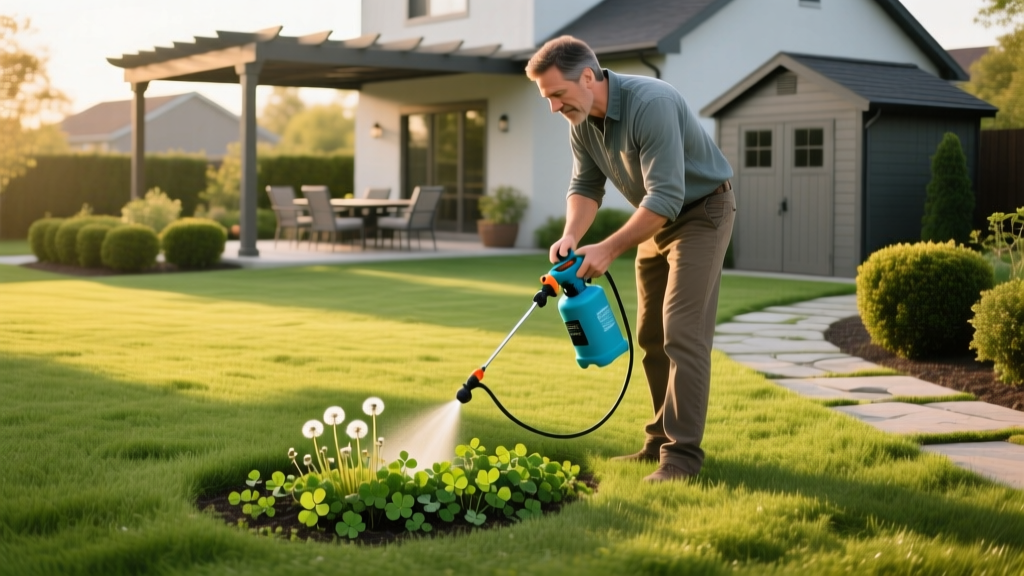
Feed Weed Control: Spot-Treatment vs. Broadcast Applications
For decades, the standard suburban lawn care regimen relied heavily on the broadcast application of combination products. Homeowners would spread a granular feed weed product across the entire yard, simultaneously applying fertilizer and broadleaf herbicides. While convenient, this 20th-century approach is increasingly rejected by modern turfgrass managers. In 2026, precision turf management dictates that decoupling your nutritional program from your chemical weed control yields a denser, healthier lawn while drastically reducing chemical runoff and herbicide resistance.
This guide dismantles the outdated broadcast methodology and provides a rigorous, species-specific spot-treatment framework. By separating your soil nutrition from your weed eradication, you eliminate collateral damage to your grass, save money on chemical inputs, and target invasive species at their most vulnerable growth stages.
The Hidden Costs of Broadcast Feed Weed Products
Granular combination products—often marketed under the umbrella of a feed weed and seed program—force a compromise between the optimal application rate for fertilizer and the optimal application rate for herbicide. This structural flaw creates three distinct problems for your lawn:
- Herbicide Overapplication: To deliver the required nitrogen load (typically 1 lb of N per 1,000 sq ft), you must apply a heavy volume of granules. This inadvertently dumps excessive amounts of active ingredients like 2,4-D and Dicamba onto the soil, which can stunt root growth in sensitive warm-season grasses like Centipede and St. Augustine.
- Volatile Organic Compound (VOC) Drift: When applied during the temperature fluctuations of late spring, granular ester-based herbicides can vaporize and drift onto neighboring ornamental plants, causing severe leaf cupping and defoliation.
- Economic Inefficiency: A standard 14-lb bag of broadcast combination product costs roughly $55 to $75 and covers 5,000 square feet. By purchasing professional-grade liquid concentrates and spot-treating only the affected zones, the cost per treatment drops to less than $4 for the same area.
⚠️ Critical Warning on Dicamba Volatility: The EPA has heavily restricted the use of Dicamba in residential settings due to off-target damage. If your legacy feed weed product contains Dicamba, do not apply it when ambient temperatures exceed 85°F, as the chemical will volatilize and drift into adjacent garden beds, devastating broadleaf ornamentals and vegetable crops.
The Modern Protocol: Decoupling Fertilizer and Herbicide
To transition from a broadcast dependency to a precision spot-treatment model, you must separate the two biological objectives: feeding the soil profile and eradicating the weed.
Step 1: Baseline Soil Nutrition
Submit a soil sample to your local university extension office. Apply a dedicated, single-purpose granular fertilizer based strictly on the phosphorus, potassium, and pH deficiencies identified in the report. According to University of Minnesota Extension, a thick, vigorously growing turf canopy naturally outcompetes up to 80% of common annual weeds without chemical intervention.
Step 2: Targeted Scouting
Walk your lawn 48 hours after mowing. Map out specific weed clusters rather than treating the entire property. Identify the exact species, as post-emergent herbicides are highly specific to weed biology (e.g., grassy vs. broadleaf vs. sedge).
Step 3: Liquid Spot Application
Mix the appropriate liquid active ingredient in a dedicated pump sprayer. Apply only to the weed and a 2-inch buffer zone surrounding it. This localized approach prevents the accumulation of residual herbicides in the broader soil microbiome.
Species-Specific Spot-Treatment Matrix
The success of a spot-treatment regimen relies entirely on matching the active ingredient to the specific weed biology. Below is the 2026 professional matrix for the four most pervasive lawn weeds in North America. Note: Always add a non-ionic surfactant (0.25% v/v) to liquid mixtures to break the surface tension of the weed's waxy cuticle.
| Weed Species | Active Ingredient | Mix Rate (per 1 Gallon) | Optimal Temp Window |
|---|---|---|---|
| Crabgrass (Grassy) | Quinclorac | 1.5 fl oz + 1 tsp Methylated Seed Oil | 65°F - 85°F (Early tiller stage) |
| Dandelion (Broadleaf) | Triclopyr + 2,4-D Amine | 2.0 fl oz | 55°F - 75°F (Fall rosette stage) |
| Yellow Nutsedge (Sedge) | Sulfentrazone | 0.75 fl oz | 70°F - 90°F (Pre-nutlet formation) |
| White Clover (Broadleaf) | MCPP-P | 1.25 fl oz | 60°F - 80°F (Active flowering) |
Selecting the Right Spot-Treatment Equipment
Executing a precise spot-treatment requires equipment that delivers a consistent droplet size without excessive overspray. Avoid hose-end sprayers entirely; they are impossible to calibrate for localized applications and violate EPA guidelines for targeted pest control.
1. Manual 1-Gallon Poly Pump Sprayer (e.g., Chapin 20000)
- Pros: Inexpensive ($18-$25), highly durable, easy to clean, allows for exact pressure control to minimize drift.
- Cons: Requires manual pumping to maintain 40 PSI, can cause arm fatigue on properties larger than 10,000 sq ft.
- Best For: Lawns with scattered, isolated weed clusters (less than 15% total weed coverage).
2. Battery-Powered Backpack Sprayer (e.g., Solo 418 Battery)
- Pros: Maintains a constant 40 PSI automatically, ergonomic for large properties, holds up to 2 gallons for extended run times.
- Cons: Higher upfront cost ($120-$160), requires battery maintenance and winterization.
- Best For: Large estates or properties battling dense, localized patches of creeping Charlie or ground ivy.
3. Targeted Gel Applicator Wands
- Pros: Zero drift risk, ideal for treating weeds growing directly inside flower beds or near sensitive vegetable gardens.
- Cons: Extremely slow application rate, impractical for treating turfgrass areas.
- Best For: Hardscape borders, driveway cracks, and ornamental bed perimeters.
Frequently Asked Questions
Can I spot-treat weeds on the same day I apply granular fertilizer?
Yes, but timing matters. Apply your granular fertilizer first and water it into the soil profile. Wait 24 hours for the grass to absorb the moisture and the granules to dissolve. Then, apply your liquid spot-treatment. If you spray liquid herbicide onto dry, freshly applied granular fertilizer, the liquid will rehydrate the granules and cause the fertilizer to stick to the weed leaves, resulting in severe chemical burn to the surrounding turf.
Why did my Quinclorac spot-treatment fail to kill mature crabgrass?
Quinclorac is highly effective on crabgrass in the 1-tiller to 3-tiller stage. Once crabgrass reaches maturity (5+ tillers and visible seed heads), its cellular structure becomes too thick for the herbicide to translocate to the roots. For mature crabgrass, you must switch to a non-selective spot-treatment like Glyphosate (using a shielded wand to protect the surrounding grass) or manually extract the plant, followed immediately by an application of a pre-emergent like Prodiamine to prevent the dropped seeds from germinating.
Is it safe to use a surfactant with all spot-treatments?
Non-ionic surfactants (NIS) are mandatory for Quinclorac and highly recommended for Triclopyr mixtures. However, do not use a surfactant when spot-treating with Sulfentrazone on St. Augustine or Centipede grass. The surfactant increases the penetration rate of the Sulfentrazone, which can cause temporary phytotoxicity (yellowing) in these sensitive warm-season species.

