
Lawn Care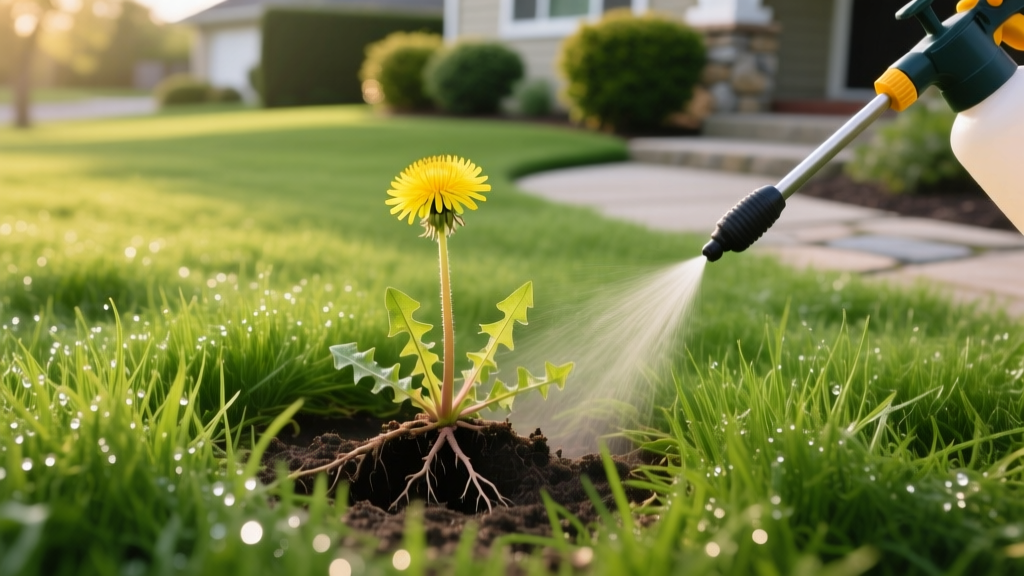
Targeted Weed Control for Dandelions: Spot-Treatment Guide
The Anatomy of a Dandelion Infestation
Effective weed control for dandelions (Taraxacum officinale) requires understanding the plant's subterranean architecture. Dandelions are perennial broadleaf weeds anchored by a brittle, fleshy taproot that typically extends 6 to 10 inches deep in residential lawns, though it can reach 15 inches in uncompacted soil. If mechanical removal leaves just one inch of the upper taproot intact, the weed will regenerate a new crown within 14 days.
Because dandelions reproduce primarily via wind-blown seeds (achenes) and secondary crown shoots, broadcasting pre-emergent herbicides across an entire lawn is often economically and environmentally inefficient for isolated outbreaks. Spot-treatment targets the specific physiological vulnerabilities of the dandelion rosette without disrupting the surrounding turfgrass microbiome.
Post-Emergent Active Ingredients: Comparison Matrix
Selecting the correct chemistry depends on your grass type, local regulations, and whether you prefer synthetic or organic routes. According to University of Minnesota Extension turf specialists, systemic herbicides that translocate down to the taproot are mandatory for permanent eradication.
| Active Ingredient | Trade Name Examples | Grass Safety | Approx. Cost (2026) | Time to Necrosis |
|---|---|---|---|---|
| 2,4-D + Dicamba + Quinclorac | Ortho WeedClear, Trimec Classic | Safe for most cool/warm-season grasses | $18 - $25 / Gallon RTU | 7 - 14 days |
| FeHEDTA (Chelated Iron) | Fiesta, Sunday Dandelion Doom | Safe for cool-season; stains warm-season | $30 - $45 / Quart Concentrate | 3 - 5 days (requires 2 apps) |
| Triclopyr | Ortho Brush-B-Gon (Spot use only) | Cool-season only (damages Bermuda/Zoysia) | $22 / 32oz RTU | 10 - 21 days |
The Mechanism of Synthetic Auxins (2,4-D)
Synthetic auxins like 2,4-D mimic indole-3-acetic acid (IAA), a natural plant growth hormone. When absorbed through the dandelion's broad leaves, it triggers uncontrolled, unsustainable cell division. The plant's vascular tissue essentially strangles itself, preventing nutrients from reaching the deep taproot. This systemic action is why 2,4-D remains the gold standard for managing broadleaf weeds in turf.
Organic Spot-Treatment: The FeHEDTA Advantage
For homeowners managing cool-season lawns (Kentucky Bluegrass, Fescue, Ryegrass) who want to avoid synthetic herbicides, Iron HEDTA (Hydroxyethylenediaminetriacetic acid) is the premier choice. FeHEDTA exploits a fundamental biological difference between monocots (grasses) and dicots (broadleaf weeds).
How Chelated Iron Works: Dandelions absorb massive quantities of the chelated iron, leading to lethal oxidative stress and rapid tissue necrosis (blackening) within 24 hours. Turfgrasses, however, possess a natural mechanism to regulate iron uptake, allowing them to survive and even benefit from the foliar iron application, which temporarily darkens the grass blade.
Application Nuance: FeHEDTA is a contact herbicide, not a systemic one. It burns the top growth rapidly but may not kill a 10-inch taproot on the first pass. You must schedule a second application exactly 7 to 10 days after the first, once the dandelion pushes new shoots from the surviving root crown. Products like Fiesta Turf Weed Killer ($42/quart) or Sunday Dandelion Doom ($25/bottle) are highly concentrated and must be diluted at 3.2 fl oz per gallon of water.
Step-by-Step Spot-Treatment Protocol
Timing and technique dictate the success rate of your weed control for dandelions. Follow this precise protocol to ensure the herbicide reaches the taproot.
- Target the Rosette Stage: Apply treatments in early spring (when soil temps hit 55°F) or early fall (September). Avoid mid-summer applications when temperatures exceed 85°F, as heat stress causes the dandelion to shut down its vascular system, halting herbicide translocation.
- Mow 48 Hours Prior: Cut your lawn to its standard height (e.g., 3 inches for Tall Fescue) two days before treatment. This ensures maximum leaf surface area is exposed on the dandelion rosette without competition from surrounding grass blades.
- Add a Non-Ionic Surfactant (NIS): If using a concentrated synthetic herbicide, add an NIS at a rate of 0.25% v/v (roughly 1/2 teaspoon per gallon). Dandelion leaves have a thick, waxy cuticle. The surfactant reduces water's surface tension from 72 dynes/cm to under 30 dynes/cm, allowing the chemical to spread and penetrate the leaf rather than beading up and rolling off.
- Spot-Spray the Crown: Use a 1-gallon pump sprayer with a pinpoint nozzle. Do not drench the soil. Apply a fine mist directly to the center of the dandelion rosette (the crown) until the leaves are uniformly wet but not dripping.
- Withhold Water and Mowing: Do not irrigate the lawn for 24 hours post-application. Wait at least 48 hours before your next mowing to allow maximum translocation time.
Warning: Herbicide Drift and Volatility
When using ester-based 2,4-D formulations in temperatures above 80°F, the chemical can vaporize and drift onto nearby ornamental broadleaf plants, causing severe cupping and distortion to trees and shrubs. Always use amine-based formulations (like Trimec) for spot treatments near garden beds, and spray during early morning hours when wind speeds are below 5 mph.
When using ester-based 2,4-D formulations in temperatures above 80°F, the chemical can vaporize and drift onto nearby ornamental broadleaf plants, causing severe cupping and distortion to trees and shrubs. Always use amine-based formulations (like Trimec) for spot treatments near garden beds, and spray during early morning hours when wind speeds are below 5 mph.
Post-Treatment Lawn Recovery
Successful dandelion eradication leaves behind 2- to 4-inch bare soil circles. If left untreated, these bare spots become prime real estate for crabgrass and prostrate spurge by late June.
Once the dandelion crown has completely collapsed (usually 14 days post-spray), rake out the dead organic matter. Overseed the bare spots using a matching turf cultivar. For cool-season lawns, apply a high-quality Kentucky Bluegrass or Perennial Ryegrass seed at a rate of 3 to 4 lbs per 1,000 square feet. Top-dress with 1/4 inch of screened compost to retain moisture, and keep the spot consistently damp for 14 days to ensure germination. Integrating this recovery step transforms a reactive weed control strategy into a proactive lawn-thickening program.
Frequently Asked Questions
Can I just pull dandelions by hand instead of spraying?
Hand-pulling is only viable if the soil is heavily saturated from recent rain, allowing the entire taproot to slide out. If the root snaps below the crown, the weed will return. For mature dandelions with deep taproots, chemical or iron-based spot treatment is significantly more reliable.
Will vinegar kill dandelions?
Horticultural vinegar (20% acetic acid) is a non-selective contact burn-down agent. It will destroy the dandelion leaves but will also kill any surrounding grass it touches. Furthermore, it does not translocate to the taproot, guaranteeing the dandelion will resprout within two weeks. It is not recommended for targeted lawn care.

