
Lawn Care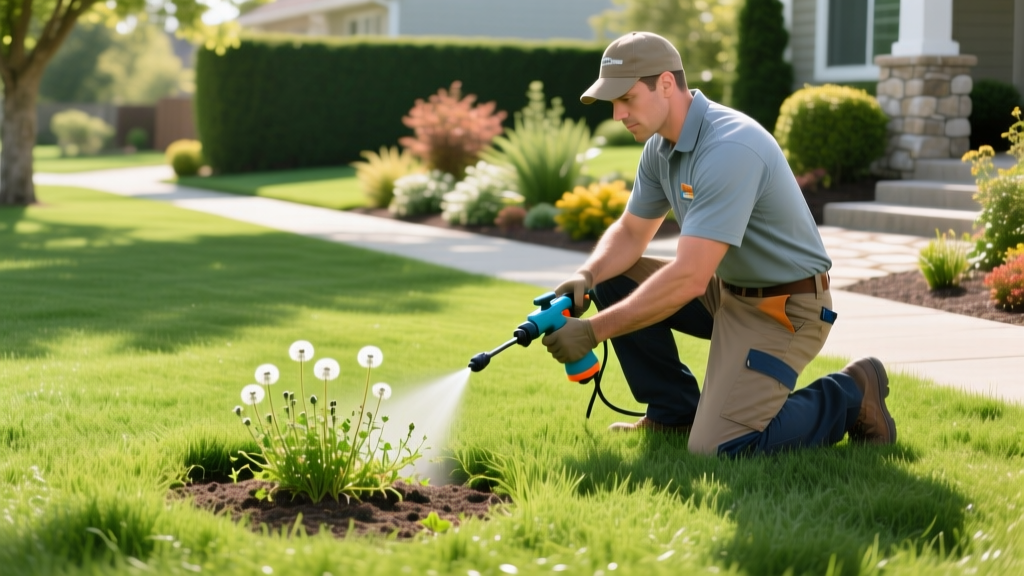
Spot-Treatment Guide: When to Hire a Weed Elimination Service
The Spot-Treatment Decision Matrix
Spot-treating weeds is the most ecologically sound and cost-effective method for managing isolated infestations in an otherwise healthy turfgrass canopy. However, the efficacy of a DIY approach degrades rapidly when dealing with perennial grassy weeds, complex sedge species, or mature broadleaf colonies. Deciding whether to mix your own tank or contract a professional weed elimination service depends on three variables: weed biology, lawn square footage, and your application equipment.
Decision Framework: If your lawn has fewer than 15 isolated weed clusters and consists of standard annual broadleaf weeds (e.g., dandelions, henbit), DIY spot-treatment is optimal. If you are facing creeping perennials (ground ivy, dallisgrass), sedges (nutsedge), or the infestation exceeds 20% of your total turf area, the specialized tank mixes and commercial-grade surfactants utilized by a professional weed elimination service will yield a significantly higher eradication rate.
Species-Specific Spot-Treatment Protocols
The most common failure mode in DIY weed control is applying a generic 'weed and feed' or broad-spectrum liquid to a species that requires a specific active ingredient and adjuvant. Professional turf managers tailor their chemistry to the exact biological classification of the target weed.
1. Grassy Weeds (Crabgrass, Dallisgrass, Poa Annua)
Grassy weeds share a similar biological structure with your desirable turf, making selective eradication highly complex. For large crabgrass (Digitaria sanguinalis), the industry standard is Quinclorac (commercial trade name: Drive XLR8). Quinclorac mimics auxin, causing uncontrolled growth that ultimately destroys the weed. However, it requires the addition of a Methylated Seed Oil (MSO) adjuvant at 1% v/v to penetrate the waxy cuticle of mature crabgrass. Dallisgrass (Paspalum distichum) is notoriously resistant to standard herbicides and typically requires sequential spot-treatments with MSMA (where legally permitted) or specialized fluazifop formulations, which are heavily restricted to licensed applicators.
2. Broadleaf Weeds (Dandelion, Ground Ivy, Clover)
While dandelions are easily controlled with standard 2,4-D amine formulations, creeping perennials like Ground Ivy (Glechoma hederacea) and White Clover require systemic translocation. A professional weed elimination service will typically deploy a three-way ester blend containing Triclopyr, 2,4-D, and Dicamba. Ester formulations are vastly superior to amines for spot-treating broadleaf weeds in cool weather (below 70°F) because they penetrate the leaf cuticle faster. According to Penn State Extension's Turfgrass Program, applying triclopyr-based blends in the fall when weeds are actively storing carbohydrates in their root systems ensures the herbicide is translocated down to the rhizomes, preventing spring regrowth.
3. Sedges (Yellow and Purple Nutsedge, Kyllinga)
Sedges are neither grasses nor broadleaf weeds; they possess triangular stems and reproduce via underground tubers (nutlets). Standard broadleaf herbicides will not kill them. The gold standard for nutsedge spot-treatment is Halosulfuron-methyl (trade name: SedgeHammer). This sulfonylurea herbicide inhibits the ALS enzyme, halting amino acid synthesis. It is highly effective but slow-acting, taking 14 to 21 days to show visible necrosis. A critical requirement for halosulfuron is the mandatory inclusion of a non-ionic surfactant (NIS) at 0.25% v/v to ensure the microscopic droplets adhere to the upright, waxy sedge leaves.
Cost Breakdown: Professional Service vs. DIY Spot-Treatment
Understanding the financial implications of weed management requires looking beyond the initial price tag. While DIY appears cheaper upfront, the cost of repeated failures and turf damage can quickly eclipse professional service fees. The table below outlines the 2026 estimated costs for an average 5,000 sq. ft. residential lawn.
| Cost Factor | DIY Spot-Treatment | Professional Weed Elimination Service |
|---|---|---|
| Initial Chemical/Equipment Cost | $45 - $85 (Concentrate + 1-gal sprayer) | $0 (Included in service fee) |
| Per-Visit / Per-Application Cost | $10 - $15 (Pro-rated chemical cost) | $65 - $115 (Standalone spot-treatment visit) |
| Annual Program Cost (4-6 visits) | $60 - $120 (Total annual chemical spend) | $450 - $750 (Bundled with fertilizer/pre-emergent) |
| Efficacy on Perennial/Sedge Weeds | Low to Moderate (High failure rate) | High (Commercial-grade chemistry) |
| Risk of Turf Phytotoxicity | Moderate (Mixing errors, temperature drift) | Very Low (Calibrated equipment, licensed techs) |
Critical Failure Modes in DIY Spot-Treatments
When homeowners attempt to replicate the results of a professional weed elimination service, they frequently encounter biological and mechanical barriers that render the herbicide useless. Avoiding these specific failure modes is the difference between a pristine lawn and a patchy, chemical-burned yard.
- Omitting the Surfactant: Herbicide labels for products like SedgeHammer and Quinclorac legally and chemically require an adjuvant. Water has high surface tension; without a surfactant to break this tension, the spray droplets will bead up and roll off the waxy leaves of nutsedge and mature crabgrass, resulting in zero absorption.
- Temperature Volatility and Drift: Applying herbicides containing Dicamba or 2,4-D ester when ambient temperatures exceed 85°F causes the chemical to vaporize. This vapor can drift into neighboring garden beds, severely damaging or killing ornamental shrubs, tomatoes, and flowering plants. Purdue University's Turfgrass Science Department explicitly warns against applying volatile esters during summer heat waves, recommending amine formulations or fall applications instead.
- Incorrect Droplet Size and Pressure: Professional applicators use Air Induction (AI) nozzles, such as the TeeJet AIXR11004, operated at low pressures (15-20 PSI). This produces large, 400-to-500-micron droplets that resist wind drift and penetrate deep into the weed canopy. Homeowners using standard pump sprayers often generate fine, 150-micron mist droplets that blow away in a mild breeze, wasting chemical and endangering non-target plants.
- Ignoring the Growth Stage: Spot-treating crabgrass after it has produced tillers (side shoots) and seed heads drastically reduces Quinclorac's efficacy. The optimal window for spot-treatment is when the weed is in the 1-to-3 leaf stage. Once mature, mechanical removal followed by a pre-emergent application is the only viable strategy.
What to Expect from a Professional Weed Elimination Service
If your lawn's weed pressure dictates hiring a professional, it is vital to understand what separates a premium turf management company from a low-tier 'spray-and-go' operation. A legitimate weed elimination service will execute a specific workflow during a spot-treatment visit:
- Species Identification: The technician will walk the property to identify specific weed species, noting whether the lawn is dealing with annuals, perennials, or sedges, rather than blindly spraying a blanket three-way herbicide over the entire property.
- Custom Tank Mixing: Based on the identified species and your specific turf type (e.g., avoiding Triclopyr on St. Augustine grass, which is highly sensitive to it), the technician will mix a targeted solution in a dedicated spot-treatment tank on their rig.
- Calibrated Application: Using a commercial backpack sprayer or a specialized spot-treatment wand attached to their main rig, the technician will apply the mixture only to the target weeds and a 2-inch buffer zone, minimizing chemical load on the surrounding soil.
- Post-Application Review: The service should provide a detailed invoice listing the exact active ingredients applied, the application rates, and a recommended timeframe for a follow-up inspection (typically 14 to 21 days later) to assess root kill and determine if a secondary application is necessary.
Expert Warning: Never hire a weed elimination service that refuses to disclose the exact active ingredients and application rates used on your property. By law, commercial applicators must maintain detailed records of all restricted-use and general-use pesticide applications. If a company claims their mixture is a 'proprietary secret,' terminate the contract immediately, as this violates state pesticide regulatory standards and leaves you blind to potential environmental or pet safety risks.
Ultimately, the choice between grabbing a pump sprayer from the garage or calling a professional hinges on the biological resilience of the weeds in your yard. For simple annuals, DIY spot-treatment remains a highly effective, low-cost strategy. But when confronted with the aggressive rhizomes of ground ivy or the subterranean tubers of purple nutsedge, the specialized chemistry and calibrated equipment of a professional weed elimination service provide a definitive, long-term solution.

