
Lawn Care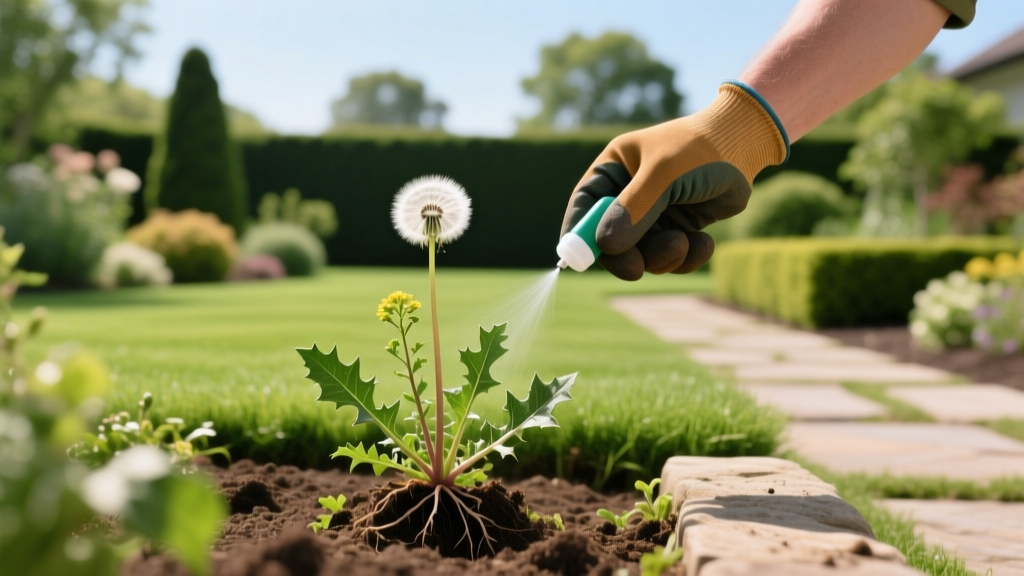
Spot-Treatment Guide: Eradicating Any Weed in Gardening Beds
Broadcast spraying herbicides near ornamental plants, vegetable gardens, and turf borders guarantees collateral damage. Precision spot-treatment is the only viable strategy for managing a stubborn weed in gardening beds without harming desirable root systems or foliage. This guide details the exact chemical formulations, hardware calibration, and application techniques required to eliminate specific weed species while preserving your landscape investments.
The Spot-Treatment Decision Matrix
Selecting the wrong active ingredient is the primary cause of ornamental plant death during weed eradication. Use this matrix to match the weed species with the correct selective or non-selective chemistry.
| Weed Category | Target Species | Active Ingredient | Trade Name Example | Soil Activity | Avg. Cost |
|---|---|---|---|---|---|
| Broadleaf | Dandelion, Plantain, Thistle | 2,4-D Amine + Dicamba | Bayer BioAdvanced Lawn Weed | Low | $18 / 32oz |
| Grassy | Crabgrass, Bermudagrass | Fluazifop-butyl | Ortho Grass-B-Gon | None | $14 / 16oz |
| Sedge | Yellow/Purple Nutsedge | Halosulfuron-methyl | SedgeHammer | Moderate | $18 / 5-pack |
| Perennial/Vining | Bindweed, Poison Ivy | Triclopyr + Glyphosate | Crossbow / Roundup Pro | Low (Glyphosate) | $45 / gal |
Broadleaf Weeds: Formulation Chemistry Matters
When treating broadleaf weeds like dandelions, clover, or plantain in garden borders, homeowners frequently reach for standard 2,4-D products. However, the formulation of the 2,4-D dictates whether your nearby ornamentals will survive the application.
Amine vs. Ester Formulations
Most consumer-grade weed killers use an amine salt formulation. Amine salts are water-soluble and have low volatility, making them safe for spot-treating near flower beds even in warm weather. Professional-grade or agricultural products often use an ester formulation. Esters penetrate waxy weed cuticles faster and work better in cool spring weather, but they are highly volatile.
CRITICAL WARNING: Never use an ester-based 2,4-D or Triclopyr product in July or August when temperatures exceed 85°F. The chemical will vaporize and drift, causing severe leaf-curling, stunting, and epinasty in your prized tomato plants, hydrangeas, and ornamental shrubs up to 50 feet away from the application site.
For spot-treating broadleeks in tight garden beds, mix a dedicated amine-based concentrate at a rate of 2 tablespoons per gallon of water. Apply directly to the center of the weed rosette using a low-pressure stream, avoiding the surrounding mulch or soil to prevent root uptake by shallow-rooted perennials.
Grassy Weeds and Sedges in Ornamental Beds
Grassy weeds invading flower beds present a unique challenge because they share the same monocot biology as many desirable ornamental grasses (like fescue, liriope, and miscanthus). Non-selective herbicides will kill both the weed and the ornamental grass.
Fluazifop for Grassy Invaders
If your garden bed consists entirely of broadleaf ornamentals (hostas, daylilies, roses) and is infested with crabgrass, bermudagrass, or goosegrass, Fluazifop-butyl (sold as Ortho Grass-B-Gon or Green Light Bermudagrass Killer) is the ideal selective spot-treatment. Fluazifop targets the ACCase enzyme found only in grasses. You can spray it directly over the top of broadleaf ornamentals without causing phytotoxicity. Mix at 0.5 oz per gallon and apply when grassy weeds are young and actively growing (under 4 inches tall).
Halosulfuron for Nutsedge
Nutsedge is not a grass; it is a sedge, identifiable by its triangular stem ('sedges have edges'). Standard grass killers will not touch it. Halosulfuron-methyl (SedgeHammer) is the industry standard for spot-treating nutsedge in garden beds.
- Mixing Ratio: One 0.03 oz water-soluble bag per 1 to 2 gallons of water.
- Surfactant Requirement: You must add a non-ionic surfactant (NIS) at 0.25% v/v (roughly 1/2 teaspoon per gallon). Without the surfactant, the halosulfuron will bead up and roll off the waxy nutsedge leaves, rendering the $18 treatment useless.
- Application Timing: Spray when the nutsedge has reached the 3- to 5-leaf stage. Spraying too early misses the underground nutlets; spraying too late reduces translocation to the roots.
The 'Nuclear Option': Non-Selective Systemics
When dealing with deeply rooted perennials like field bindweed, wild violet, or creeping charlie intertwined with desirable shrubs, selective herbicides often fail. This requires a non-selective systemic approach using Glyphosate (41% concentrate) or Glufosinate.
According to the University of California Statewide IPM Program, systemic herbicides must be absorbed by the foliage and translocated to the root system to achieve total kill. Glyphosate (e.g., Roundup Pro Concentrate) takes 7 to 14 days to show yellowing, while Glufosinate (e.g., Finale) acts as a contact burner with limited systemic movement, showing necrosis in 48 hours but often failing to kill the deep taproot.
The Sponge-Painting Technique
When bindweed wraps around the canes of a rose bush or the trunk of a young maple, spraying is impossible without risking fatal drift. Instead, use the sponge-painting method:
- Mix 41% Glyphosate at a high concentration: 3 oz per 1 gallon of water.
- Don a heavy-duty nitrile glove on your non-dominant hand.
- Dip a small foam craft brush or a dedicated sponge into the solution.
- Physically wipe the saturated sponge directly onto the leaves of the target weed, carefully peeling the vine away from the desirable plant as you paint.
THE IMAZAPYR TRAP: Never use products labeled 'Extended Control' or 'GroundClear' containing Imazapyr near the drip line of desirable trees or shrubs. Imazapyr is highly soil-active and persists for months. It will be absorbed by the fine feeder roots of mature oaks, pines, and maples, inevitably killing the tree 12 to 18 months after application. Always read the active ingredient label, not just the front marketing text.
Hardware Calibration and Drift Mitigation
The physical tool you use to apply the herbicide is just as critical as the chemical itself. A high-pressure hose-end sprayer is entirely inappropriate for garden bed spot-treatment due to microscopic aerosol drift.
- The Sprayer: Use a dedicated 1-gallon or 2-gallon poly pump sprayer (e.g., Chapin 20000 series, approx. $15-$20). Dedicate this sprayer only to herbicides; never use it for liquid fertilizers or foliar feeds later.
- The Nozzle: Swap the standard flat-fan nozzle for a cone nozzle or a low-pressure stream tip. You want a heavy, directional stream that drops directly onto the weed, not a fine mist that hangs in the air.
- Physical Shields: When spraying near the base of desirable plants, use a commercial herbicide shield or a simple 12x12 inch piece of corrugated cardboard held inches from the ground to block overspray and splash-back from hitting the bark of young trees.
- Pressure Control: Pump the sprayer only 5 to 7 times. You want roughly 15-20 PSI. Over-pressurizing to 40+ PSI forces the liquid through the nozzle too fast, atomizing it into drift-prone micro-droplets.
Post-Eradication Soil Protocols
Spot-treating existing weeds only solves half the problem. The disturbed soil and open canopy left by the dead weed will immediately invite new weed seeds to germinate. The Environmental Protection Agency (EPA) emphasizes that integrated pest management requires follow-up prevention to reduce long-term chemical reliance.
Once the spot-treated weeds have completely browned and been removed (usually 14 days post-application), apply a granular pre-emergent specifically formulated for ornamental beds. Isoxaben (sold as Gallery or Preen Garden Weed Preventer) is highly effective against broadleaf weed seeds and will not harm established ornamentals. Apply at a rate of 2.5 lbs per 1,000 square feet, water it in with 0.5 inches of irrigation to activate the chemical barrier, and immediately cover the bare soil with 2 to 3 inches of hardwood mulch to block UV light from triggering weed seed germination.
Frequently Asked Questions
Can I use vinegar (acetic acid) to spot-treat weeds in my garden beds?
Horticultural vinegar (20% to 30% acetic acid) is a non-selective contact herbicide. It will burn the foliage off young, annual weeds within hours. However, it possesses zero systemic activity, meaning it will not kill the roots of perennial weeds like dandelions or bermudagrass; they will simply resprout in two weeks. Furthermore, 20% acetic acid is highly corrosive, requires severe PPE (goggles, respirator), and will temporarily drop the soil pH, potentially locking out nutrients for nearby desirable plants. Synthetic systemic herbicides are vastly more effective and require lower application volumes.
How long should I wait to plant new flowers after spot-treating with Glyphosate?
Glyphosate is inactivated upon contact with soil particles (it binds tightly to organic matter and clay). You can safely plant new ornamental flowers, shrubs, or vegetables in a garden bed just 24 to 48 hours after a glyphosate spot-treatment, provided the spray did not heavily drench the soil. If you used a product containing Imazapyr or Prometon, you cannot plant anything in that soil for 6 to 12 months.

