
Lawn Care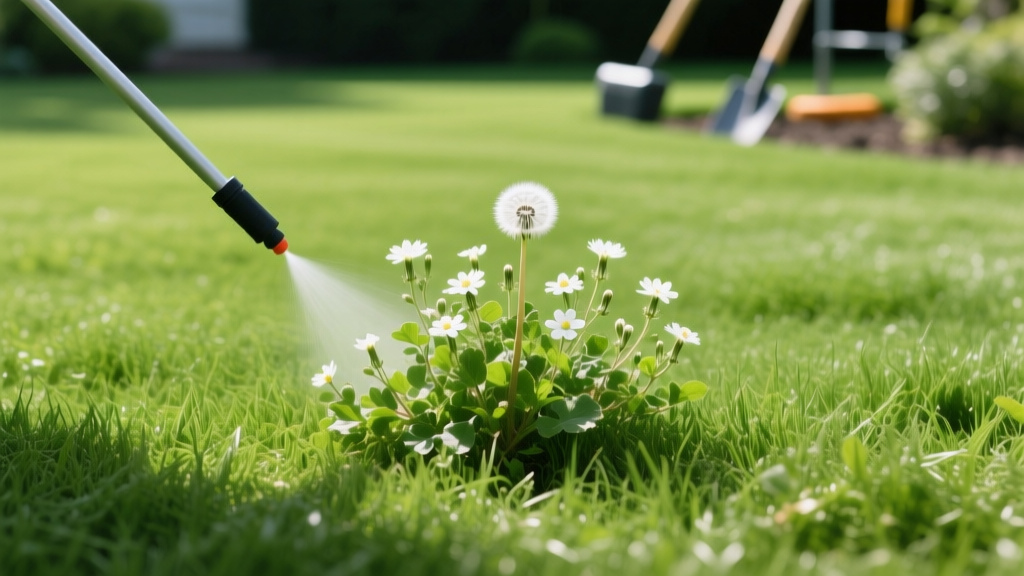
Spot Treatment Guide: How to Kill Weeds With White Flowers
Encountering weeds with white flowers in your turf is a clear indicator of underlying soil imbalances, mowing errors, or seasonal life cycles. While a uniform blanket of white blooms might look picturesque to a casual observer, to a turfgrass manager, it signals aggressive competition for water, light, and nutrients. Spot-treating these specific broadleaf invaders requires precise chemical selection, as the waxy cuticles and deep taproots of certain white-flowered species readily shrug off generic, off-the-shelf herbicides.
This guide bypasses generic advice and provides exact active ingredients, mixing ratios, and application protocols to eradicate the four most common white-flowered lawn weeds in 2026.
Rapid Identification Matrix for Weeds With White Flowers
Before mixing any herbicide, confirm the exact species. Misidentifying a winter annual as a perennial will result in wasted chemicals and rapid regrowth. Use this diagnostic matrix to pinpoint your invader.
| Common Name | Flower Structure | Leaf Shape & Arrangement | Root System & Life Cycle | Primary Soil Indicator |
|---|---|---|---|---|
| White Clover (Trifolium repens) | Dense, spherical heads (0.5-1 inch) on long stalks | Three oval leaflets with white 'V' chevron marks | Shallow stolons (creeping); Perennial | Low Nitrogen, low mowing height |
| Common Chickweed (Stellaria media) | Small, star-like, 5 petals (looks like 10 due to deep notches) | Smooth, oval, opposite leaves on hairy stems | Shallow, fibrous; Winter Annual | Compacted, consistently moist soil |
| Field Bindweed (Convolvulus arvensis) | Trumpet-shaped, 1 inch wide, often with pinkish stripes | Arrowhead or halberd-shaped, alternate | Deep taproot (up to 10+ ft); Perennial vine | Drought-stressed, neglected turf |
| English Daisy (Bellis perennis) | Classic daisy: white rays with a yellow center | Spatulate (spoon-shaped), scalloped edges, basal rosette | Fibrous, short rhizomes; Perennial | Low soil pH, heavy clay |
For authoritative botanical breakdowns and regional emergence timelines, consult the Penn State Extension White Clover profile and the UC Davis IPM Chickweed guidelines.
Targeted Spot-Treatment Chemistry & Dosages
Generic "weed and feed" granules are ineffective for spot-treating established patches of these weeds. You need a liquid post-emergent broadleaf herbicide applied via a pump sprayer. Below are the professional-grade formulations that actually work, along with current 2026 pricing and exact mix rates.
1. The Broad-Spectrum Standard: SpeedZone (Carfentrazone + 2,4-D + MCPP + Dicamba)
Best for: White Clover, English Daisy, and Chickweed.
Why it works: The addition of Carfentrazone-ethyl provides a rapid "burn-down" effect within 24 hours, while the systemic hormones (2,4-D and MCPP) travel to the roots to kill the plant entirely.
Mix Rate: 1.5 fl oz per 1 gallon of water (covers approx. 1,000 sq ft).
Cost: ~$48 per pint (yields roughly 10 gallons of mixed solution).
2. The Bindweed Specialist: Quinclorac (Drive XLR8 or Ortho WeedClear)
Best for: Field Bindweed.
Why it works: Bindweed's massive taproot stores immense energy. Standard 2,4-D only burns the top growth. Quinclorac is highly systemic and translocates deep into the taproot, though it often requires two applications spaced 21 days apart.
Mix Rate (Concentrate): 0.75 fl oz per 1 gallon of water.
Cost: ~$75 for 8 oz of professional concentrate (Drive XLR8).
3. The Organic Alternative: Iron HEDTA (Fiesta Turf Weed Killer)
Best for: Chickweed and young Clover in cool-season lawns where synthetic hormones are restricted.
Why it works: Chelated iron causes oxidative stress and cellular collapse in broadleaf weeds but is safe for most grasses.
Mix Rate: Ready-to-use (RTU) or mix concentrate at 3.2 fl oz per gallon.
Cost: ~$65 per gallon of concentrate. Note: Requires 2 applications 21 days apart for >80% control.
⚠️ CRITICAL WARNING: Bindweed Volatility & Drift
When spot-treating Field Bindweed near desirable ornamental beds or vegetable gardens, never use products containing Dicamba or 2,4-D ester formulations when temperatures exceed 85°F. These chemicals will vaporize (volatilize) and drift, causing severe cupping and distortion to nearby tomatoes, grapes, and redbud trees. Use an amine-based 2,4-D or stick strictly to Quinclorac for bindweed near sensitive plants.
The 4-Step Spot-Spraying Protocol
Chemical efficacy drops by up to 40% if application mechanics are flawed. Follow this exact sequence to ensure the herbicide penetrates the leaf cuticle and reaches the root zone.
- Prep the Foliage (Day 1): Do not spray if the weeds are covered in dust or drought-stressed (leaves rolled up). Mow the lawn 24 hours before spraying to remove excess grass blade interference, allowing the herbicide to coat the weed leaves directly.
- Add a Non-Ionic Surfactant (NIS): White clover and bindweed have highly hydrophobic (water-repelling) waxy leaves. Add a surfactant like Southern Ag Surfactant ($12/pint) at a rate of 1 teaspoon (0.25% v/v) per gallon of mixed herbicide. This breaks the surface tension, forcing the chemical to spread evenly across the leaf rather than beading up and rolling off.
- Calibrate and Apply (Day 2): Use a 1-gallon or 2-gallon pump sprayer equipped with a flat-fan nozzle (not a cone nozzle). Spray until the weed leaves are uniformly wet, but not dripping. Dripping wastes chemical and increases soil residual toxicity. Keep the wand within 12 inches of the target weed to prevent wind drift.
- The 48-Hour Rain & Mow Fast: Do not water the lawn, and ensure no rain is forecast for 48 hours post-application. Wait a full 48 hours before mowing again to allow maximum translocation of the systemic herbicide down into the stolon or taproot.
Cultural Corrections: Why They Invaded
Killing the weed is only 50% of the job. If you do not correct the environmental flaw, the weed seed bank in your soil will germinate a new flush within 60 days.
- For White Clover: Clover fixes its own atmospheric nitrogen. Its presence screams that your soil is nitrogen-deficient. Apply a high-nitrogen fertilizer (e.g., 29-0-4) at a rate of 1.0 lb of actual nitrogen per 1,000 sq ft in the fall and spring to help the turfgrass outcompete the clover.
- For Common Chickweed: Chickweed thrives in shallow, compacted, and frequently watered soils. Transition to deep, infrequent watering (1 inch per week applied in a single session) and perform core aeration in the fall to alleviate compaction.
- For English Daisy: Daisies tolerate extremely low mowing heights and acidic soils. Raise your mower deck to a minimum of 2.5 inches for cool-season grasses (3 inches is ideal) and apply granular lime if a soil test reveals a pH below 6.0.
Troubleshooting Treatment Failures
Why did my clover turn brown at the edges but survive in the center?
You likely applied the herbicide during a temperature spike (above 85°F) or used a weak mix rate. The heat caused rapid desiccation of the outer leaf tissue (the "burn" from Carfentrazone), which sealed off the plant's vascular system before the systemic 2,4-D could travel to the center crown. Wait 21 days for the clover to push new green growth, then re-apply in the early morning when temperatures are between 65°F and 75°F.
I sprayed bindweed three times and it keeps coming back. What now?
Field bindweed maintains a root system that can extend 10 feet deep and 30 feet laterally, according to the University of Minnesota Extension. A single spot treatment only depletes the top 12 inches of root reserves. You must commit to a "depletion strategy." Spray the bindweed with Quinclorac, wait 21 days for it to regrow to the 4-leaf stage, and spray again. Repeat this cycle 3 to 4 times throughout the growing season to exhaust the taproot's carbohydrate reserves.
Can I use a pre-emergent to stop white flowers next year?
Only for Chickweed. Because Common Chickweed is a winter annual that germinates in early fall, applying a pre-emergent like Prodiamine 65 WDG (at 0.4 oz per 1,000 sq ft) in late August to early September will create a chemical barrier that stops chickweed seeds from sprouting. Pre-emergents will not stop White Clover, Bindweed, or Daisies, as these are perennials that spread primarily via vegetative stolons, rhizomes, or deep taproots, not just annual seed germination.

