
Lawn Care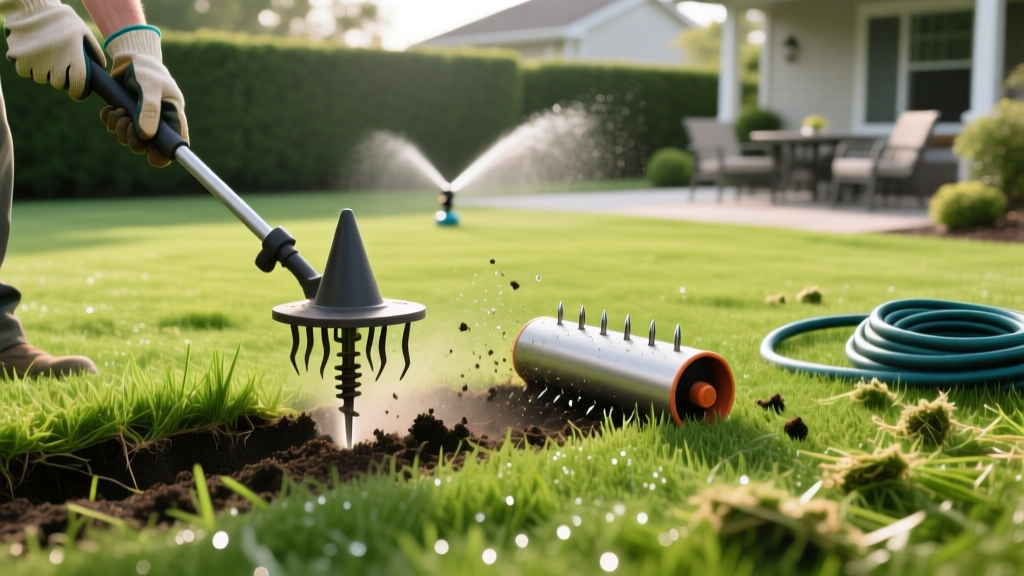
Aeration Types Spray and Cone: Step-by-Step Lawn Procedures
Soil compaction reduces subsurface pore space to below 10%, suffocating turfgrass roots, restricting water infiltration, and promoting shallow root systems. While hollow-tine core aeration is widely considered the gold standard for heavy clay soils, homeowners and turf managers frequently evaluate alternative aeration types, spray and cone methods represent two distinct, non-invasive approaches to soil management. Liquid (spray) aeration utilizes chemical surfactants to break soil surface tension and flocculate clay particles, while cone (spike) aeration uses solid tines to mechanically puncture the soil profile. Neither method removes a soil core, meaning their applications, timing, and step-by-step procedures differ vastly from traditional coring.
According to the University of Minnesota Extension, understanding the physical limitations of your soil type is critical before selecting an aeration method. Misapplying cone aeration on wet, heavy clay can actually worsen compaction through lateral smearing, while spray aeration requires specific soil moisture baselines to penetrate effectively. This guide details the exact step-by-step procedures, chemical dilution rates, and mechanical specifications required to execute spray and cone aeration correctly in 2026.
Mechanics and Use Cases: Spray vs. Cone Aeration
Before initiating any lawn maintenance procedure, you must match the aeration method to your specific soil profile and turf condition. Below is a functional comparison matrix to aid in your decision-making process.
| Feature | Spray (Liquid) Aeration | Cone (Spike) Aeration |
|---|---|---|
| Primary Mechanism | Anionic/cationic surfactants break soil particle bonds | Solid steel tines physically displace soil laterally |
| Best Soil Type | Moderate clay, hydrophobic soils, thatch-heavy lawns | Sandy loams, mildly compacted soils, pre-seeding prep |
| Worst Soil Type | Severely compacted subsoil (hardpan layers) | Heavy, wet clay (causes lateral smearing/plow pan) |
| Equipment Cost | $25–$45 per 5,000 sq ft (surfactant concentrate) | $45 manual step-on tool; $120/day tow-behind rental |
| Optimal Timing | Early spring or early fall; avoids peak summer heat | Anytime soil is moist but not saturated |
Step-by-Step Procedure: Applying Spray (Liquid) Aeration
Liquid aeration relies on advanced soil conditioners—typically formulated with ammonium lauryl sulfate, yucca extract, or ethoxylated alcohols—to reduce the surface tension of water and separate tightly bound clay particles. This creates micro-fissures that allow oxygen and water to reach the root zone without mechanical disruption.
Pro Tip: The Screwdriver Test
Before mixing your surfactant, push a 6-inch flathead screwdriver into the soil. If it penetrates easily to the handle, your soil is not severely compacted, and spray aeration will be highly effective. If you cannot push it past 2 inches, you likely have a hardpan layer that requires mechanical core aeration first.
Before mixing your surfactant, push a 6-inch flathead screwdriver into the soil. If it penetrates easily to the handle, your soil is not severely compacted, and spray aeration will be highly effective. If you cannot push it past 2 inches, you likely have a hardpan layer that requires mechanical core aeration first.
Step 1: Mow and Dethatch
Mow your lawn to a height of 1.5 to 2.0 inches. If your thatch layer exceeds 0.5 inches, run a power rake or dethatching rake over the lawn first. Thick thatch will intercept the liquid surfactant, preventing it from reaching the soil interface.
Step 2: Mix the Surfactant Solution
Fill a 2-gallon or 4-gallon backpack sprayer with clean water. Add the liquid aerating soil loosener at a rate of 2 to 3 fluid ounces per 1,000 square feet (always verify the specific manufacturer's label, as concentrations of alkoxylated alcohols vary by brand). Agitate the tank thoroughly to ensure the surfactant is fully emulsified.
Step 3: Apply in a Cross-Hatch Pattern
Calibrate your sprayer nozzle to a medium fan spray. Walk the lawn in straight, parallel lines, applying the solution evenly. Once the first pass is complete, walk the lawn again in a perpendicular direction (cross-hatch pattern). This ensures uniform coverage and prevents localized pooling, which can cause temporary turf burn due to surfactant concentration.
Step 4: Immediate Water-In
Within 30 minutes of application, irrigate the lawn with exactly 0.25 inches of water. This activates the surfactant, pulling it down into the top 4 to 6 inches of the soil profile where the primary root mass resides. Without this immediate water-in, the sun's UV rays will degrade the active chemical compounds within hours.
Step-by-Step Procedure: Executing Cone (Spike) Aeration
Cone aeration utilizes solid, conical spikes (typically 3 to 4 inches long and 0.5 inches in diameter at the base) to punch holes into the turf. According to Clemson University's Home & Garden Information Center, while spike aeration does not alleviate deep compaction as effectively as core removal, it is an excellent, low-impact method for improving surface drainage and preparing a seedbed for overseeding in sandy or loamy soils.
Step 1: Site Preparation and Utility Marking
Mow the lawn slightly lower than your normal maintenance height (around 1.5 inches) to allow the spikes maximum soil contact. Walk the property and flag all shallow irrigation heads, valve boxes, and buried dog fences. Cone tines can easily puncture PVC irrigation lines or low-voltage wiring if they strike them at an angle.
Step 2: Moisture Calibration
Cone aeration requires the soil to be moist but not saturated. Water the lawn deeply 24 hours before the procedure. If the soil is too dry, the steel tines will bend or fail to penetrate to the required 3-inch depth. If the soil is muddy, the lateral pressure of the cone will smear the clay walls of the hole, sealing it off and creating a 'glazing' effect that repels water.
Step 3: Mechanical Execution
- Manual Tools (Yard Butler or Step-On Spikers): Drive the tines vertically into the soil using your full body weight. Space the punctures 4 to 6 inches apart in a grid pattern. Focus heavily on high-traffic areas like walkways and play zones.
- Tow-Behind Spike Rollers: Attach the roller to your utility vehicle or tractor. Add 40 to 60 lbs of weight (sandbags or concrete blocks) to the roller drum to ensure the 3-inch tines fully penetrate the soil. Drive at a slow, steady pace of 2 to 3 MPH to prevent tearing the turf canopy.
Step 4: Topdressing and Dragging
Because cone aeration does not remove soil, the holes will quickly close up as the surrounding soil expands back into the void. To keep the holes open, immediately topdress the lawn with a 0.25-inch layer of coarse masonry sand or compost. Use a piece of chain-link fence or a specialized lawn drag mat to work the material down into the spike holes.
Post-Aeration Recovery and Overseeding Protocols
Both spray and cone aeration create a temporary window of opportunity for nutrient uptake and seed-to-soil contact. To maximize the ROI of your labor, follow these post-procedure protocols:
- Fertilization (48 Hours Post-Aeration): Apply a starter fertilizer with an NPK ratio of 16-4-8 or 18-24-12, supplemented with 2% chelated iron. The open micro-fissures (from spray) or physical holes (from cone) allow the phosphorus to reach the root zone directly, bypassing the thatch layer where it normally binds and becomes unavailable.
- Overseeding Integration: If overseeding, cone aeration provides superior seed-to-soil contact compared to spray aeration. Drop your seed (e.g., Tall Fescue at 5 lbs per 1,000 sq ft) immediately after spiking, then drag the lawn to push the seeds into the cone voids.
- Herbicide Restrictions: Do not apply pre-emergent herbicides (like Prodiamine) for at least 4 weeks after overseeding in aerated holes, as this will halt the germination of your new turfgrass seed.
Common Failure Modes and Troubleshooting
| Symptom | Underlying Cause | Corrective Action |
|---|---|---|
| Surfactant pooling on surface after spray aeration | Soil is severely hydrophobic or application rate exceeded 3 oz/1000 sq ft. | Reduce concentration; apply a dedicated wetting agent (like Aqueduct) 3 days prior to the liquid aerator. |
| Cone tines bending or failing to penetrate | Soil is bone-dry, or hitting a sub-surface rock/hardpan layer. | Irrigate with 0.5 inches of water 24 hours prior. Switch to hollow-tine core aeration if hardpan is present. |
| Turf tearing during tow-behind cone aeration | Turning the tractor while the spike roller is engaged in the soil. | Always lift the roller or drive straight before making turns to prevent lateral shearing of the grass crowns. |
Warning: Heavy Clay Limitations
If your lawn consists of heavy Georgia red clay or Midwest glacial till, rely on spray aeration only as a supplemental treatment between annual core aeration sessions. Relying exclusively on cone (spike) aeration in heavy clay will eventually create a compacted 'plow pan' layer exactly 3 inches below the surface, which will permanently restrict deep root growth and drought tolerance.
If your lawn consists of heavy Georgia red clay or Midwest glacial till, rely on spray aeration only as a supplemental treatment between annual core aeration sessions. Relying exclusively on cone (spike) aeration in heavy clay will eventually create a compacted 'plow pan' layer exactly 3 inches below the surface, which will permanently restrict deep root growth and drought tolerance.

