
Lawn Care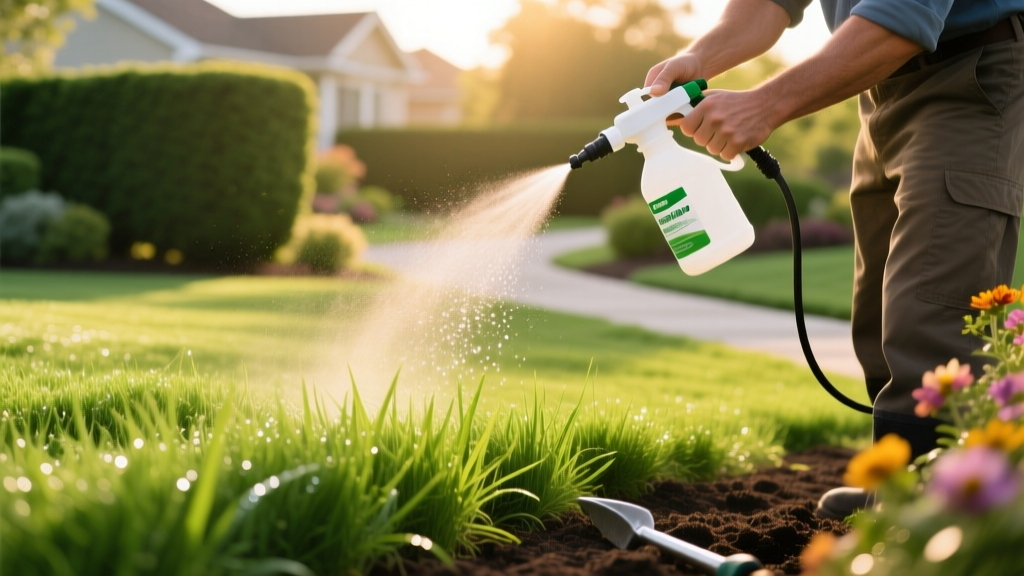
Spray Fertilizer for Grass: Complete Liquid Feeding Guide
The Mechanics of Liquid Turf Nutrition
Applying spray fertilizer for grass bypasses the slow breakdown process of granular prills, delivering water-soluble nutrients directly to the turf canopy and root zone. Liquid formulations rely on two primary uptake pathways: foliar absorption through the leaf stomata and soil drenching via root interception. Because the nutrients are already dissolved, grass blades can absorb nitrogen and micronutrients within 24 to 48 hours, making liquid feeding the industry standard for rapid correction of deficiencies and immediate color enhancement.
According to turfgrass research from University of Minnesota Extension, liquid fertilizers offer superior uniformity compared to rotary spreaders, eliminating the striping effect common with overlapping granular passes. However, this rapid availability requires precise calibration to prevent osmotic stress and foliar burn.
Spray Fertilizer for Grass vs. Granular: A Data-Driven Comparison
Choosing between liquid and granular depends on your specific agronomic goals, budget, and equipment availability. The matrix below breaks down the operational differences based on current 2026 turf management standards.
| Performance Metric | Spray / Liquid Fertilizer | Granular Fertilizer |
|---|---|---|
| Nutrient Availability | 24 - 72 hours (Immediate) | 7 - 28 days (Slow/Controlled) |
| Application Uniformity | Excellent (No overlap striping) | Moderate (Prone to spreader streaks) |
| Risk of Foliar Burn | High (If misapplied or unwatered) | Low (Requires moisture to activate) |
| Equipment Required | Hose-end sprayer or pump tank | Rotary or drop spreader |
| Cost per 1,000 sq. ft. | $0.08 - $0.15 | $0.12 - $0.22 |
| Best Use Case | Micro-nutrients, iron, quick green-up | Base NPK feeding, winterizers |
Top Liquid Formulations and NPK Profiles
Not all liquid concentrates are created equal. The market has shifted toward highly chelated micronutrients and stabilized nitrogen sources. Here are three specific formulations that dominate the residential and prosumer space this year.
1. Simple Lawn Solutions 16-4-8 (Balanced Maintenance)
Priced at approximately $24.99 for a 32 oz hose-end bottle, this formulation covers up to 3,200 square feet. The 16-4-8 NPK ratio provides a balanced nitrogen-to-potassium profile, ideal for late-spring or early-fall maintenance. It includes chelated iron and seaweed extract, which buffers the soil against mild pH fluctuations.
2. PetraTools 28-0-0 High Nitrogen (Rapid Green-Up)
Retailing around $34.99 per gallon, this high-analysis nitrogen solution is designed for severe yellowing or post-dormancy wake-up calls. Because it lacks phosphorus and potassium, it should only be used if a recent soil test confirms adequate P and K levels. Apply at a rate of 3 oz per 1,000 sq. ft. to avoid burning the leaf tips.
3. Southern Ag Chelated Liquid Iron (Chlorosis Correction)
At $14.99 for 32 oz, this is a targeted micronutrient spray rather than a complete NPK fertilizer. It corrects iron chlorosis (yellowing with green veins) in high-pH soils where granular iron sulfate becomes locked up and unavailable to the roots. The chelating agent keeps the iron soluble even in alkaline conditions up to a pH of 7.5.
⚠️ Critical Warning: The Iron Watering Rule
When applying liquid NPK (Nitrogen-Phosphorus-Potassium), you must water the lawn with 1/4 inch of irrigation immediately after application to wash the salts off the leaf blade and into the soil. However, when applying liquid iron, do NOT water it in. Iron requires foliar absorption and must dry completely on the grass blade to be effective. Watering liquid iron immediately will wash it into the soil where it may oxidize and become unavailable.
Step-by-Step Calibration and Application Protocol
Proper equipment calibration is the difference between a lush lawn and a burned one. Follow this exact protocol for pump sprayers and hose-end attachments.
- Test Water pH: Liquid fertilizers, especially those containing iron, perform poorly in hard water. If your tap water pH is above 7.0, add a water conditioner or ammonium sulfate to lower the spray solution pH to 5.5-6.0.
- Add Surfactant: Mix 1/2 teaspoon of non-ionic surfactant (like Hi-Yield Spreader Sticker) per gallon of spray solution. This breaks the surface tension of the water, allowing the fertilizer to coat the grass blade evenly rather than beading up and rolling off.
- Set Pump Pressure: If using a backpack or hand-pump sprayer, maintain a consistent 30 to 40 PSI. This generates a fine mist (medium droplet size) that maximizes foliar coverage without causing excessive runoff.
- Calibrate Walk Speed: Mark out a 20 x 50 foot area (1,000 sq. ft.). Fill your sprayer with exactly the amount of water and concentrate required for 1,000 sq. ft. Walk the area at a natural, steady pace. If you run out of liquid before finishing the area, you are walking too fast; if you have liquid left over, you are walking too slow.
- Use a Dye Indicator: Add a few drops of turf marker dye (e.g., Blue Marker Dye, ~$12/gallon) to the tank. This provides a visual trail of where you have sprayed, preventing costly double-pass overlaps that cause nitrogen burn.
Troubleshooting Common Liquid Fertilizer Failures
Symptom: White or Brown Streaking Across the Lawn
Cause: Uneven overlap or walking too fast on the return pass. Liquid sprays leave no physical footprint, making it easy to miss 2-inch gaps between passes.
Fix: Always use a visible dye indicator in your tank. For future applications, attach a sprayer guide wand with a physical width marker (usually 4 to 6 feet wide) to guarantee exact overlapping.
Symptom: Brown, Crispy Leaf Tips 24 Hours After Application
Cause: Osmotic stress (fertilizer burn) caused by applying high-nitrogen liquids during peak heat (above 85°F) or failing to water in NPK salts.
Fix: Restrict liquid NPK applications to early morning (before 8:00 AM) when stomata are open and temperatures are cool. If burn occurs, flush the area with 1/2 inch of water daily for three days to leach excess salts past the root zone.
Symptom: Grass Remains Yellow Despite Iron Application
Cause: pH lockout or using non-chelated iron sulfate in alkaline soils. Standard iron sulfate oxidizes rapidly in soils with a pH above 7.0, turning into rust-like compounds the grass cannot absorb.
Fix: Switch to an EDDHA-chelated liquid iron, which remains stable in soils up to a pH of 9.0. Alternatively, apply elemental sulfur granularly in the fall to gradually lower the soil pH over the next 12 months.
Frequently Asked Questions
Can I mix liquid herbicides with spray fertilizer for grass?
Yes, but with strict limitations. You can tank-mix broadleaf herbicides (like 2,4-D or Trimec) with liquid fertilizers to save time. However, never mix liquid iron with herbicides containing glyphosate or certain sulfonyleureas, as the iron ions can bind to the active ingredients and neutralize the weed control. Always perform a small 'jar test' by mixing both products in a clear glass; if the solution clumps or forms a gel, they are incompatible.
How often should I apply liquid fertilizer compared to granular?
Because liquid fertilizers lack the polymer coatings found in slow-release granular products, they leach through the soil profile much faster. While a granular application lasts 6 to 8 weeks, liquid applications typically need to be repeated every 3 to 4 weeks during the active growing season to maintain consistent nitrogen levels in the plant tissue. Many turf managers use granular for the heavy base feeding and supplement with liquid spray every 14 days for micronutrients and color boosts.
For comprehensive regional guidelines on turfgrass nutrient requirements and soil testing protocols, consult the Clemson University Home & Garden Information Center to ensure your spray regimen aligns with local environmental regulations and grass species requirements.

