
Lawn Care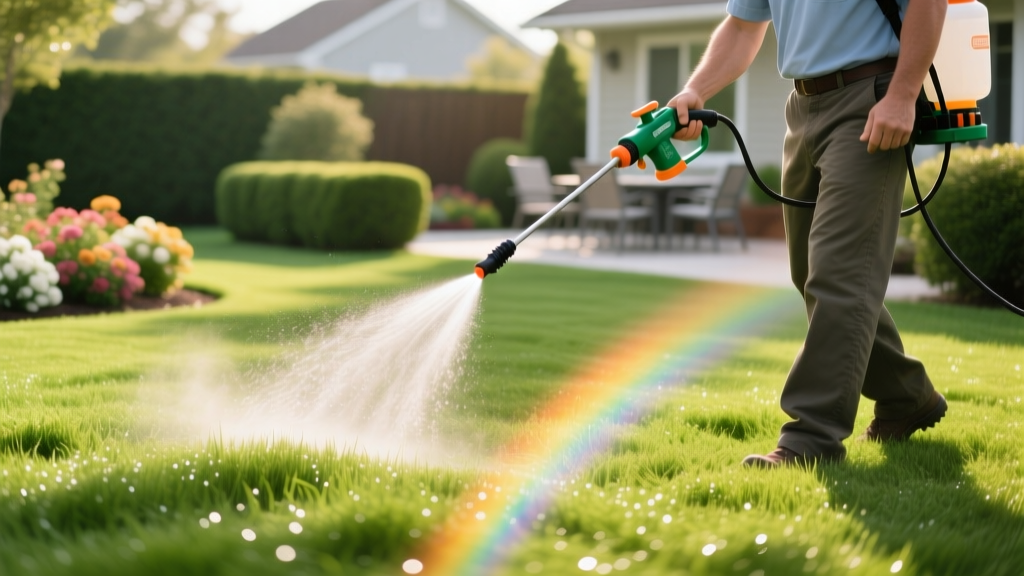
How to Apply Spray Lawn Fertilizer for Rapid Green-Up
Granular fertilizers rely on soil microbes and irrigation to break down prills, a process that can take one to two weeks before turf shows results. Spray lawn fertilizer bypasses this delay. By delivering water-soluble nutrients directly to the leaf tissue and root zone, liquid applications trigger visible green-up within 24 to 48 hours. However, the margin for error with liquids is razor-thin. Incorrect dilution, poor calibration, or missing a non-ionic surfactant can result in severe foliar burn or patchy, streaked growth. This guide details the exact mixing protocols, equipment calibration, and application strategies required to safely spoon-feed your turf using DIY spray lawn fertilizer.
The Science of Foliar Uptake vs. Soil Absorption
When you spray liquid fertilizer, the nutrients enter the grass plant through two distinct pathways. Understanding this dual-action mechanism is critical for timing your applications.
Foliar Absorption (1 to 4 Hours): Water-soluble nitrogen sources like urea and ammonium sulfate penetrate the leaf cuticle and enter through the stomata. This provides an immediate metabolic boost, driving chlorophyll production and rapid color response without forcing excessive vertical top growth.
Soil Absorption (12 to 48 Hours): The portion of the spray that drips off the leaf blade or is intentionally watered into the soil is absorbed by the root hairs. This provides sustained nutrition and allows less mobile nutrients like phosphorus and potassium to reach the root zone.
Soil Absorption (12 to 48 Hours): The portion of the spray that drips off the leaf blade or is intentionally watered into the soil is absorbed by the root hairs. This provides sustained nutrition and allows less mobile nutrients like phosphorus and potassium to reach the root zone.
According to turfgrass research from the University of Minnesota Extension, liquid applications are particularly effective for correcting acute micronutrient deficiencies—such as iron chlorosis in high-pH soils—because foliar feeding bypasses soil tie-up issues entirely.
Essential Equipment for DIY Spray Applications
The success of a spray lawn fertilizer application hinges entirely on uniform droplet distribution. Using the wrong sprayer or nozzle will guarantee streaking. Here is the professional-grade equipment hierarchy for residential lawns.
| Equipment Type | Recommended Model | Estimated Cost | Best Use Case |
|---|---|---|---|
| Hose-End Sprayer | Gilmour 362 Dial Sprayer | $20 - $25 | Lawns under 3,000 sq ft; beginners. |
| Pump Tank Sprayer | Chapin 2-Gallon Poly Sprayer | $25 - $35 | Spot treatments and small repair zones. |
| Battery Backpack | PetraTools 4-Gallon 20V (with TeeJet 11004 VS Flat Fan nozzle) | $130 - $160 | Lawns over 5,000 sq ft; precise, streak-free overlap. |
Expert Nozzle Tip: If using a backpack sprayer, swap the standard cone nozzle for a TeeJet 11004 VS Flat Fan nozzle. At 40 PSI, it delivers exactly 1.1 gallons per minute. Walking at a standard 2.7 mph pace with a 20-inch spray swath, this mathematically guarantees a carrier rate of 1 gallon per 1,000 square feet, eliminating the guesswork from your application.
Formulating the Mix: N-P-K Ratios and Surfactants
Liquid fertilizers are highly concentrated. A standard DIY maintenance mix utilizes a balanced liquid N-P-K ratio, supplemented with a wetting agent to ensure the droplets spread across the leaf blade rather than beading up and rolling off.
Core Fertilizer Selection
- Spring/Early Summer: Simple Lawn Solutions 16-4-8 Liquid Iron (~$35/gallon). Provides high nitrogen for growth and iron for deep greening without excessive phosphorus.
- Mid-Summer Spoon-Feeding: PetraTools 20-0-0 Ammonium Sulfate (~$28/gallon). Delivers quick-release nitrogen to maintain color during heat stress without pushing vulnerable top growth.
- Root Building (Fall): Extreme 0-0-18 Liquid Potassium (~$40/gallon). Fortifies cell walls for winter hardiness and drought resistance.
The Surfactant Multiplier
Water has high surface tension. Without a non-ionic surfactant like Southern Ag Surfactant (~$15/quart), liquid fertilizer will bead on waxy grass cuticles (especially on Zoysia and Bermuda). Add 0.5 ounces of surfactant per gallon of finished spray mix. This reduces surface tension, allowing the nutrient solution to form a uniform film over the leaf tissue, increasing foliar uptake efficiency by up to 40%.
Step-by-Step Calibration and Application Protocol
Never guess your dilution rates. Follow this exact protocol to calibrate your sprayer and mix your solution safely.
- Calibrate the Carrier Rate: Mark off a 20 ft x 50 ft area of your driveway or lawn (exactly 1,000 sq ft). Fill your sprayer with exactly 1.5 gallons of plain water. Spray the marked area at your normal walking pace and nozzle height (18 inches off the ground). Measure the water left in the tank. If you used exactly 1 gallon, your carrier rate is 1 gal/1,000 sq ft.
- Calculate the Product Dose: Check the fertilizer label. If it recommends 3 oz per 1,000 sq ft, and your carrier rate is 1 gallon per 1,000 sq ft, you will mix 3 oz of fertilizer per gallon of water in your tank.
- Mix in the Correct Order: To prevent chemical lock-up and excessive foaming, always follow the W.A.L.E.S. mixing order. Fill the tank halfway with Water, add Agitators (if using wettable powders), add Liquid fertilizers, add Emulsifiable concentrates, and finally add Surfactants. Top off with the remaining water.
- Execute the Spray Pattern: Spray only when wind speeds are below 8 mph to prevent drift. Walk in straight lines, overlapping your previous spray swath by 50%. Keep the nozzle exactly 18 inches above the turf canopy to ensure the flat fan pattern has fully developed before hitting the grass.
- Post-Application Watering: While foliar nutrients absorb immediately, wait 4 hours to allow the leaves to dry, then apply 0.1 inches of irrigation to wash any residual salts off the blade and into the soil, preventing tip burn.
Troubleshooting Common Spray Fertilizer Failures
Even with careful planning, environmental variables can disrupt liquid applications. Use this diagnostic framework to identify and correct issues.
- Symptom: Alternating dark and light green stripes (Streaking).
Cause: Inconsistent walking speed, wind drift, or failing to overlap the spray swath by 50%.
Fix: Use a sprayer with a pressure regulator to maintain a constant flow rate, and mark your wheel tracks with landscaping paint to guide your overlap. - Symptom: Brown, crispy grass blade tips (Tip Burn).
Cause: Applying liquid nitrogen during temperatures exceeding 85°F, or failing to add enough water carrier, resulting in salt accumulation on the leaf.
Fix: Restrict spray applications to early morning (before 8 AM) or late evening. Increase your water carrier volume from 1 gallon to 1.5 gallons per 1,000 sq ft to dilute the salts. - Symptom: Sprayer nozzle clogging or sputtering.
Cause: Mixing incompatible products (e.g., combining liquid iron with high-phosphorus liquids) causing precipitation, or failing to use an inline mesh filter.
Fix: Always install a 50-mesh inline strainer between the pump and the nozzle. Never mix liquid iron and liquid phosphorus in the same tank; apply them in separate passes spaced two weeks apart.
Liquid vs. Granular: Strategic Timing Matrix
Spray lawn fertilizer is not a complete replacement for granular feeds; it is a tactical tool. The Penn State Extension recommends integrating both methods based on seasonal turfgrass metabolic demands.
| Season | Primary Method | Strategic Rationale |
|---|---|---|
| Early Spring | Granular (Slow-Release) | Provides a 60-day baseline of nitrogen to support the primary spring growth flush without requiring weekly refills. |
| Peak Summer | Spray Lawn Fertilizer | Spoon-feeding low doses of liquid nitrogen and iron maintains color without pushing lush, disease-susceptible top growth during high heat and humidity. |
| Early Fall | Granular (High Potassium) | Builds deep root carbohydrate reserves for winter survival. Granular ensures the heavy nutrient load reaches the soil profile efficiently. |
| Spot Repair | Spray Lawn Fertilizer | Liquid feeds applied to newly seeded or sodded areas provide immediate, easily accessible nutrition to support rapid root establishment. |
By mastering the calibration, mixing chemistry, and seasonal timing of liquid feeds, you transition from basic lawn maintenance to precision turf management. Spray applications offer unparalleled control over your lawn's nutrition, allowing you to correct deficiencies in hours rather than weeks while minimizing the environmental footprint of excess soil runoff.

