
Lawn Care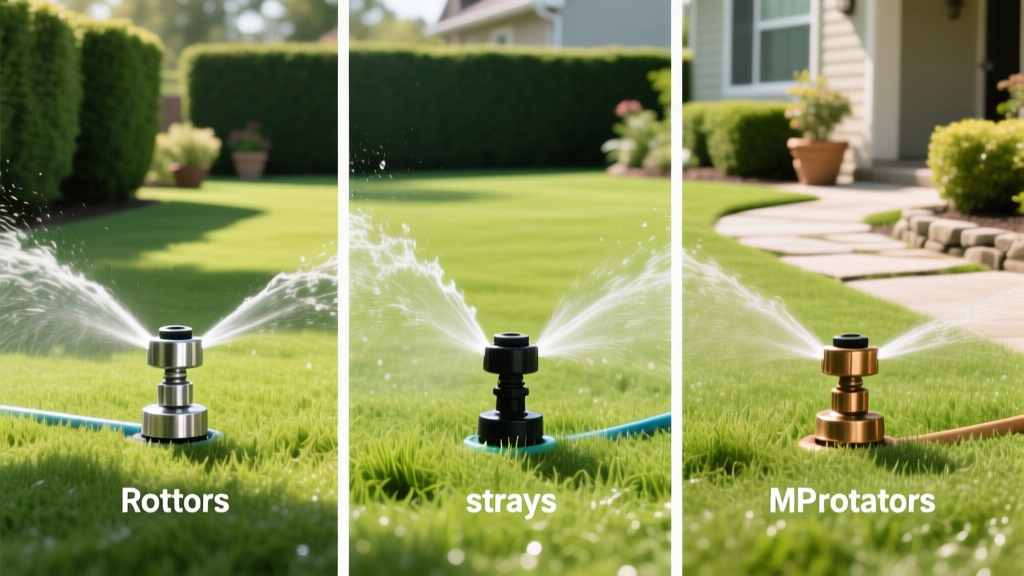
Sprinkler Head Types Compared: Rotors, Sprays, and MP Rotators
Selecting the correct irrigation hardware dictates the health of your turf and the efficiency of your water bill. Mixing incompatible sprinkler head types on a single zone or ignoring soil infiltration rates leads to localized flooding, dry spots, and wasted runoff. According to the EPA WaterSense program, improper irrigation scheduling and mismatched hardware account for up to 50% of residential outdoor water waste. This guide breaks down the technical specifications, ideal use cases, and real-world failure modes of the three primary sprinkler head types: fixed sprays, gear-driven rotors, and multi-stream rotary nozzles.
The Core Sprinkler Head Types Explained
1. Fixed Spray Heads
Fixed spray heads emit a continuous fan-shaped sheet of water. They are designed for small, rectangular, or narrow turf areas where the radius does not exceed 15 feet. Because they apply water rapidly, they require shorter run times but are highly susceptible to wind drift and misting if water pressure exceeds their optimal range.
Technical Specs:
• Operating Pressure: 15–30 PSI
• Flow Rate: 1.5–2.5 GPM per nozzle
• Precipitation Rate: 1.5–2.5 inches per hour
• Standard Models: Rain Bird 1800 Series, Toro 570Z
• Average Cost: $3–$6 per head (bodies and nozzles sold separately)
• Operating Pressure: 15–30 PSI
• Flow Rate: 1.5–2.5 GPM per nozzle
• Precipitation Rate: 1.5–2.5 inches per hour
• Standard Models: Rain Bird 1800 Series, Toro 570Z
• Average Cost: $3–$6 per head (bodies and nozzles sold separately)
2. Gear-Driven Rotors
Rotors use an internal gear mechanism to rotate a single stream of water back and forth across the lawn. They are engineered for large, open expanses requiring a 15- to 45-foot throw radius. Rotors apply water much slower than spray heads, making them ideal for slopes and soils with slow absorption rates.
Technical Specs:
• Operating Pressure: 30–50 PSI
• Flow Rate: 2.0–4.5 GPM per nozzle
• Precipitation Rate: 0.5–1.0 inches per hour
• Standard Models: Rain Bird 5000 Plus, Hunter PGP-Ultra
• Average Cost: $10–$18 per head
• Operating Pressure: 30–50 PSI
• Flow Rate: 2.0–4.5 GPM per nozzle
• Precipitation Rate: 0.5–1.0 inches per hour
• Standard Models: Rain Bird 5000 Plus, Hunter PGP-Ultra
• Average Cost: $10–$18 per head
3. Multi-Stream Rotary Nozzles (MP Rotators)
Rotary nozzles screw onto standard spray bodies but replace the single fan of water with multiple, slowly rotating streams. This technology drastically reduces the precipitation rate, virtually eliminating runoff on clay soils while maintaining excellent wind resistance.
Technical Specs:
• Operating Pressure: 25–50 PSI
• Flow Rate: 0.4–0.8 GPM per nozzle
• Precipitation Rate: 0.4–0.6 inches per hour
• Standard Models: Hunter MP Rotator MP3000, Rain Bird R-VAN
• Average Cost: $8–$12 per nozzle
• Operating Pressure: 25–50 PSI
• Flow Rate: 0.4–0.8 GPM per nozzle
• Precipitation Rate: 0.4–0.6 inches per hour
• Standard Models: Hunter MP Rotator MP3000, Rain Bird R-VAN
• Average Cost: $8–$12 per nozzle
Technical Specification Matrix
When designing or auditing an irrigation zone, you must never mix different sprinkler head types on the same valve. The precipitation rates vary so wildly that matching run times is mathematically impossible without overwatering one area or underwatering another.
| Head Type | Optimal PSI | Max Radius | Precipitation Rate (in/hr) | Best Application |
|---|---|---|---|---|
| Fixed Spray | 20-30 | 15 ft | 1.5 - 2.5 | Small strips, narrow side yards |
| Gear Rotor | 35-45 | 45 ft | 0.5 - 1.0 | Large open lawns, sports fields |
| MP Rotator | 30-40 | 35 ft | 0.4 - 0.6 | Clay soils, slopes, retrofits |
Matching Hardware to Soil Infiltration Rates
The most common mistake in irrigation design is ignoring the relationship between the sprinkler's precipitation rate and the soil's infiltration rate. Data from the Utah State University Extension highlights that when precipitation exceeds infiltration, water pools and runs off into storm drains, carrying fertilizers and pesticides with it.
- Clay Soils (Infiltration: 0.1 to 0.2 in/hr): Clay absorbs water painfully slow. If you use fixed spray heads (2.0 in/hr), runoff begins within 5 to 8 minutes. Solution: Use MP Rotators (0.4 in/hr) and employ 'cycle and soak' programming (e.g., three 10-minute cycles spaced two hours apart).
- Loam Soils (Infiltration: 0.4 to 0.8 in/hr): Loam is forgiving. Fixed sprays, rotors, and MP rotators all work well here, provided run times are calibrated to the specific nozzle output.
- Sandy Soils (Infiltration: 2.0+ in/hr): Sand drains rapidly and holds little moisture. Fixed spray heads are ideal here because their high precipitation rate delivers water faster than it drains away, ensuring the root zone is saturated before the water disappears.
Real-World Failure Modes and Diagnostics
Even premium hardware fails when site conditions change or maintenance is neglected. Here is how to diagnose the most frequent sprinkler head type failures in the field.
1. Misting and Fogging (High Pressure)
The Symptom: Spray heads emit a fine, white mist that blows away in the breeze rather than falling onto the grass. This occurs when municipal water pressure exceeds 40 PSI, atomizing the water droplets.
The Fix: Do not just throttle the valve. Install pressure-regulating spray bodies, such as the Hunter Pro-Spray PRS30, which contain an internal regulator that caps the output at exactly 30 PSI, reducing water waste by up to 30% while ensuring uniform droplet size.
2. The 'Donut' Effect (Poor Head-to-Head Coverage)
The Symptom: The grass is green immediately around the sprinkler and at the far edge of the yard, but brown in the middle.
The Fix: Sprinkler heads must be spaced so the throw of one head reaches the base of the adjacent head (head-to-head coverage). Rotors lose significant water pressure at the outer edge of their throw. If your rotors are spaced 35 feet apart using a 30-foot nozzle, the middle will dry out. Always space rotors at 80% to 90% of their listed maximum radius.
3. Geysers and Low Pressure on the Zone
The Symptom: One head shoots a massive geyser straight up, while the rest of the heads on the zone barely pop up.
The Fix: A geyser means the nozzle is missing or the internal filter is completely blown out. Water takes the path of least resistance, dumping all the zone's GPM through that one open hole, starving the other heads of pressure. Replace the nozzle and the internal 40-mesh filter screen immediately.
Zone Hydraulics: Sizing Your Valves
Before adding or changing sprinkler head types, you must calculate the total Gallons Per Minute (GPM) of the zone. The Irrigation Association dictates that pipe friction limits how much water can safely flow through a zone valve.
Pipe Capacity Limits (Schedule 40 PVC):
• 3/4-inch pipe: Max 10 GPM
• 1-inch pipe: Max 15 GPM
• 1.25-inch pipe: Max 22 GPM
• 3/4-inch pipe: Max 10 GPM
• 1-inch pipe: Max 15 GPM
• 1.25-inch pipe: Max 22 GPM
Calculation Example: If you have a 1-inch mainline feeding a zone valve, your absolute maximum capacity is 15 GPM. If you install 10 gear-driven rotors equipped with 2.0 GPM nozzles, your total demand is 20 GPM. This exceeds the pipe's capacity, resulting in severe pressure loss, retracted pop-ups, and uneven coverage. To fix this, you must either split the zone into two separate valves or swap the rotors for low-flow MP Rotators (0.6 GPM each), which would drop the total zone demand to a safe 6 GPM.
Understanding the hydraulic limits of your piping, combined with the specific precipitation rates of your chosen hardware, is the only way to build an irrigation system that maintains uniform turf health without generating excess runoff.

