
Lawn Care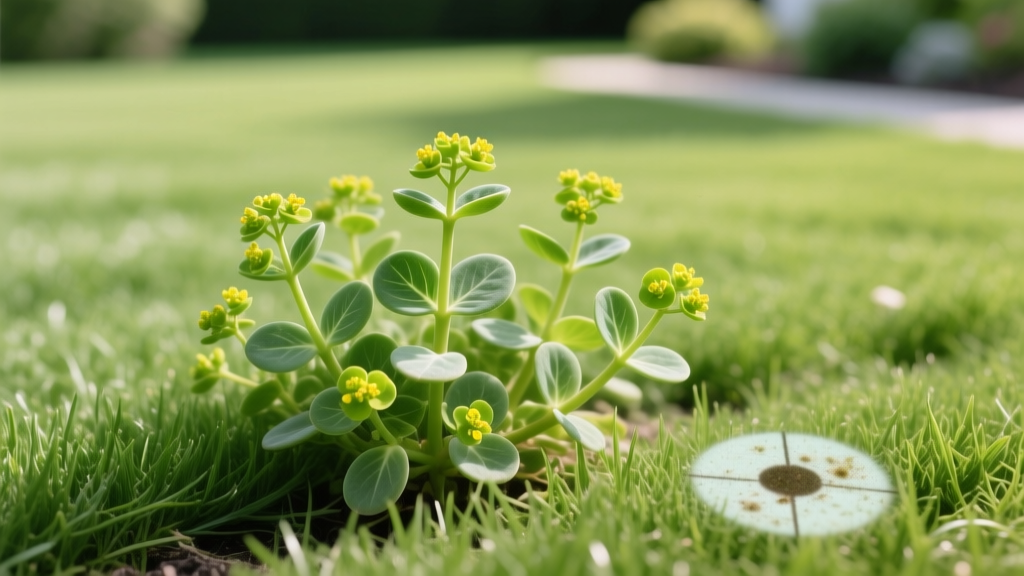
Spurge Weeds: Lawn Identification and Spot-Treatment Guide
The Biology of Spurge: Why It Invades Thin Turf
Spurge weeds, primarily Euphorbia supina (prostrate spurge) and Euphorbia maculata (spotted spurge), are aggressive summer annuals that exploit weak, compacted, or drought-stressed turf. Unlike broadleaf weeds that compete vertically for sunlight, spurge grows in a low, prostrate mat, choking out grass seedlings and spreading horizontally up to 18 inches in diameter. According to the University of California Integrated Pest Management program, spurge thrives in high-heat conditions where cool-season grasses like Kentucky bluegrass or fescue are naturally dormant or stressed.
The defining biological trait of all spurge species is the milky, latex-like sap that exudes when the stem is broken. This sap is mildly toxic and can cause contact dermatitis, making manual removal without proper protective gear a painful mistake. Furthermore, spurge develops a deep, wiry taproot that allows it to survive brief droughts and makes hand-pulling largely ineffective if the root snaps below the soil line.
Prostrate vs. Spotted Spurge: Field Identification Matrix
Accurate identification dictates your chemical approach. While both species respond to similar post-emergent herbicides, distinguishing them helps you understand the severity of your soil compaction issues. Spotted spurge is generally a stronger indicator of severely compacted, poor-draining soil.
| Trait | Prostrate Spurge (E. supina) | Spotted Spurge (E. maculata) | Prostrate Knotweed (Lookalike) |
|---|---|---|---|
| Growth Habit | Flat, creeping mat, highly branched | Upright but sprawling, less dense | Wiry, zig-zag stems, very tough |
| Leaf Markings | Uniform green, slightly hairy | Distinct purple/red spot in center | Blue-green, smooth, no spots |
| Stem Color | Reddish-green | Green to reddish | Pale green, swollen nodes |
| Sap Test | Milky white sap exudes when broken | Milky white sap exudes when broken | Clear sap (No latex) |
| Root System | Shallow fibrous with a central taproot | Deep, prominent taproot | Shallow, fibrous, easily pulled |
Spot-Treatment Protocols: Selective vs. Non-Selective Herbicides
Because spurge is a broadleaf weed, selective systemic herbicides are the primary defense for active infestations in established lawns. However, the waxy cuticle on spurge leaves can repel standard chemical applications, requiring specific formulations for effective translocation to the taproot.
Selective Post-Emergent Formulations (The Multi-Active Approach)
Single-active-ingredient herbicides (like basic 2,4-D) often fail against mature spurge due to leaf wax resistance. The most effective spot-treatment strategy utilizes a 4-way herbicide blend containing carfentrazone-ethyl. Carfentrazone is a PPO inhibitor that rapidly burns through the waxy leaf cuticle, causing cellular rupture within hours. This "burn-down" effect opens the plant tissue, allowing the systemic auxins (2,4-D, MCPP-p, and dicamba) to translocate down to the taproot and kill the weed entirely.
- Top Product Recommendation: SpeedZone Southern or SpeedZone Lawn Weed Killer. (Retail cost: $45–$60 for a 16 oz bottle, which treats up to 16,000 sq ft).
- Mixing Ratio: 1.1 to 1.5 fluid ounces per gallon of water for spot spraying.
- Surfactant Requirement: SpeedZone contains built-in surfactants. If using a generic 4-way concentrate, add a non-ionic surfactant (NIS) at 0.25% v/v (approx. 1/2 teaspoon per gallon) to break the leaf surface tension.
Non-Selective Spot Spraying (For Severe Mats or Hardscapes)
If spurge has formed a solid mat in a sidewalk crack, driveway edge, or a completely dead patch of dormant warm-season grass (like winter Bermuda), use a non-selective herbicide. Glufosinate-ammonium (e.g., Finale) is preferred over glyphosate for spot treatments because it acts faster (3-5 days) and has minimal soil residual activity, allowing you to reseed or resod the bare spot within 48 hours.
⚠️ Temperature Volatility Warning: Never apply products containing 2,4-D or dicamba when ambient temperatures exceed 85°F. At high temperatures, these herbicides vaporize and drift, causing severe phytotoxicity (leaf cupping and distortion) to nearby ornamental trees, shrubs, and garden beds. The Environmental Protection Agency (EPA) strictly mandates label adherence regarding temperature thresholds to prevent off-target damage.
Step-by-Step Spot Application Workflow
- Prep the Canopy: Mow the lawn 24 hours before application. This removes the upper grass canopy and exposes the low-growing spurge mats to direct spray contact.
- Verify Weather Windows: Ensure no rainfall is forecast for 24 hours and that daytime highs will remain below 85°F. Early morning applications (between 7 AM and 9 AM) are optimal.
- Calibrate the Sprayer: Use a dedicated 1-gallon or 2-gallon pump sprayer. Do not use a hose-end sprayer for spot treatments, as the dilution rate is impossible to control and you risk herbicide runoff.
- Apply to Wetness: Spray the spurge mat until the leaves are visibly wet and glistening, but not to the point of dripping or runoff. Over-spraying wastes chemical and increases soil contamination.
- Post-Application Wait: Do not mow for 48 hours after application. The systemic chemicals require this time to travel from the burned leaves down into the taproot.
Eradicating the Root Cause: Soil Compaction and Pre-Emergents
Treating spurge post-emergently is a temporary fix. Spurge is an ecological indicator of compacted soil and thin turf canopies. If you do not address the soil profile, spurge will return the following summer.
Cultural Corrections: Perform core aeration in the fall (for cool-season grasses) or late spring (for warm-season grasses) to alleviate the compaction that spurge thrives in. Raise your mowing height by 0.5 inches; a taller grass canopy shades the soil surface, preventing spurge seeds from receiving the light required for germination.
Pre-Emergent Timing: Spurge seeds germinate when soil temperatures at a 2-inch depth consistently reach 60°F to 65°F. You must apply a pre-emergent herbicide when soil temperatures hit 55°F for three consecutive days. Prodiamine 65 WDG (applied at 0.18 oz per 1,000 sq ft) or Dithiopyr (Dimension) are highly effective at creating a chemical barrier in the top inch of soil that halts spurge root development upon germination.
Frequently Asked Questions
Can I pull spurge by hand instead of spraying?
You can, but it is rarely successful for mature plants. The taproot of spotted spurge frequently snaps off an inch below the soil surface when pulled dry. The weed will regenerate from the remaining root crown within 10 days. If you must hand-pull, do so immediately after a heavy rain when the soil is soft, and wear nitrile gloves to prevent contact dermatitis from the latex sap.
Why did my standard 2,4-D treatment fail to kill the spurge?
Standard amine formulations of 2,4-D often bead up and roll off the waxy, hairy leaves of prostrate spurge. Furthermore, 2,4-D alone lacks the rapid burn-down action required to penetrate the plant's defenses. Switching to an ester-based formulation or a 4-way mix containing carfentrazone (like SpeedZone) will resolve this failure mode.
Will pre-emergent kill the spurge that is already growing in my lawn?
No. Pre-emergents like Prodiamine only stop seeds from developing roots. They have zero post-emergent activity on mature spurge plants. You must use a post-emergent selective herbicide to kill existing weeds, wait 10 days for them to die, and then apply your pre-emergent to stop the next flush of seeds.

