
Lawn Care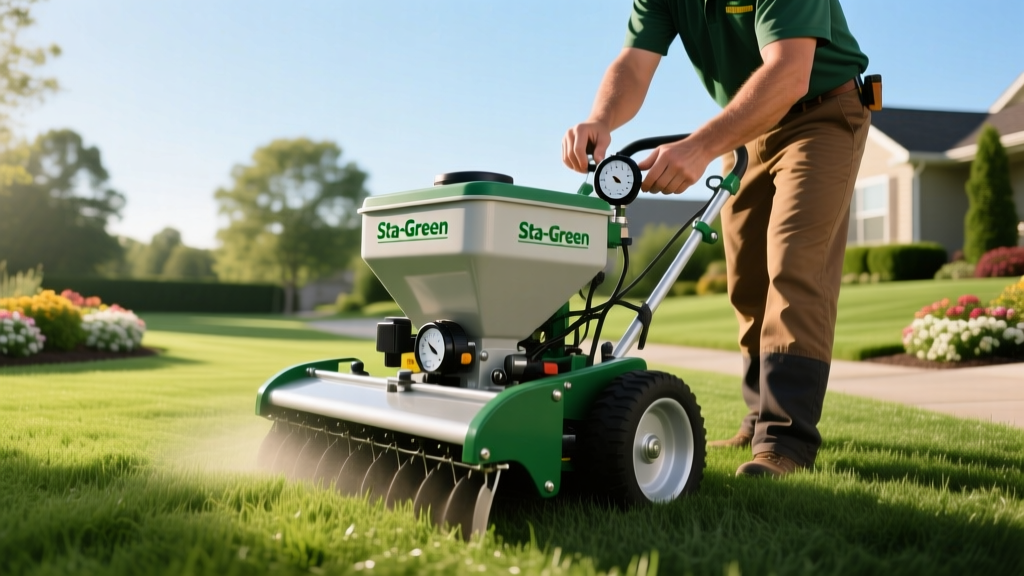
How to Calibrate a Sta-Green Fertilizer Spreader Properly
The Hidden Cost of Factory Dial Settings
Sta-Green broadcast spreaders, sold primarily through Lowe's, offer an affordable entry point for homeowners managing cool- and warm-season turf. However, relying on the factory-printed dial settings found on fertilizer bags is the leading cause of uneven nutrient distribution and severe fertilizer burn. Manufacturing tolerances on budget-friendly spreaders mean the physical gate opening at a dial setting of '5' can vary by up to 15% between individual units. Furthermore, granule density and prill size vary drastically between brands like Scotts, Milorganite, and Lesco, rendering generic bag settings unreliable.
Warning: Over-applying quick-release nitrogen (like urea or ammonium sulfate) by just 20% due to poor calibration can cause osmotic stress, pulling moisture out of grass roots and resulting in irreversible 'fertilizer burn' within 48 hours. According to Penn State Extension, proper calibration is the single most critical step in preventing turf toxicity.
Sta-Green Spreader Models: What You Are Working With
Before calibrating, identify your specific model. The mechanics of the flow gate and impeller differ slightly between the standard 40 lb capacity and the heavier 80 lb capacity models. As of 2026, these are the primary models in the Sta-Green lineup:
| Model / Capacity | Tire Type | Gearbox Material | Approx. 2026 Price |
|---|---|---|---|
| 40 lb Broadcast | 10-inch Pneumatic (Air-filled) | Enclosed Plastic / Metal Gears | $49 - $59 |
| 50 lb Drop Spreader | Solid Plastic | Exposed Metal Linkage | $65 - $75 |
| 80 lb Broadcast | 12-inch Pneumatic | Heavy-Duty Enclosed | $89 - $109 |
The 100-Square-Foot 'Catch Test' Calibration Method
To achieve exact nutrient application rates, you must perform a physical catch test. This method, endorsed by the University of Minnesota Extension, removes guesswork and accounts for your specific walking speed and the exact granule prill size of your chosen fertilizer.
Step 1: Calculate the Target Weight
Read the fertilizer bag's coverage rate. If a 20 lb bag covers 5,000 square feet, the application rate is 4 lbs per 1,000 sq ft. For a 100 sq ft test area (10 ft x 10 ft), you need exactly 0.4 lbs (6.4 ounces) of product.
Step 2: Prepare the Test Zone
Measure a 10 ft by 10 ft square on your driveway or a flat tarp. Do not test on grass, as you cannot recover the granules to weigh them. Ensure the surface is dry so granules do not stick.
Step 3: Execute the Pass
- Weigh out exactly 6.4 ounces of fertilizer using a digital kitchen scale and pour it into the Sta-Green hopper.
- Set the flow dial to the manufacturer's suggested starting point (usually around 4 or 5 for standard prills).
- Start walking at your normal mowing pace (about 3 mph) before opening the hopper lever.
- Open the lever as you cross the starting line of your 10x10 box.
- Close the lever exactly as you cross the finish line.
Step 4: Weigh and Adjust
Collect all the fertilizer that landed inside the 10x10 box and weigh it.
- If you have product left over: Your dial setting is too low. Increase the dial by 0.5, add more fertilizer to the hopper, and repeat.
- If the hopper emptied before you reached the end: Your dial setting is too high. Decrease the dial by 0.5 and repeat.
2026 Dial Settings Matrix for Popular Turf Foods
While you should always perform the catch test, the following baseline dial settings for the standard Sta-Green 40 lb broadcast spreader serve as reliable starting points based on recent prill formulations. Note that organic fertilizers typically require wider gate openings due to irregular granule shapes.
| Fertilizer Brand & Type | N-P-K Ratio | Starting Dial Setting | Prill Characteristics |
|---|---|---|---|
| Scotts Turf Builder SummerGuard | 26-0-2 | 3.5 | Uniform, small spherical |
| Milorganite Organic Nitrogen | 5-2-0 | 14.0 | Irregular, heavy pellets |
| Lesco Starter Fertilizer | 18-24-12 | 5.0 | Medium uniform prills |
| Jonathan Green Green-Up | 29-0-3 | 4.5 | Medium uniform prills |
Troubleshooting Uneven Spread Patterns
If your lawn shows alternating dark green and pale yellow stripes a week after application, your spreader is delivering an uneven fan pattern. Here is how to diagnose and fix the most common Sta-Green mechanical failures:
Symptom: Heavy streaks directly behind the spreader, light on the edges.
Cause: The metal impeller beneath the hopper is caked with dried, hardened fertilizer, altering the centrifugal throw.
Fix: Remove the cotter pin holding the impeller, slide it off the axle, and scrub it with a stiff nylon brush and warm water. Do not use a wire brush, which will scratch the powder coating and accelerate future rust.
Cause: The metal impeller beneath the hopper is caked with dried, hardened fertilizer, altering the centrifugal throw.
Fix: Remove the cotter pin holding the impeller, slide it off the axle, and scrub it with a stiff nylon brush and warm water. Do not use a wire brush, which will scratch the powder coating and accelerate future rust.
Symptom: Spreader abruptly stops dropping product midway through the lawn.
Cause: Moisture entered the hopper, causing hygroscopic fertilizers (like those high in ammonium sulfate) to clump and bridge over the flow gate.
Fix: Always store fertilizer indoors. If bridging occurs, use a wooden dowel to break up the clump inside the hopper. Never use your hands, as the sharp granules can cause micro-abrasions.
Cause: Moisture entered the hopper, causing hygroscopic fertilizers (like those high in ammonium sulfate) to clump and bridge over the flow gate.
Fix: Always store fertilizer indoors. If bridging occurs, use a wooden dowel to break up the clump inside the hopper. Never use your hands, as the sharp granules can cause micro-abrasions.
Edge Cases: Spreading on Slopes and Near Landscape Beds
The standard Sta-Green broadcast spreader throws product in a 10-to-12-foot diameter fan. When navigating slopes or adjacent to concrete driveways and flower beds, this wide throw becomes a liability.
Installing a Deflector Shield
For edging work, purchase a universal spreader deflector shield (often sold under the Agri-Fab brand, which shares OEM parts with Sta-Green). This metal baffle bolts directly to the left side of the spreader deck, cutting the throw width in half and preventing granules from landing in mulch beds or staining concrete. When using a deflector, you must double your walking passes and halve your flow rate dial setting to maintain the correct application density.
Navigating Inclines
Gravity alters the flow rate of granules through the gate. When pushing the Sta-Green spreader uphill, the product shifts backward in the hopper, slightly starving the front gate. When walking downhill, product piles against the gate, increasing the flow rate by up to 10%. To mitigate this, always spread on slopes by walking across the incline (horizontally) rather than up and down, keeping the hopper level relative to the gate mechanism.
End-of-Season Maintenance to Prevent Gear Failure
The most common point of failure on budget spreaders is the drive gear stripping or the axle seizing due to corrosive fertilizer dust. Urea and ammonium sulfate are highly corrosive to untreated steel and will pit the metal impeller within a single season if left unwashed.
Pro-Tip for Winterization: After your final fall application, wash the hopper, gate, and impeller thoroughly with a garden hose. Allow it to dry completely in the sun. Once dry, apply a light coat of White Lithium Grease (not standard WD-40, which attracts dust and gums up) to the axle gear and the metal linkage connecting the handle lever to the flow gate. Store the spreader suspended on a wall hook to prevent the pneumatic tires from developing flat spots during winter months.
Frequently Asked Questions
Can I use a Sta-Green spreader for grass seed?
Yes, but you must recalibrate. Grass seed is significantly lighter and larger than fertilizer prills. For example, Kentucky Bluegrass seed requires a much wider gate opening (often dial 10-12) compared to a dense synthetic fertilizer. Always perform the 100 sq ft catch test with your specific seed mix to avoid running out of seed halfway through the lawn.
Why is my Sta-Green spreader leaving a line of unspread grass between passes?
This indicates your walking speed is too fast, or your overlap is insufficient. The effective spread width is always 2 to 3 feet narrower than the absolute maximum throw distance. If the spreader throws 10 feet total, your effective overlap zone should be based on an 8-foot width. Align the edge of your spreader wheel with the tire tracks left by your previous pass to ensure perfect overlap.

