
Lawn Care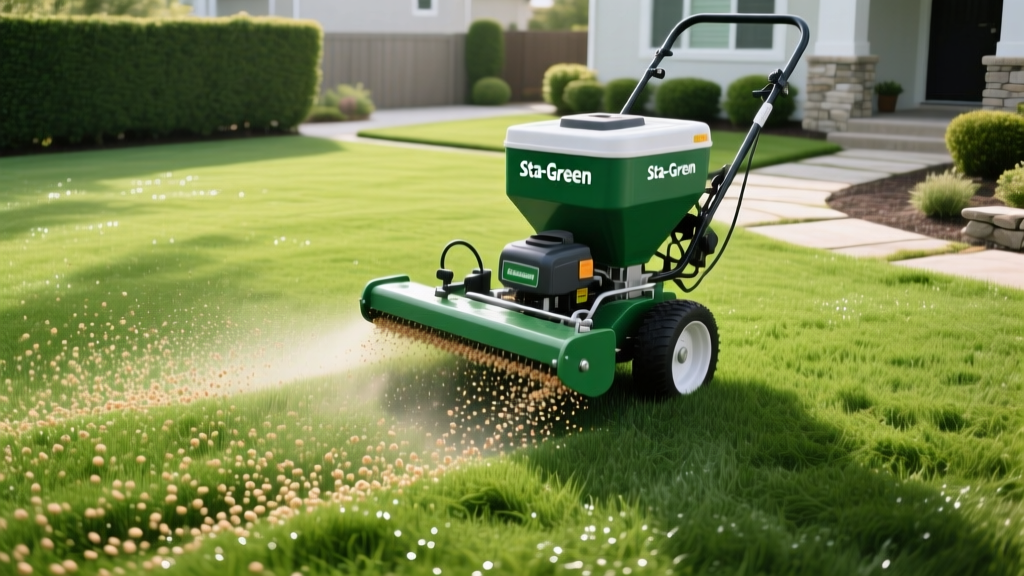
Sta-Green Fertilizer Spreader Settings: Dosage, Coverage & Cost Guide
The Physics of Sta-Green Prill Sizes
Applying Sta-Green fertilizer requires more than simply copying the dial settings printed on a bag of competing brands. Sta-Green products, widely distributed through Lowe's and independent garden centers, utilize a specific prill (granule) density and size distribution that differs from Scotts Turf Builder or Lesco professional lines. The average Sta-Green granule measures between 1.5mm and 2.2mm in diameter, with a higher bulk density due to the inclusion of dense micronutrient cores in their Weed & Feed and Winterizer formulations.
If you use a generic setting chart, you risk over-application by up to 18%, which causes nitrogen burn (manifesting as yellowing leaf tips and necrotic spotting within 48 hours), or under-application, which fails to deliver the promised 30-day weed suppression. According to turfgrass management guidelines from the University of Minnesota Extension, calibrating your spreader to the specific bulk density of your chosen product is the only way to guarantee the labeled application rate.
"Bulk density dictates how quickly granules flow through the spreader hopper agitator. A heavier, denser prill will flow faster at the same dial setting than a lighter, porous prill, completely altering your per-square-foot dosage."
Universal Spreader Calibration Matrix for Sta-Green
The following matrix provides baseline dial settings for the three most common rotary and drop spreaders used by homeowners. These settings are engineered to deliver the exact labeled dosage for Sta-Green's core product lines. Always perform a physical 10x10 test before full application.
| Spreader Model | Sta-Green Weed & Feed (3.5 lbs / 1,000 sq ft) |
Sta-Green Ultra Winterizer (4.0 lbs / 1,000 sq ft) |
Sta-Green Starter (3.0 lbs / 1,000 sq ft) |
|---|---|---|---|
| Scotts EdgeGuard Mini (Rotary) | 3.25 | 3.75 | 2.75 |
| Scotts Classic Drop (Drop) | 5.5 | 6.25 | 4.75 |
| Agri-Fab 45-0543 (Tow-Behind) | 2.5 | 3.0 | 2.0 |
Step-by-Step Dosage Calibration Protocol
Do not rely solely on the matrix above. Manufacturing tolerances, worn agitator gears, and local humidity levels can shift your actual output by 10% to 15%. Follow this 100-square-foot calibration protocol recommended by Scotts calibration guidelines to lock in your exact Sta-Green spreader settings.
Pro Tip: Never calibrate over your actual lawn. Spilled or over-applied fertilizer during testing will burn a concentrated 10x10 patch of grass. Always test on a driveway or use a collection tarp.
- Calculate the Test Weight: Determine the labeled rate per 1,000 square feet. For Sta-Green Weed & Feed, this is 3.5 lbs. Divide by 10 to get the 100-square-foot requirement: 0.35 lbs (exactly 5.6 ounces).
- Weigh the Product: Use a digital kitchen scale to measure exactly 5.6 ounces of Sta-Green fertilizer. Pour this into your empty, dry spreader hopper.
- Mark the Test Zone: Measure a 10-foot by 10-foot area on your driveway (100 sq ft total). Mark the start and stop lines with chalk.
- Execute the Pass: Set your spreader dial to the baseline setting from the matrix (e.g., 3.25 for the EdgeGuard Mini). Start walking before opening the hopper, and close the hopper immediately after crossing the stop line.
- Evaluate the Residue: Weigh the remaining fertilizer in the hopper. If exactly 5.6 ounces were dispersed, your setting is perfect. If product remains, increase the dial by 0.25. If the hopper emptied before the stop line, decrease by 0.25.
2026 Coverage Math and Cost Analysis
Understanding the financial efficiency of your Sta-Green application requires breaking down the coverage math against current retail pricing. As of early 2026, a standard 14,000-square-foot bag of Sta-Green Weed & Feed retails for approximately $48.99 at major home improvement centers.
- Total Bag Weight: 49 lbs (14,000 sq ft coverage at 3.5 lbs/1k).
- Cost Per 1,000 Sq Ft: $3.50.
- Cost Per Acre (43,560 sq ft): $152.46.
- Professional Comparison: Hiring a commercial service like TruGreen or Lawn Doctor typically costs between $7.50 and $12.00 per 1,000 square feet for a comparable synthetic weed-and-feed application.
Warning - The Over-Application Tax: If your spreader is miscalibrated and applies at 4.5 lbs per 1,000 sq ft instead of 3.5 lbs, your 14,000 sq ft bag will run out at 10,888 sq ft. Your cost per 1,000 sq ft jumps to $4.50, wasting $13.85 per bag while simultaneously increasing the risk of turf burn and groundwater nitrate leaching.
Common Over-Application Failure Modes
EdgeGuard Physics and Miscalculations
Rotary spreaders equipped with edge guards (which block half the impeller to prevent granules from landing in flower beds) alter the centrifugal force of the spread pattern. When the EdgeGuard is engaged, the effective swath width drops from 10 feet to roughly 5 feet. If you do not adjust your walking overlap pattern to match the narrowed 5-foot swath, you will double-apply Sta-Green along borders, resulting in severe chemical burn to the turf edges.
Humidity Clumping in Drop Spreaders
Sta-Green's high-iron formulations are highly hygroscopic, meaning they absorb moisture from the air rapidly. When using a drop spreader on a humid morning (relative humidity above 70%), the granules can bridge and clump over the agitator bar. This causes intermittent flow starvation followed by sudden dumps of product when the clump breaks apart. Always apply Sta-Green products when humidity is below 65%, and physically agitate the hopper every 5 minutes during use.
Frequently Asked Questions
Can I use Scotts Turf Builder settings for Sta-Green products?
No. While the physical spreader hardware is identical, the prill density of Sta-Green is roughly 8% heavier than standard Scotts Turf Builder. Using a Scotts setting will result in an under-application of Sta-Green, reducing weed control efficacy and nitrogen delivery.
How do I clean my spreader after using Sta-Green Weed & Feed?
Sta-Green Weed & Feed contains broadleaf herbicides (like 2,4-D and Mecoprop) that will kill ornamental plants and vegetables if cross-contaminated. Empty the hopper, use a shop vac to remove dust from the agitator gears, and wash the undercarriage with a high-pressure hose. Allow it to dry completely in direct sunlight before storing.
What is the ideal walking speed for these settings?
The dial settings in the calibration matrix assume a standard walking pace of 3.0 miles per hour (roughly 120 steps per minute). If you naturally walk slower (2.0 mph), you must reduce your dial setting by 0.5 to compensate for the increased dwell time over any given square foot of lawn.

