
Lawn Care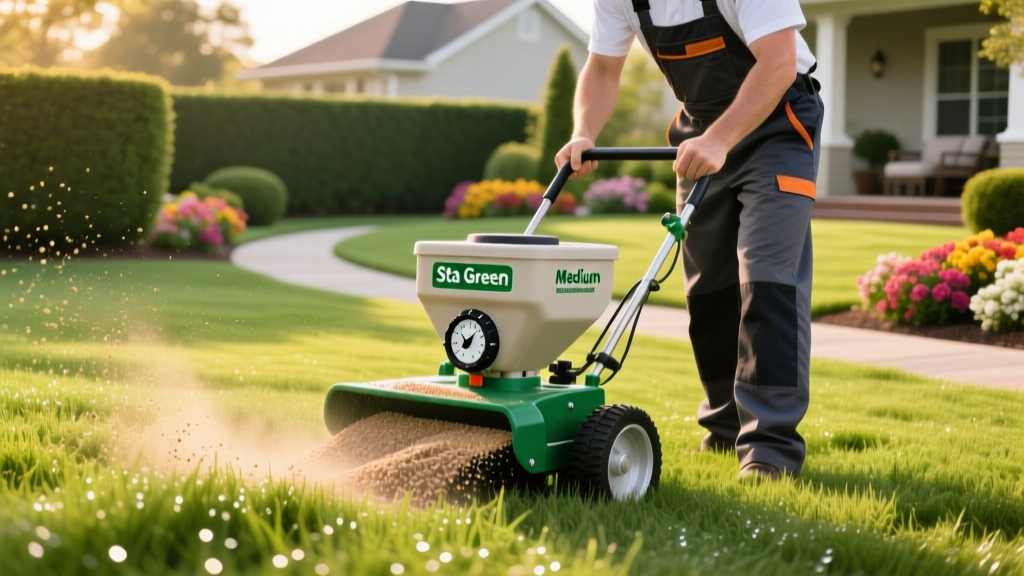
Sta Green Rotary Spreader Settings: Dosage & Coverage Guide
The Calibration Problem: Why Factory Settings Fail
Applying granular lawn care products requires precision, but relying solely on the printed sta green rotary spreader settings on the back of a fertilizer bag is a common agronomic mistake. Sta-Green spreaders, frequently sold at major home improvement retailers and often manufactured by Agri-Fab or Earthway, utilize a mechanical gate system controlled by a numbered dial (typically 1-10 or 1-15). However, the actual flow rate is dictated by three variables that factory charts ignore: the Size Guide Number (SGN) of the granule, ambient humidity, and your specific walking pace.
Fertilizer granules are not uniform across brands. Sta-Green lawn fertilizers typically feature an SGN of 220 to 240, meaning the particles are slightly smaller and denser than premium professional-grade products like Lesco (which often sit at an SGN of 280). Smaller particles flow faster through the spreader gate. If you use a generic setting chart without accounting for the specific SGN and weight of the product, you risk over-applying by up to 20%, leading to severe fertilizer burn, or under-applying, which fails to control weeds and starves the turf.
According to turfgrass specialists at Penn State Extension, mechanical spreader calibration is the only reliable method to ensure uniform nutrient distribution, as factory dial settings are merely baselines that assume a perfectly level lawn and a walking speed of exactly 3 miles per hour.
Reference Chart: Baseline Sta-Green Product Settings
While calibration is mandatory for perfect results, you need a starting point. The table below provides the baseline dial settings for the most popular Sta-Green products when used in a standard Sta-Green rotary (broadcast) spreader with a 1-10 scale. If your model uses a 1-15 scale, multiply the 1-10 setting by 1.5.
| Product Name | N-P-K Ratio | Bag Weight | Coverage (sq ft) | Target Rate (lbs/1k) | Dial Setting (1-10) |
|---|---|---|---|---|---|
| Sta-Green Lawn Fertilizer | 28-0-3 | 40 lbs | 10,000 | 4.0 | 4.5 |
| Sta-Green Weed and Feed | 22-0-0 | 20 lbs | 5,000 | 4.0 | 5.0 |
| Sta-Green Crabgrass Preventer | 0-0-0 (w/ Prodiamine) | 18 lbs | 5,000 | 3.6 | 3.5 |
| Sta-Green Tall Fescue Seed | N/A | 25 lbs | 5,000 | 5.0 | 6.0 |
| Sta-Green Winterizer | 32-0-10 | 40 lbs | 10,000 | 4.0 | 4.5 |
Note: These settings assume a standard walking speed of 2.5 to 3.0 mph. If you walk faster, increase the dial by 0.5; if you walk slower, decrease it by 0.5.
Dosage Economics: Calculating Real Coverage Costs
Understanding your spreader settings directly impacts your annual lawn care budget. Over-application doesn't just burn grass; it wastes money. Let us break down the real-world dosage economics of using Sta-Green products compared to professional alternatives in 2026.
Cost Per 1,000 Square Feet Breakdown
- Sta-Green Lawn Fertilizer (28-0-3): A 40 lb bag retails for approximately $24.98 and covers 10,000 sq ft. Cost: $2.50 per 1,000 sq ft.
- Sta-Green Weed & Feed (22-0-0): A 20 lb bag retails for $18.48 and covers 5,000 sq ft. Cost: $3.70 per 1,000 sq ft.
- Professional Alternative (e.g., Lesco 32-0-10): A 50 lb bag retails for $45.00 and covers 12,500 sq ft. Cost: $3.60 per 1,000 sq ft.
Sta-Green offers a highly competitive cost-per-thousand ratio for straight fertilizers, making accurate dial settings crucial. If your spreader gate is stuck open a fraction of an inch due to debris, and you apply 5.0 lbs per 1,000 sq ft instead of the targeted 4.0 lbs, you effectively reduce your coverage area by 20%, forcing you to purchase an extra bag mid-season and increasing your annual chemical costs by $30 to $50.
The 100-Square-Foot Driveway Calibration Test
To eliminate guesswork, turfgrass scientists at the University of Florida IFAS recommend the 100-square-foot catch test. This takes exactly five minutes and guarantees your sta green rotary spreader settings are perfectly tuned to your specific walking gait and the current humidity level.
Step-by-Step Calibration Protocol
- Measure the Test Zone: Use a tape measure to mark a 10-foot by 10-foot square (100 sq ft) on your driveway or a tarp. Do not test on grass, as you cannot easily recover the granules.
- Load the Hopper: Add exactly 5 pounds of your chosen Sta-Green product to the spreader hopper.
- Catch the Output: Place a clean plastic catch basin or bucket directly under the spreader deflector. Close the hopper gate, walk the 10-foot distance at your normal mowing/fertilizing pace, and open the gate exactly as you cross the starting line. Close it at the finish line.
- Weigh the Catch: Pour the caught granules onto a digital kitchen or postal scale. Weigh the output in ounces.
- Calculate the Multiplier: Multiply the weight caught (in ounces) by 0.625. This gives you the exact pounds applied per 1,000 square feet. (Formula: Ounces caught × 0.625 = Lbs/1,000 sq ft).
- Adjust and Repeat: If your target is 4.0 lbs/1,000 sq ft (which equals 6.4 ounces caught in the 100 sq ft test), adjust the dial up or down and repeat the walk until you hit 6.4 ounces.
Edge Cases & Application Failures
Even with perfect dial settings, rotary spreaders introduce unique distribution challenges that drop spreaders do not. Understanding these edge cases is the difference between a uniform, dark green lawn and one with visible striping.
The 50% Overlap Rule
Rotary spreaders throw granules in a wide, teardrop-shaped fan pattern. The heaviest concentration of product lands directly under the hopper, while the edges of the throw receive significantly fewer granules. To achieve uniform dosage, you must overlap your wheel tracks by 50% on each pass. If your spreader throws 8 feet wide, your next pass should be 4 feet over. Failing to overlap results in severe striping, where the grass directly under the hopper receives double the dose (causing burn) and the edges receive none.
Humidity and Hopper Clumping
Sta-Green fertilizers contain hygroscopic salts, meaning they absorb moisture from the air. If you are applying Weed and Feed on a humid morning (relative humidity above 75%), the granules will swell and bridge across the hopper gate. This causes the flow rate to drop mid-application. The Fix: Never store fertilizer in an unsealed bag in a damp garage overnight before application. If clumping occurs during use, keep a wooden dowel or plastic stirrer in your pocket to break up bridges in the hopper without scratching the plastic or metal gate mechanism.
Spreader Maintenance: Preventing Gate Corrosion
The most common reason a spreader's dial settings stop working after two seasons is corrosion of the agitator and gate plate. Fertilizer salts will rapidly oxidize bare metal and degrade cheap plastics if left in the hopper.
- Immediate Washdown: After every use, empty the hopper completely. Run the spreader over a gravel driveway or grassy area with the gate fully open to clear the impeller.
- Neutralize the Salts: Use a garden hose with a spray nozzle to wash the underside of the hopper and the axle. Avoid high-pressure washers, which can force water into the wheel bearings and strip the grease.
- Lubricate the Linkage: Once a month during the application season, apply a dry graphite lubricant or silicone spray to the dial cable and the gate hinge. Avoid wet oils like WD-40, which attract dust and fertilizer grit, eventually turning into a grinding paste that seizes the dial.
By combining the baseline sta green rotary spreader settings with the 100-square-foot catch test and strict maintenance protocols, you ensure that every dollar spent on lawn care translates directly into uniform, healthy turf growth without the risk of chemical burn or nutrient runoff.

