
Lawn Care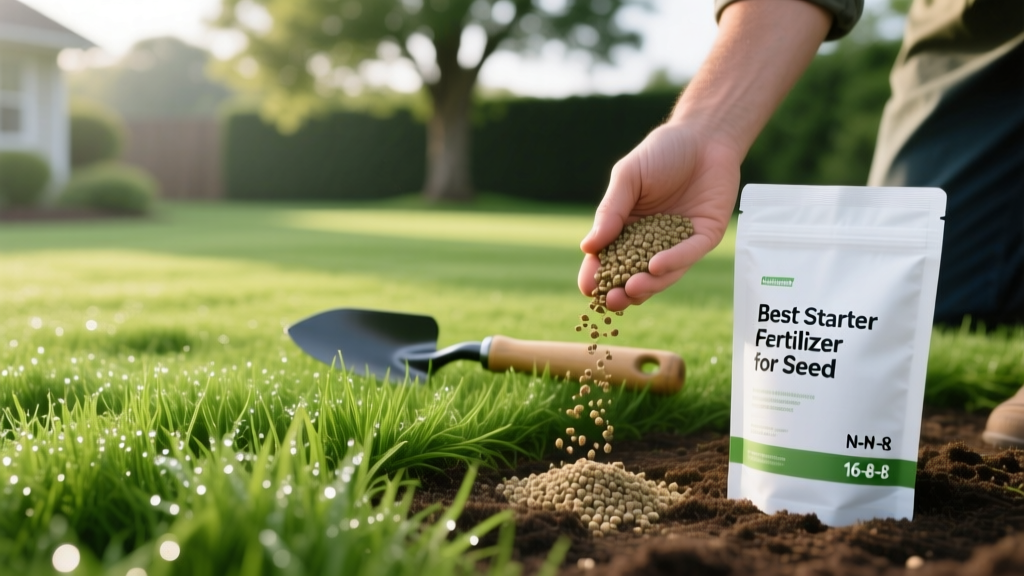
Best Starter Fertilizer for Seed: N-P-K Ratios & Timing
Establishing a new lawn from seed requires a fundamentally different nutritional approach than maintaining mature turf. While established grass thrives on high-nitrogen diets, germinating seeds and young seedlings demand immediate access to phosphorus for root development and a carefully managed nitrogen release to avoid osmotic burn. Using the wrong formulation is one of the most common reasons for seeding failure, resulting in patchy germination or seedling desiccation.
This guide breaks down the exact chemistry, N-P-K ratios, and application timelines required when selecting a starter fertilizer for seed, including specific product formulations and pricing for the 2026 market.
The Chemistry of Seedling Nutrition
Mature turfgrass primarily requires nitrogen (N) for blade growth. However, a seed's first priority is establishing a radicle (primary root) and secondary root system. This process is entirely dependent on phosphorus (P).
Unlike nitrogen, which is highly mobile in soil, phosphorus is virtually immobile. According to University of Minnesota Turfgrass Science, phosphorus moves less than one inch through the soil profile per year. If you broadcast a high-phosphorus starter fertilizer on top of existing soil without incorporating it, the nutrients will remain stranded in the top millimeter, unreachable by developing roots. For bare-ground seeding, phosphorus must be raked or tilled into the top 1 to 2 inches of soil prior to dropping seed.
⚠️ Regulatory Warning: Phosphorus Runoff
Many states and municipalities strictly regulate or outright ban the use of phosphorus-containing fertilizers on established lawns to prevent aquatic eutrophication. However, most jurisdictions grant an exemption for newly seeded or overseeded lawns. Always check your local Department of Agriculture regulations before purchasing a high-P starter fertilizer, and keep a copy of your seed purchase receipt as proof of establishment.
Many states and municipalities strictly regulate or outright ban the use of phosphorus-containing fertilizers on established lawns to prevent aquatic eutrophication. However, most jurisdictions grant an exemption for newly seeded or overseeded lawns. Always check your local Department of Agriculture regulations before purchasing a high-P starter fertilizer, and keep a copy of your seed purchase receipt as proof of establishment.
Decoding the N-P-K Matrix for Seed Germination
Not all starter fertilizers are created equal. The ideal ratio depends on your soil test results and whether you are doing a bare-ground establishment or overseeding an existing lawn.
| N-P-K Profile | Best Use Case | Soil Condition |
|---|---|---|
| High-P (e.g., 18-24-12) | Bare-ground establishment, poor soils | Low baseline phosphorus (Mehlich-3 P < 25 ppm) |
| Balanced (e.g., 24-25-4) | Standard overseeding, general new lawns | Moderate baseline phosphorus (25-50 ppm) |
| Low-P / High-N (e.g., 28-5-10) | Overseeding thick, established turf | High baseline phosphorus (> 50 ppm) |
2026 Market Leaders: Specific Formulations & Costs
When purchasing a starter fertilizer for seed, pay close attention to the nitrogen source. Fast-release urea has a high salt index (75), which can draw moisture out of tender seedlings, causing fertilizer burn. Look for products utilizing methylene urea, sulfur-coated urea (SCU), or methylene diurea (MDU) for slow, safe release.
1. Scotts Turf Builder Starter Food for New Grass (24-25-4)
Price: ~$38.00 for a 14 lb bag (covers 5,000 sq. ft.)
Analysis: This is the industry standard for residential overseeding. It provides a massive dose of phosphorus (25%) to support root growth and uses a blend of fast- and slow-release nitrogen. It contains no weed control, making it perfectly safe for all grass types, including sensitive fine fescues.
2. Scotts Starter Food for New Grass Plus Weed Preventer (21-22-4)
Price: ~$48.00 for a 14 lb bag (covers 5,000 sq. ft.)
Analysis: This formulation includes 0.08% Mesotrione (the active ingredient in Tenacity). Mesotrione inhibits the HPPD enzyme in broadleaf weeds and crabgrass, bleaching them white without harming most cool-season grass seedlings. Edge Case Warning: Fine fescues (Chewings, Creeping Red, Hard) can exhibit temporary phytotoxicity (bleaching) from mesotrione. If seeding a pure fine fescue lawn, avoid this product and use the standard 24-25-4 formula instead.
3. Jonathan Green Black Beauty Starter (12-18-8)
Price: ~$45.00 for a 15 lb bag (covers 5,000 sq. ft.)
Analysis: A premium, professional-grade option featuring a lower overall salt index and a high percentage of slow-release methylene urea. The 12-18-8 ratio is excellent for soils that already have moderate phosphorus levels but need a gentle, sustained nutrient release over 6 to 8 weeks to carry seedlings through their first mowing.
Precision Application Timeline
Timing is just as critical as the product selection. Follow this step-by-step framework to maximize germination rates and seedling survival.
- Day -14 (Soil Prep): Conduct a soil test. If pH is below 6.0, apply pelletized lime. Phosphorus becomes chemically locked up (tied to aluminum and iron) in highly acidic soils, rendering your starter fertilizer useless.
- Day 0 (Seeding & Initial Feed): Aerate or dethatch the soil. Apply the starter fertilizer for seed before dropping the seed. Rake the fertilizer lightly into the top 1/2 inch of soil. Drop your seed, and roll or rake to ensure seed-to-soil contact.
- Day 0 to Day 28 (The Mesotrione Window): If using a mesotrione-based starter, the pre-emergent barrier degrades after roughly 3 to 4 weeks. This perfectly aligns with the germination window of Kentucky Bluegrass (14-21 days) and Tall Fescue (7-12 days), protecting the soil while the grass establishes.
- Day 30 to 45 (First Mow & Follow-up): Once the new grass reaches 3.5 inches and has been mowed twice, the seedling roots are mature enough to handle standard nitrogen. Transition to a balanced lawn food (e.g., 32-0-4) to push lateral spread and tillering.
Troubleshooting Common Seedling Failure Modes
Even with the right starter fertilizer for seed, environmental and mechanical errors can derail establishment. Watch for these specific failure modes:
- Osmotic Desiccation (Fertilizer Burn): Symptoms include yellowing or browning of the seedling tips within 48 hours of application. This occurs when too much fast-release nitrogen is applied, or when the soil dries out, concentrating the fertilizer salts. Fix: Water deeply immediately after application to dissolve salts and move them below the root zone.
- Phosphorus Tie-Up: Seedlings stall at the 1-leaf stage and turn purplish-red. This indicates a severe phosphorus deficiency, often caused by applying starter fertilizer to soils with a pH above 7.5 (where P binds to calcium) or below 5.5. Fix: Address the pH first; foliar feeding with a liquid kelp or phosphite solution can provide a temporary bridge.
- Pre-Emergent Contamination: If you or a previous contractor applied a standard pre-emergent like Prodiamine or Dithiopyr within the last 4 months, your seed will germinate but the radicle will immediately die upon contacting the chemical barrier. Fix: There is no chemical reversal. You must wait out the half-life of the pre-emergent or physically remove the top 2 inches of soil.
Frequently Asked Questions
Can I use a winterizer fertilizer instead of a starter?
No. Winterizers (typically formulated around 32-0-10) are designed to load the plant's crown with potassium for cold tolerance and contain zero phosphorus. Applying a winterizer to new seed will result in weak, underdeveloped root systems that will likely die during the first summer drought.
How much water does newly seeded lawn need after fertilizing?
According to Penn State Extension, newly seeded lawns require light, frequent watering to keep the top 1/2 inch of soil consistently moist. This usually means watering for 5 to 10 minutes, 2 to 3 times a day, depending on evaporation rates. Once seedlings reach 1 inch tall, transition to deeper, less frequent watering to encourage roots to chase the moisture down into the soil profile.
Is organic starter fertilizer effective for seed?
Organic options like Milorganite (5-2-0) or bone meal (3-15-0) are excellent for long-term soil biology but are generally too slow to mineralize for the immediate demands of seed germination. If you prefer organic routes, use a blended organic starter that includes some naturally derived, fast-acting nitrogen (like feather meal) combined with rock phosphate, but expect germination vigor to be slightly lower than with synthetic methylene-urea blends.

