
Lawn Care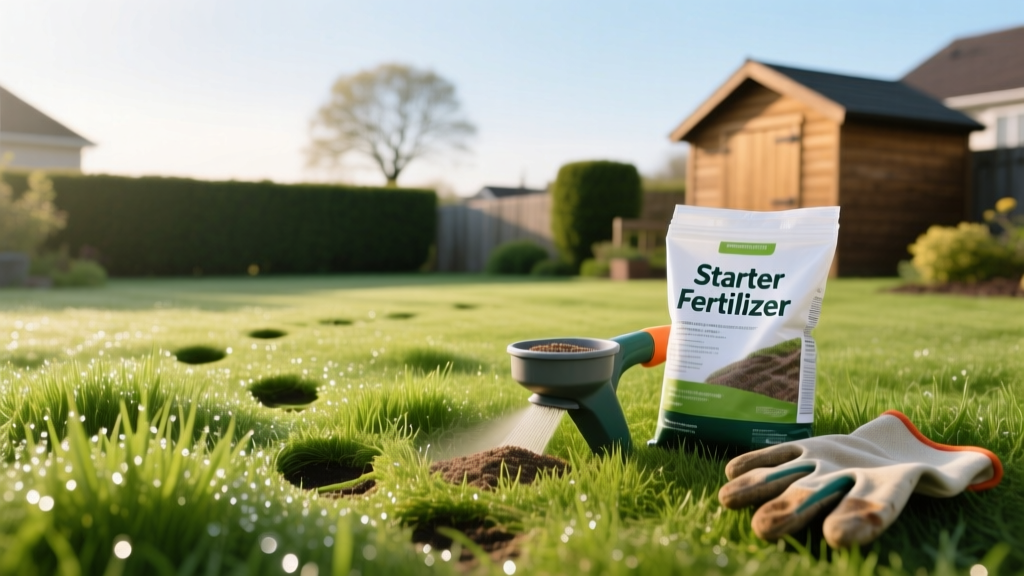
Starter Fertilizer Guide: When to Start Fertilizer for New Lawns
Establishing a new lawn from seed, overseeding an existing turf, or laying fresh sod requires a fundamentally different nutritional approach than maintaining mature grass. While mature lawns prioritize nitrogen for blade growth and color, new turf demands massive root development to survive transplant shock and drought stress. This is where starter fertilizer becomes critical. Knowing exactly when to start fertilizer applications—and understanding the specific N-P-K chemistry required—dictates whether your new lawn will thrive or fail in its first 60 days.
The Chemistry of Starter Fertilizer: Why Phosphorus is King
Standard maintenance fertilizers typically feature high nitrogen and low phosphorus ratios (e.g., 32-0-10). Starter fertilizers invert or balance this ratio to prioritize phosphorus (the middle number in the N-P-K triad). Phosphorus is the primary driver of ATP (adenosine triphosphate) production in plants, which fuels cell division and root meristem expansion. Without adequate bioavailable phosphorus in the top 2 to 4 inches of soil, grass seedlings will germinate but fail to develop the lateral root mass required to access deeper soil moisture.
Expert Insight: The P2O5 Conversion Factor
Fertilizer labels list phosphorus as P2O5 (phosphate). To calculate the actual elemental phosphorus (P) you are applying, multiply the P2O5 percentage by 0.436. For example, a 50 lb bag of 10-18-10 fertilizer contains 9 lbs of P2O5, which equates to 3.92 lbs of actual elemental phosphorus. Agronomists recommend applying 0.5 to 1.0 lbs of actual P per 1,000 square feet at the time of seeding.
Starter Fertilizer vs. Regular Maintenance Fertilizer
Applying standard winterizer or summer turf builder products to newly seeded soil is a common and costly mistake. The high salt index of quick-release nitrogen in standard fertilizers can chemically burn delicate seedling radicles (embryonic roots). Below is a direct comparison of their chemical profiles and use cases.
| Feature | Starter Fertilizer | Regular Maintenance Fertilizer |
|---|---|---|
| Typical N-P-K Ratio | 10-18-10, 16-24-8, or 24-25-4 | 32-0-10, 28-0-3, or 30-0-4 |
| Primary Function | Stimulate root mass, seedling vigor, and sod knit | Promote vertical blade growth, color, and density |
| Nitrogen Source | Often includes ammonium sulfate for immediate uptake | Heavy reliance on methylene urea or sulfur-coated urea (slow-release) |
| Salt Index Risk | Lower risk to germinating seeds when applied at correct rates | High risk of desiccation and burn to unestablished seedlings |
| Application Timing | Day of seeding, overseeding, or sod installation | 4 to 6 weeks after germination, or on mature turf |
Step-by-Step Application Guide for Seed and Sod
To maximize nutrient uptake without causing seed desiccation, follow this precise application sequence. These steps assume you have already performed a core aeration or topsoil grading.
- Conduct a Mehlich-3 Soil Test: Before purchasing product, test your soil. If your Mehlich-3 phosphorus extraction reads above 50 ppm (parts per million), your soil already has sufficient phosphorus. In this case, use a zero-phosphorus starter alternative (like a high-potassium root stimulator) to comply with environmental regulations.
- Calibrate Your Spreader: Never guess the dial setting. Place a 10x10 foot (100 sq ft) tarp on the driveway. Walk over it at your normal pace with the spreader engaged. Weigh the granules caught on the tarp and multiply by 10 to determine your exact application rate per 1,000 sq ft.
- Apply Before Seed Contact: For seeding, broadcast the starter fertilizer over bare soil before dropping seed. This prevents the granules from getting trapped in the seed canopy and ensures the phosphorus is in direct contact with the soil matrix where roots will emerge.
- Incorporate Lightly: Use a lawn roller or drag mat to mix the top 1/4 inch of soil, seed, and fertilizer. Phosphorus is highly immobile in soil; it will not leach down to the roots with water alone like nitrogen does. It must be physically incorporated into the root zone.
- Watering Protocol: Apply 1/4 inch of water immediately after installation to activate the fertilizer prills. For the first 14 days, water 3 to 4 times daily for 5-10 minutes to keep the top inch of soil moist without washing away the seed or creating anaerobic soil conditions.
Top Starter Fertilizer Formulations and Cost Breakdown
Pricing and formulations shift based on raw material costs, but the following products remain the industry benchmarks for residential and light-commercial turf establishment.
- Scotts Turf Builder Starter Food for New Grass (24-25-4): A highly accessible, fast-acting synthetic option. The high nitrogen (24%) provides a quick green-up, while the 25% phosphorus ensures root growth. Cost: Approximately $28 for a 14 lb bag covering 5,000 sq ft ($5.60 per 1,000 sq ft). Spreader Setting: Scotts Rotary Spreader dial at 6.5.
- Jonathan Green Black Beauty Starter Fertilizer (12-24-12): A balanced, professional-grade formulation with a lower salt index, making it exceptionally safe for delicate bluegrass and fescue seedlings. Contains humic acids to improve soil cation exchange capacity (CEC). Cost: Approximately $42 for a 50 lb bag covering 10,000 sq ft ($4.20 per 1,000 sq ft).
- Espoma Organic Lawn Starter (9-3-6 + Biotone): For homeowners managing organic lawns or dealing with strict municipal phosphorus bans. The 3% phosphorus is derived from bone meal and poultry manure, releasing slowly via microbial breakdown. Includes Biotone microbes to expand root surface area. Cost: Approximately $35 for an 18 lb bag covering 2,500 sq ft ($14.00 per 1,000 sq ft).
The Phosphorus Ban: Navigating State and Local Regulations
You cannot blindly apply high-phosphorus starter fertilizers in every region. Due to the severe impact of phosphorus runoff on freshwater eutrophication (toxic algae blooms), several states and municipalities have enacted strict lawn fertilizer laws. According to the Environmental Protection Agency, nutrient pollution remains one of the most widespread, costly, and challenging environmental problems affecting water bodies.
States like New York, Minnesota, Wisconsin, and Michigan have banned the sale and application of lawn fertilizers containing phosphorus unless one of two conditions is met:
Warning: Applying phosphorus to an established lawn or newly seeded lawn without a verified soil test deficiency can result in municipal fines ranging from $250 to $1,000 in regulated watersheds. Always keep a physical or digital copy of your soil test report on hand when purchasing starter fertilizer at retail centers in regulated states.
For detailed regional guidelines and agronomic thresholds, turf managers should consult university extension programs, such as the Penn State Extension Fertilizing Lawns guide or the NC State TurfFiles Fertilization protocols, which provide state-specific legal limits and soil test interpretation matrices.
Frequently Asked Questions
Can I use starter fertilizer on an existing, mature lawn?
No. Mature lawns already possess deep, established root systems and rarely require supplemental phosphorus unless a soil test confirms a severe deficiency. Applying starter fertilizer to mature turf wastes money and significantly increases the risk of phosphorus runoff into local storm drains, as the mature root zone cannot absorb the excess P2O5.
How long does it take for starter fertilizer to work?
Water-soluble synthetic starter fertilizers (like ammonium phosphate) dissolve within 24 to 48 hours of irrigation. You will see visible seedling vigor and accelerated root knitting within 10 to 14 days. Organic starter fertilizers relying on bone meal or feather meal require soil temperatures above 65°F and active microbial populations, taking 3 to 6 weeks to mineralize into plant-available forms.
Should I apply starter fertilizer before or after laying sod?
Always apply starter fertilizer to the bare, graded soil before unrolling the sod pallets. If you apply it on top of the laid sod, the granules will sit on the leaf blades and thatch layer, failing to reach the soil interface where the new sod roots need to penetrate. Lightly rake the fertilizer into the top 1/2 inch of soil before laying the turf.

