
Lawn Care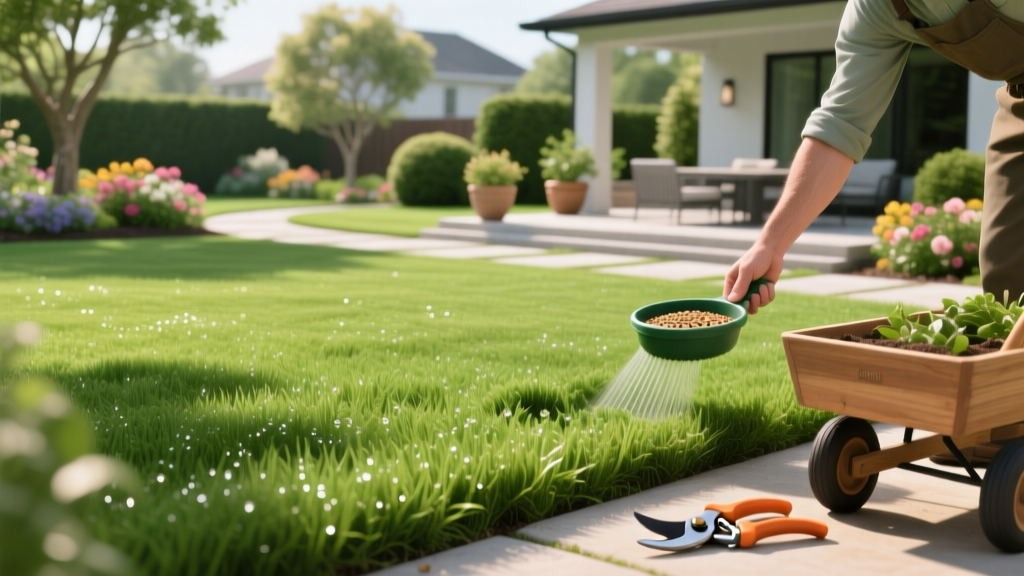
How to Grow a Beautiful Lawn: A Step-by-Step Maintenance Calendar
The Biology of a Beautiful Lawn
Achieving a beautiful lawn requires moving beyond random weekend chores to a systematic, biology-driven calendar. Turfgrass thrives on predictable cycles of nutrient uptake, root expansion, and dormancy. Whether you are managing cool-season grasses like Kentucky Bluegrass and Tall Fescue, or warm-season varieties like Bermuda and Zoysia, timing is your most critical variable. Applying the right product at the wrong biological window wastes money and can actively harm your turf. This step-by-step maintenance procedure aligns your inputs with the natural growth cycles of your grass.
Pro Tip: The Soil Temperature Rule
Never base your spring or fall applications on the calendar date. Use a soil thermometer to measure the temperature at a 2-inch depth. Pre-emergent herbicides must be applied when soil temps consistently hit 50°F to 55°F, while fall overseeding is best initiated when soil temps drop back below 70°F.
Never base your spring or fall applications on the calendar date. Use a soil thermometer to measure the temperature at a 2-inch depth. Pre-emergent herbicides must be applied when soil temps consistently hit 50°F to 55°F, while fall overseeding is best initiated when soil temps drop back below 70°F.
Phase 1: Early Spring Awakening (March - April)
Spring maintenance focuses on weed prevention and gentle wake-up feeding. Cool-season grasses naturally surge in spring; over-fertilizing early leads to excessive top growth at the expense of root development.
Step 1: Pre-Emergent Weed Control
Crabgrass and goosegrass germinate when soil temperatures reach 55°F for three consecutive days. Apply a pre-emergent containing dithiopyr (e.g., Lesco 0-0-7 with 0.38% Dimension) at a rate of 3.5 lbs per 1,000 square feet. This creates a chemical barrier in the top 1/2 inch of soil that halts cell division in germinating weed seeds. Water it in with exactly 1/4 inch of irrigation within 48 hours to activate the barrier without washing it past the root zone.
Step 2: The First Mow and Blade Sharpening
Your first cut of the season should be 1/2 inch lower than your target summer height to remove winter-burned tips and allow sunlight to reach the soil crown. Immediately after, sharpen your mower blades. A dull blade shreds grass tissue, increasing water loss by up to 30% and inviting fungal pathogens like Rhizoctonia (brown patch).
Phase 2: Peak Growth and Summer Stress (May - August)
Summer is about survival and stress mitigation. As evapotranspiration rates peak, your watering and mowing protocols must adapt to protect the turf's cellular structure.
Step 3: Deep, Infrequent Watering
According to the EPA WaterSense program, outdoor water use accounts for nearly 30% of total household consumption, much of which is wasted through shallow, daily sprinkler runs. Train your roots to grow deep by applying 1 to 1.5 inches of water per week, split into two sessions. Use a tuna can placed on the lawn to measure your sprinkler's output rate. Watering between 4:00 AM and 6:00 AM minimizes evaporative loss and reduces the leaf-wetness duration that triggers fungal diseases.
Step 4: Mowing Height Matrix
Raising your mowing height during summer heat shades the soil, reducing moisture evaporation and suppressing weed seed germination. Follow this specific matrix based on your turf type:
| Grass Type | Spring/Fall Height | Summer Heat Height | Clipping Management |
|---|---|---|---|
| Tall Fescue | 3.0 - 3.5 inches | 4.0 inches | Mulch (leave on lawn) |
| Kentucky Bluegrass | 2.5 - 3.0 inches | 3.5 inches | Mulch (leave on lawn) |
| Bermuda (Common) | 1.5 - 2.0 inches | 2.0 - 2.5 inches | Bag if clumps form |
| Zoysia | 1.5 - 2.0 inches | 2.5 inches | Bag (thatch risk) |
Phase 3: Fall Renovation and Recovery (September - November)
Fall is the most critical season for cool-season grasses. The University of Minnesota Extension notes that fall root growth continues well after top growth slows, making this the ideal window for heavy renovation.
Step 5: Core Aeration and Overseeding
If your soil is compacted or your lawn is thinning, core aeration is mandatory. Rent a walk-behind aerator (approx. $75/day) or hire a service ($15-$20 per 1,000 sq ft). The machine must pull 3-inch deep plugs spaced no more than 3 inches apart.
Immediately after aeration, overseed with a certified, weed-free seed blend. Apply Tall Fescue at 5 to 8 lbs per 1,000 sq ft, or Kentucky Bluegrass at 2 to 3 lbs per 1,000 sq ft. Drag a piece of chain-link fence or a specialized lawn rake over the area to ensure seed-to-soil contact inside the aeration holes.
Warning: Starter Fertilizer Timing
When overseeding, use a starter fertilizer high in phosphorus (e.g., 18-24-12) to promote rapid root development. However, check your local ordinances; many municipalities ban phosphorus applications unless you are actively establishing new seed or have a verified soil test deficiency.
When overseeding, use a starter fertilizer high in phosphorus (e.g., 18-24-12) to promote rapid root development. However, check your local ordinances; many municipalities ban phosphorus applications unless you are actively establishing new seed or have a verified soil test deficiency.
Step 6: The Winterizer Application
In late October or November, apply a winterizer fertilizer. Look for a formulation high in nitrogen and potassium, such as 32-0-10. The nitrogen should be at least 50% slow-release (methylene urea or sulfur-coated) to provide a steady nutrient drip that the grass stores in its root system for an explosive green-up the following spring.
Phase 4: Winter Dormancy and Planning (December - February)
While the turf is dormant, your maintenance shifts to equipment and soil chemistry.
Step 7: Comprehensive Soil Testing
Every three years, send soil samples to a university extension lab. You are testing for pH and base saturation. Turfgrass optimally absorbs nutrients when the soil pH is between 6.2 and 6.8. If your test returns a pH below 6.0, apply pelletized calcitic lime at 50 lbs per 1,000 sq ft in late winter. The freeze-thaw cycles will naturally work the lime into the soil profile.
Troubleshooting Decision Tree: Mid-Season Fixes
Even with a strict calendar, environmental variables can cause issues. Use this diagnostic flow to address common summer problems:
- Symptom: Irregular brown patches that pull up easily like a loose carpet.
Cause: White grub feeding on roots.
Fix: Apply a curative insecticide containing trichlorfon (Dylox) immediately, followed by 1/2 inch of water. - Symptom: Perfectly circular, silver-dollar-sized tan spots with smoke-colored rings in the morning dew.
Cause: Dollar Spot fungus (Clarireedia jacksonii).
Fix: Apply a fungicide with azoxystrobin or propiconazole. Increase nitrogen slightly, as Dollar Spot thrives in nitrogen-deficient turf. - Symptom: Footprints remain visible on the grass for hours after walking.
Cause: Severe drought stress and loss of cellular turgor pressure.
Fix: Initiate emergency deep watering cycle. Do not mow until the turf regains turgidity.
Executing this step-by-step blueprint transforms lawn care from a reactive chore into a proactive science. By matching your chemical, mechanical, and cultural inputs to the exact biological needs of your turfgrass, you guarantee a dense, resilient, and beautiful lawn year after year.

