
Lawn Care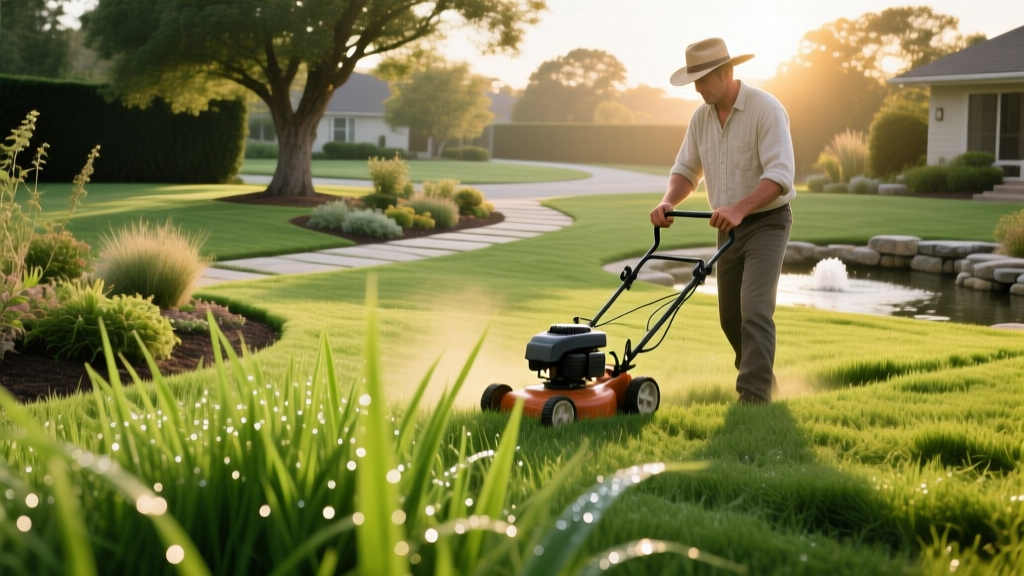
Step-by-Step Buffalo Grass Maintenance Procedures Guide
The Buffalograss Paradigm: Less is More
Buffalograss (Buchloe dactyloides) is a native prairie grass that fundamentally rejects traditional lawn care. The most frequent cause of turf failure in North American landscapes is applying Kentucky Bluegrass or Bermudagrass maintenance routines to this drought-adapted species. Modern turf-type cultivars like 'Prestige', 'Bowie', and 'UC Verde' are dioecious, meaning commercial sod is propagated exclusively from female plants to eliminate the messy, pollen-producing male seed heads. Because it evolved in arid, low-nutrient environments, excessive water and nitrogen actively destroy its root architecture and invite aggressive weed invasion.
⚠️ The Over-Care Trap: If your buffalograss is turning pale yellow in July, thinning out, or being overtaken by Bermuda and crabgrass, you are likely overwatering and over-fertilizing. According to Colorado State University Extension, buffalograss requires up to 75% less water than traditional cool-season turf and thrives on minimal nitrogen inputs.
Step 1: Precision Mowing Protocols
Buffalograss leaf tissue is softer than traditional turf, making it highly susceptible to tearing from dull mower blades. Torn leaf tips desiccate rapidly and create entry points for Curvularia leaf spot. Sharpen your rotary mower blades every 25 hours of operation, or at least twice per season.
Cultivar-Specific Cutting Heights
- 'UC Verde': Bred for dense, low growth. Maintain at 1.0 to 1.5 inches using a reel mower for a manicured look, or 2 inches with a standard rotary.
- 'Prestige' and 'Bowie': These wider-bladed cultivars perform best at 2.0 to 3.0 inches. Cutting below 1.5 inches scalps the crown, exposing the soil to UV degradation and weed germination.
- Unmowed / Naturalized: If left alone, buffalograss will fold over at 4 to 6 inches, creating a meadow-like texture. Mow only once in late fall to 3 inches to remove winter debris.
Frequency: Never remove more than one-third of the leaf blade. During peak summer growth, mow every 14 to 21 days. In spring and fall, mowing every 3 to 4 weeks is sufficient.
Step 2: Strategic Hydration Framework
Buffalograss survives on natural rainfall in many parts of the Great Plains, but supplemental irrigation is required to maintain a deep green color during July and August droughts. The critical rule is deep, infrequent soaking to drive roots down to 4–6 feet.
| Season | Watering Frequency | Volume per Application | Soil Moisture Target |
|---|---|---|---|
| Spring (Apr-May) | Every 21-28 days | 0.5 inches | Moist to 4" depth |
| Peak Summer (Jun-Aug) | Every 10-14 days | 0.75 - 1.0 inches | Moist to 6" depth |
| Fall (Sep-Oct) | Cease irrigation | 0 inches | Allow natural dormancy |
Calibrating Your Irrigation Output
Do not guess your sprinkler's output. Place three straight-sided catch cups (tuna cans work perfectly) in a triangular pattern across your irrigation zone. Run the system for 20 minutes, measure the water depth in inches, and multiply by three to calculate your hourly precipitation rate. Adjust your smart controller (like a Rachio 3 or Hunter Hydrawise) to deliver the exact seasonal volumes listed above.
Step 3: Minimalist Fertilization Math
Buffalograss requires a maximum of 1.0 to 2.0 pounds of actual Nitrogen (N) per 1,000 square feet per entire year. Applying standard 4-pound-per-1,000-sq-ft synthetic blasts will trigger rapid, weak vertical growth and invite fungal pathogens like Bipolaris leaf spot.
The Exact Application Formula
Split your annual nitrogen into two micro-doses: one in late May (after spring green-up) and one in early July. Use a slow-release, sulfur-coated, or methylene-urea fertilizer to prevent salt burn.
Calculation Example: If you purchase a 50-lb bag of 20-0-10 slow-release turf fertilizer (averaging $55–$65 in 2026), the bag contains 20% Nitrogen. To apply exactly 1 lb of N per 1,000 sq ft, you must apply 5 lbs of product per 1,000 sq ft. A single 50-lb bag will cover 10,000 square feet for one application.
For organic alternatives, Milorganite (5-2-0) is highly effective and carries zero burn risk, but requires applying 20 lbs per 1,000 sq ft to achieve 1 lb of N, which can be physically cumbersome for large properties.
Step 4: Targeted Weed Management
Because buffalograss grows slowly and forms a relatively open canopy compared to Kentucky Bluegrass, it is vulnerable to weed invasion during its 5-month winter dormancy. The Texas A&M AgriLife Extension emphasizes that pre-emergent timing is the single most critical factor in maintaining a pure buffalograss stand.
Pre-Emergent Timing
Apply Prodiamine (Barricade) or Dithiopyr (Dimension) in early spring when 2-inch soil temperatures consistently reach 55°F. This prevents crabgrass, goosegrass, and sandbur seeds from germinating. Crucial Edge Case: Do not apply pre-emergents if you plan to overseed bare patches with buffalograss seed or plugs, as these chemicals will inhibit the establishment of new stolons.
Post-Emergent Herbicide Safety Matrix
Buffalograss is highly sensitive to certain broadleaf herbicides, especially when temperatures exceed 85°F. Volatilization of ester-based chemicals will cause severe turf chlorosis and necrosis.
| Active Ingredient | Target Weed | Buffalograss Safety Profile |
|---|---|---|
| Quinclorac | Crabgrass, Foxtail | Safe (Apply with methylated seed oil) |
| 2,4-D (Amine) | Dandelion, Bindweed | Caution (Safe ONLY below 85°F; use amine, never ester) |
| Dicamba | Clover, Spurge | Caution (Reduce label rate by 25% to prevent stunting) |
| Fluazifop | Bermudagrass intrusion | Danger (Will severely damage or kill buffalograss) |
Troubleshooting Common Failures
Symptom: Summer Yellowing
Cause: Iron chlorosis induced by high soil pH (above 7.5) combined with overwatering, which suffocates roots and prevents iron uptake.
Fix: Halt irrigation for 14 days. Apply a chelated iron supplement (Fe-EDDHA) at 2 oz per 1,000 sq ft. Avoid ferrous sulfate, which locks up in alkaline soils.
Symptom: Thinning in Shaded Zones
Cause: Insufficient photosynthesis. Buffalograss requires a minimum of 6 to 8 hours of direct, unfiltered sunlight.
Fix: Prune lower tree canopies to raise the light angle. If structural shade is unavoidable, transition the shaded zone to a native groundcover like creeping thyme or vinca minor; buffalograss will not survive heavy shade.
Winter Dormancy and Spring Green-Up
Buffalograss naturally turns a straw-brown color after the first hard frost in autumn. Do not attempt to maintain winter color with ryegrass overseeding; the ryegrass will outcompete and choke out the buffalograss during spring transition. In early April, use a stiff-tined leaf rake to aggressively remove winter debris and matted stolons. This physical scarification warms the soil surface up to 4°F faster, accelerating the spring green-up process by 10 to 14 days.

